
Instead of jaw surgery:
non-surgical treatment for underbite and facial asymmetry
If the problem can be improved by moving the teeth, we proceed with braces, without surgery. If the skeletal difference is large and surgery is needed, an orthodontic specialist examines you first and then refers you to a jaw surgery hospital.
- Treated personally by Dr. Juhee Baek, orthodontic specialist with 22 years of experience
- Teeth or jawbone: we tell them apart first
- Cephalometric and panoramic X-rays in-house
- Hospital referral if surgery is needed
Non-surgical underbite correction:
could it work for me?
When your lower front teeth bite in front of your upper front teeth, or your face looks tilted to one side when you smile, jaw surgery is often the first thing that comes to mind. But an underbite or facial asymmetry can come from the position of the teeth or from the jawbone itself. Whether non-surgical correction is an option starts with telling these two apart.
It is also known as crossbite correction or braces without jaw surgery.
- Your lower front teeth bite in front of your upper front teeth
- From the side, your lower jaw looks prominent and you dislike having photos taken
- The center lines of your upper and lower front teeth do not match
- Your jaw feels like it shifts to one side when you close your mouth
- Jaw surgery was recommended, but you want to know if it can be done without surgery
- You have finished growing and wonder whether braces are still possible
Underbite and facial asymmetry:
a tooth problem or a jawbone problem?
They may look similar on the outside, but the causes fall into two main groups: teeth that are tilted or out of position (dental), and upper and lower jawbones that differ in size or position (skeletal). Many cases are a mix of both, so we look at how much each contributes.
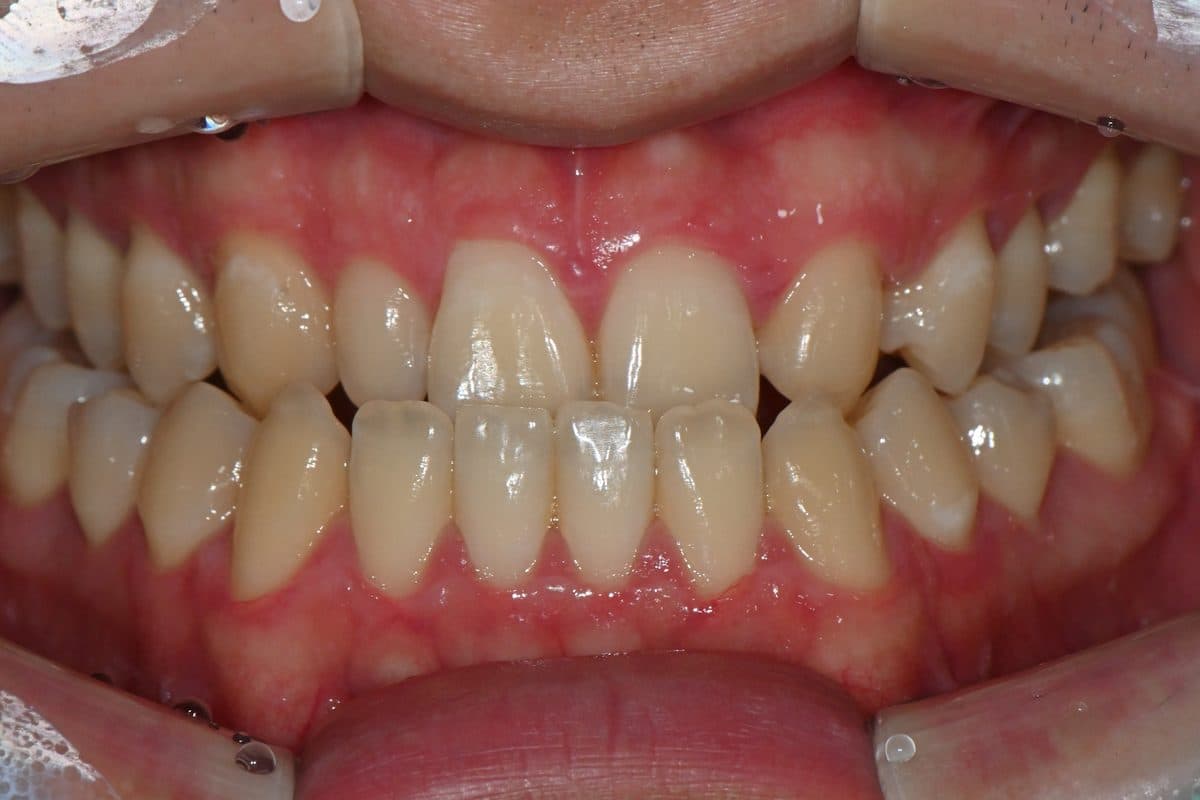
Crossbite before treatment · Real Blanche orthodontic case 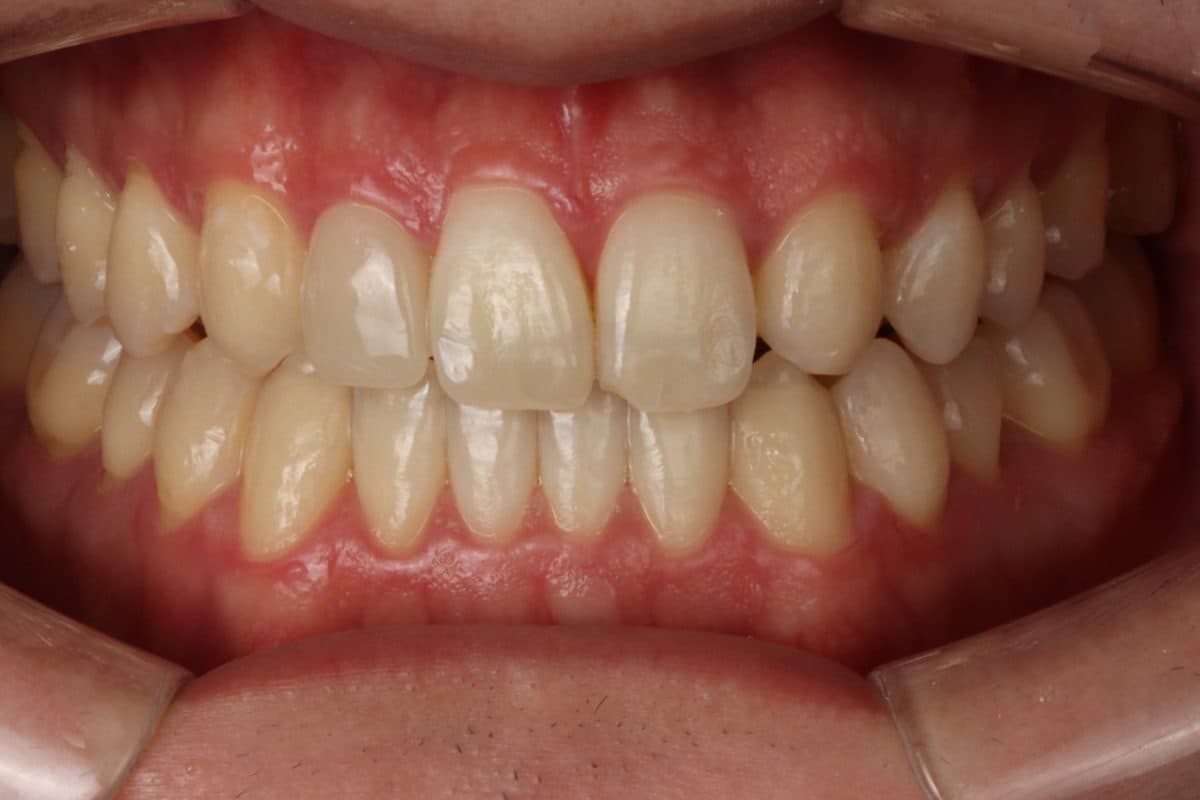
Crossbite after treatment · Real Blanche orthodontic case
Normal front-teeth bite
The upper front teeth bite slightly in front of and over the lower front teeth.
Dental crossbite
The jawbones are not far out of position, but the upper front teeth tilt inward and the lower front teeth tilt outward, so the bite is reversed.
Skeletal crossbite
The lower jaw is large or set forward, or the upper jaw is small or set back, so the positions of the jaws themselves do not match.
Facial asymmetry is also divided by cause. The dotted line in the photos below is the center line of the upper front teeth.
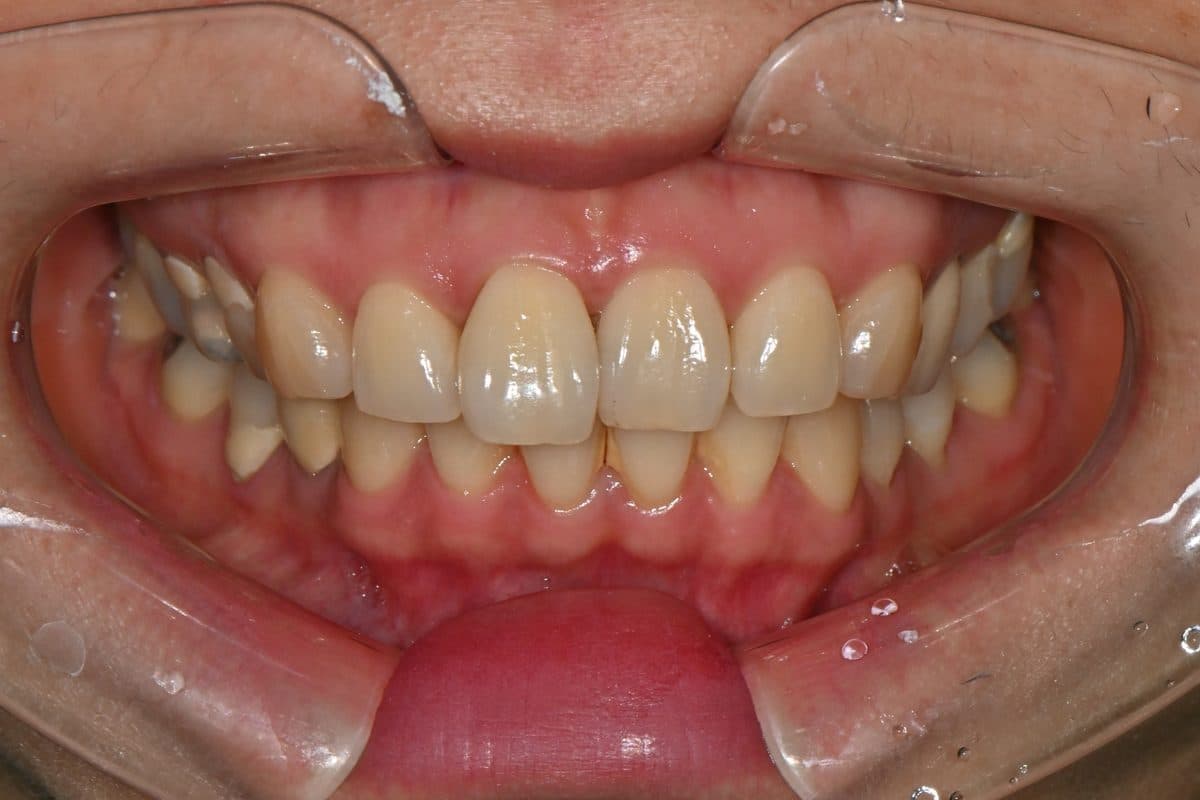
Asymmetric teeth before treatment · Real Blanche orthodontic case 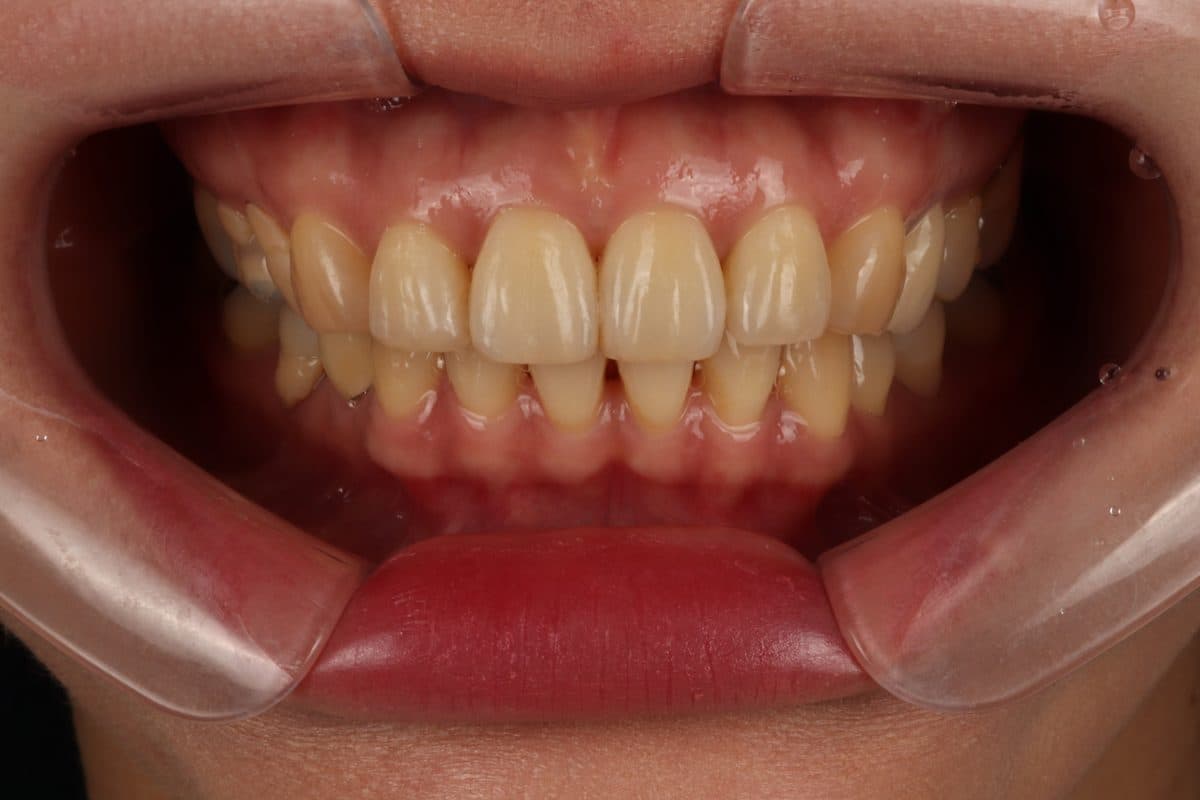
Asymmetric teeth after treatment · Real Blanche orthodontic case
Only the dental midline is off
The face and jaws are close to symmetrical, but because of how the teeth are aligned, the center lines of the upper and lower front teeth do not match.
The lower jaw shifts when biting
Certain teeth touch first, so the lower jaw slides to one side as you close. In some cases the chin returns to the center when you open your mouth.
Asymmetry of the jawbone itself
The left and right sides of the jaw differ in length or shape, so the chin stays off to one side even when you open your mouth.
Problems that come from the teeth and bite, as in ① and ②, may be improved with braces. When the jawbone is the cause, as in ③, braces can align the bite and the teeth but cannot change the shape of the jawbone itself. In reality, several causes are often mixed, so we check the proportion through examination.
These are real Blanche Dental photos (published with consent). We do not determine the cause (dental or skeletal) or the treatment method from photos alone.
Crossbite, before and after braces
This is a bite in which the lower front teeth sit in front of, or edge to edge with, the upper front teeth. Even when it looks the same, the treatment approach differs depending on whether it comes from the tilt of the teeth or a difference in jawbone size. We confirm the cause with a cephalometric X-ray before making a plan, and after treatment the upper front teeth bite in front of the lower front teeth.
These are real Blanche Dental photos published with the patient's consent. Treatment methods and results vary from person to person depending on the cause and condition.
When non-surgical underbite correction is considered
and when surgery may be needed
No single item below decides it. We judge by looking at your examination results together with the change you want most.
If the skeletal difference is large and surgery is judged necessary, an orthodontic specialist examines you first and then refers you to Blanche's partner jaw surgery hospital. You can continue your pre-surgical and post-surgical orthodontics at Blanche. Forcing a surgical case through with braces alone can tilt the teeth too far or strain the bone around them, so we tell you honestly from the start where the limits of orthodontics lie.
What the full examination checks before treating facial asymmetry
The asymmetry you see in a mirror or photo can differ from the actual asymmetry of the bones and teeth. So we overlay several records. Cephalometric and panoramic X-rays are taken in-house at Blanche.
- 01
Cephalometric X-ray
An X-ray of the head from the side (profile) and the front. It shows the position and size of the upper and lower jaws, the tilt of the front teeth and differences between the left and right jaw.
- 02
Panoramic X-ray
An X-ray that captures all the teeth and roots, the bone around them, wisdom teeth and the jaw joint area in one image. It shows whether the teeth can be moved.
- 03
Facial photos
Photos from the front, the side and while smiling show the position of the lips and chin and how tilted your face looks when you smile.
- 04
Intraoral scan
A digital scanner records your teeth without impressions. It shows how the upper and lower teeth meet and how far the center lines are off.
Along with these records, we also check how your lower jaw moves as you open and close, and whether your jaw clicks or hurts. This is needed to tell whether the jaw shifts when you bite or whether the jawbone itself is asymmetric.
Methods used when correcting without jaw surgery
Instead of moving the jawbones, we align the bite and left-right balance within the range the teeth can move. Which of the methods below we use is decided after reviewing your examination results.
- 01
Adjusting the position and tilt of the front teeth
The upper front teeth are moved forward and the lower front teeth inward so that the front teeth bite correctly. We plan only as much movement as the bone around the teeth allows.
- 02
Mini-screws (small orthodontic screws)
Moving teeth in the desired direction requires anchorage. We may consider temporarily placing a small screw in the bone to serve as an anchor, and it is removed once treatment is complete. Mini-screw fees are quoted separately.
- 03
Considering extractions
If there is not enough space to move the lower teeth back, extractions may be considered. We explain the pros and cons of both extraction and non-extraction approaches.
- 04
Aligning the bite and left-right balance
We adjust the teeth that touch first so that the lower jaw closes without shifting, and align the center lines and left-right height of the upper and lower teeth. Orthodontic elastics may also be used when needed.
- 05
MARPE (mini-screw-assisted upper jaw expansion)
One of the non-surgical options considered for adults and adolescents whose upper jaw is narrow, causing the front teeth or molars to bite in reverse. An expander anchored with mini-screws to the bone of the palate widens the upper jaw, and this is performed at Blanche. Its effect and suitability depend on age and bone condition, so we decide after examination.
Dr. Juhee Baek decides on the appliance after diagnosis and consultation. Fixed Clippy-C Braces are also used for extraction cases, and we recommend them for people who find it hard to keep wearing removable aligners. Depending on how much the teeth need to move and your lifestyle, treatment may also be done with Invisalign Clear Aligners.
A child's underbite is first assessed
in orthodontics for kids
For children whose jaws are still growing, we first consider guiding the direction of jaw growth rather than moving the teeth. In Blanche's orthodontics for kids, we use a removable Fränkel appliance for underbite and crossbite, and a palatal expander with a facemask when the upper jaw is narrow and the front teeth bite in reverse.
For children whose lower jaw grows a lot, we sometimes need to monitor until growth is complete before deciding. When to start and which appliance to use are explained in detail on our Orthodontics for Kids page.
- A child whose front teeth bite in reverse
- A child whose upper jaw looks narrow and lower jaw looks prominent
- You are concerned because someone in the family has an underbite
- The bite is reversed while the permanent front teeth are coming in
What non-surgical braces can and cannot do
Before you start, you should know what changes and what stays the same when correcting without surgery.
What you can expect
- Front teeth that bit in reverse may bite correctly, which can make biting into food easier
- The center lines of the upper and lower teeth and the left-right balance of the teeth may be aligned
- If your lower jaw shifted when biting, the asymmetry may look less noticeable as the shift decreases
- As the front teeth change position, your lips may look different (this varies greatly between people)
What braces do not change · Trade-offs
- The size and shape of the facial bones do not change. Chin length, a square jaw and differences between the left and right cheekbones are outside the scope of orthodontics
- Changes to the chin and side profile vary from person to person and may not be large
- Because the front teeth are tilted to compensate, the bone around them sets a limit, and teeth sometimes move less than planned
- There may be pain or discomfort while adjusting to the appliance, gum inflammation or cavities with insufficient care, root resorption and relapse
These are intraoral photos from a real Blanche Dental orthodontic case, published with the patient's consent. They do not show jawbone asymmetry; the appliance used and treatment time differ from case to case, and results vary from person to person.
The non-surgical underbite treatment process
Our dentists spend more than an hour on each orthodontic consultation. We keep explaining until you understand what can be done without surgery and where its limits are.
- 01
Consultation
We ask what bothers you most and what change you hope for, and look at your face and bite first.
- 02
Full exam
We record your teeth and jawbones with cephalometric and panoramic X-rays, facial photos and an intraoral scan.
- 03
Diagnosis
Based on the dental and skeletal proportions, we explain whether to proceed with non-surgical braces or consider surgery.
- 04
Plan
We decide how far to move the teeth and whether mini-screws or extractions are needed, and the dentist chooses the appliance after diagnosis and consultation.
- 05
Placement · Regular adjustments
The dentist places the appliance personally and makes adjustments while monitoring your bite and gums.
- 06
Finishing · Retainers
We confirm the bite and left-right balance, remove the appliance and keep the teeth in place with retainers.
Dr. Juhee Baek personally handles the consultation, appliance placement and final check. If the examination shows that surgery is needed, an orthodontic specialist examines you first and then refers you to a jaw surgery hospital.
Crossbite treatment time, cost and retainers
The examination fee and monthly adjustment fee are fixed; the appliance fee and treatment time depend on how far the teeth need to move, whether mini-screws or extractions are needed and the appliance, so we explain them after the full exam.
- 01
Duration
Comprehensive treatment usually takes about 1 to 2.5 years and varies from person to person. It depends on how far the teeth need to move, so we give you an estimate after the exam.
- 02
Cost
The diagnosis fee is KRW 200,000 (≈ USD 145), included in the total cost if you proceed, and the monthly adjustment fee is KRW 50,000 (≈ USD 35). The appliance fee is quoted after the full exam (Invisalign from KRW 1,000,000, ≈ USD 735), and mini-screws are charged separately. You can also check our full price list.
- 03
Visits
You need to come in for each adjustment, so an easy-to-reach location matters. We are a 30-second walk from Exit 4 of Nonhyeon Station and open until 9 p.m. on Tuesdays and Wednesdays.
- 04
Retainers
Even after a crossbite is corrected, the teeth tend to drift back. Wearing your retainer consistently and attending regular check-ups is how you keep the result.
We go over every explanation at least four times, and you can make your decision at home. The care team reviews your case together rather than relying on one person's judgment, and we plan not only for your bite today but for your smile 20 years from now.
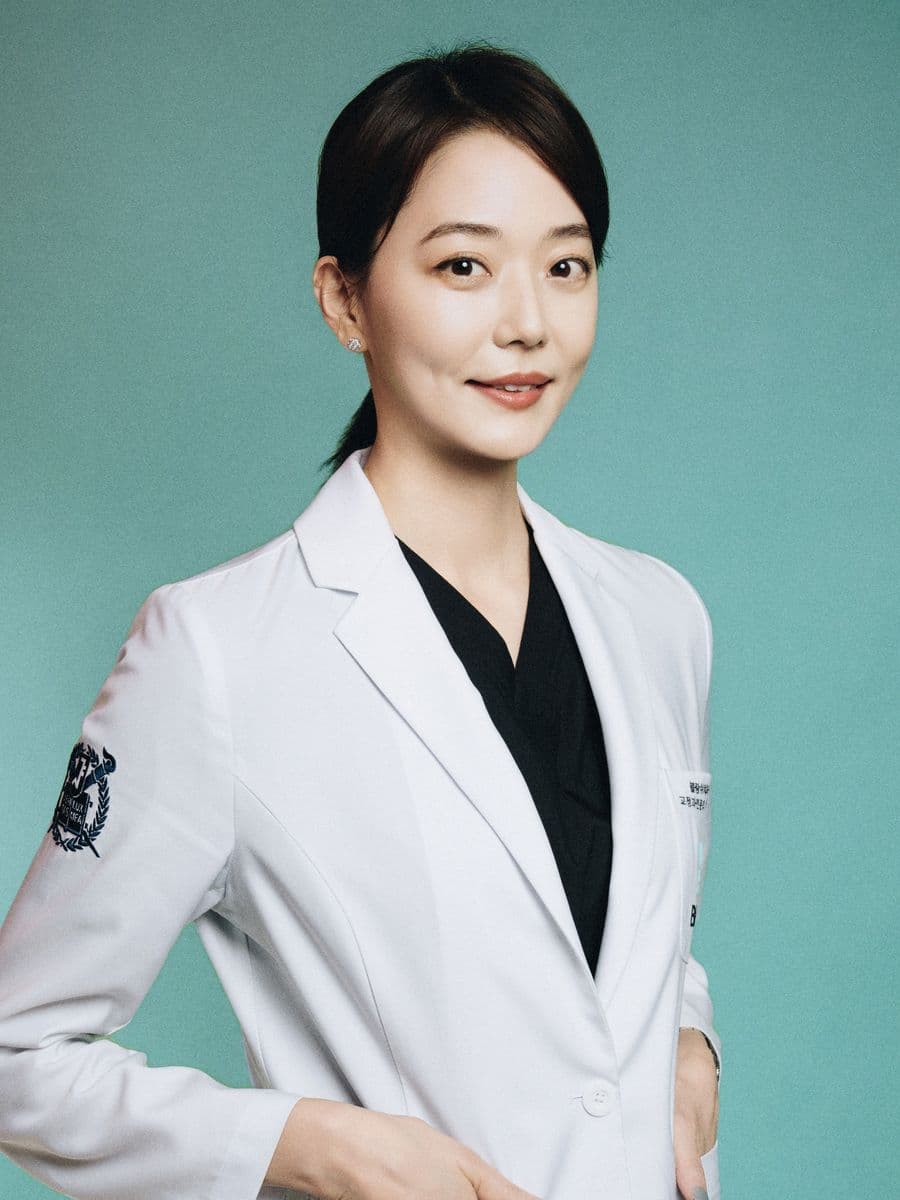
From start to finish,
Dr. Juhee Baek oversees your braces
At Blanche, orthodontic treatment is led by Dr. Juhee Baek, an orthodontic specialist who has practiced only orthodontics for 22 years. She personally handles the consultation, places the appliance and checks the final result. Orthodontic specialists make up only about 5% of dentists in Korea.
"With the know-how built up over countless orthodontic cases, I will treat you carefully and comfortably."
- Valedictorian, Kyung Hee University College of Dentistry
- Orthodontics residency, Kyung Hee University Dental Hospital
- Master's in Orthodontics, Kyung Hee University Graduate School of Dentistry
- Board-certified specialist, Korean Association of Orthodontists
- More than 10,000 orthodontic cases over 22 years
- Presented an outstanding non-extraction case at Osaka Dental University, Japan
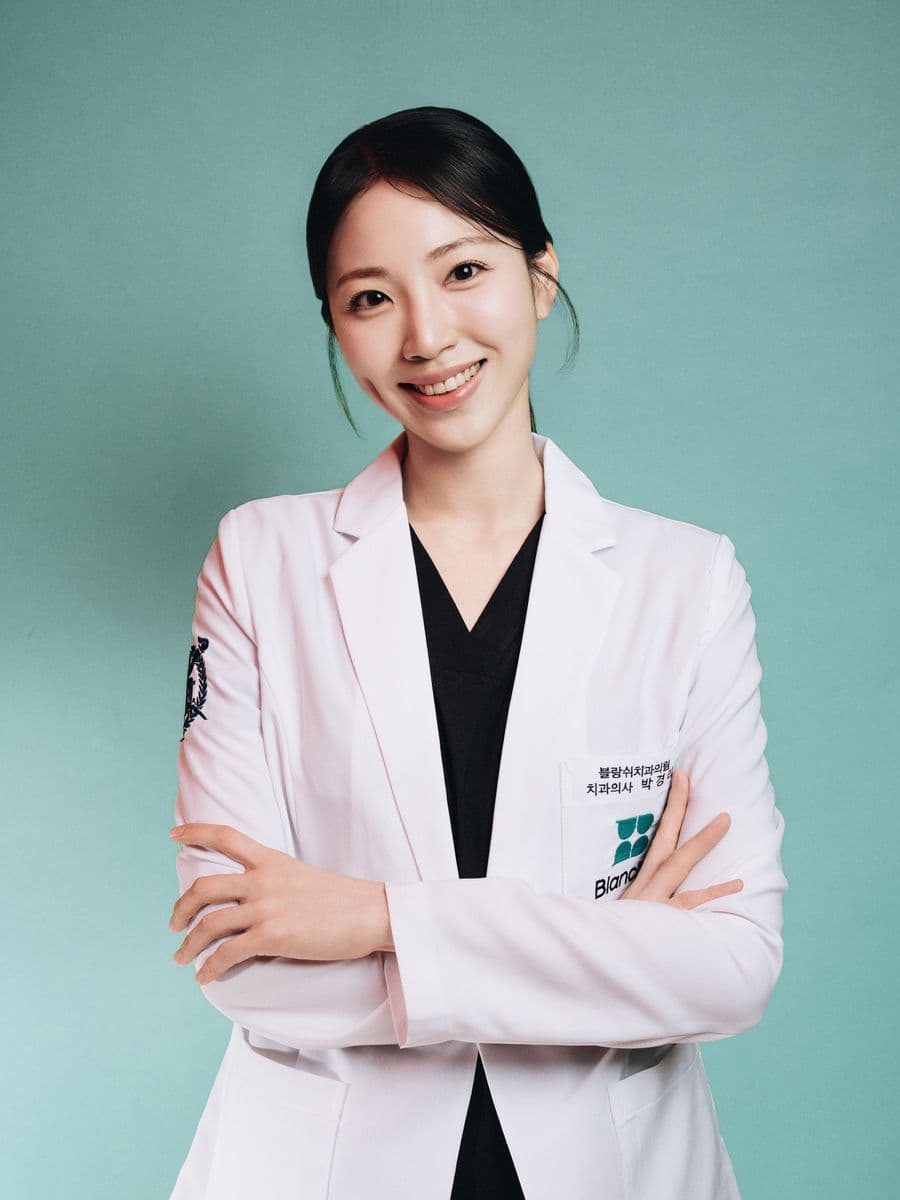
Integrated Dentistry specialist
Dr. Kyungri Park
Drawing on her experience as an orthodontic clinic director, she treats orthodontic patients together with Dr. Juhee Baek. Cavity and gum care during braces, and finishing touches such as veneers after treatment, are all provided within the same clinic.
- Graduate of Stanford University
- Graduate of Seoul National University School of Dentistry
- Master's degree, Seoul National University School of Dentistry
- Clinical training at UCLA and Columbia University dental schools, USA
- Former orthodontic clinic director and chief director
Questions about non-surgical underbite and asymmetry correction
Can an underbite really be corrected without surgery?
How can I tell whether my underbite is a tooth problem or a jawbone problem?
Can braces alone make my face symmetrical?
How is a crossbite corrected?
Jaw surgery was recommended to me. Can I get a second opinion?
Will braces make a protruding chin look less prominent?
Can braces improve a square jaw or uneven cheekbones?
Do I have to get mini-screws? Do they hurt?
Do I need extractions for non-surgical correction?
Can an underbite be corrected with clear aligners?
My narrow upper jaw causes a reverse bite. Can adults widen it?
How do you know whether an adult has finished growing?
Are children's underbites corrected the same way?
My jaw clicks. Can I still get braces?
How long does non-surgical underbite correction take?
How much does facial asymmetry correction cost?
Can the underbite come back after treatment?
I live outside Seoul or abroad. Can I consult by photo first?
Reviewed by Dr. Juhee Baek (orthodontic specialist, 22 years of experience; Master's in Orthodontics, Kyung Hee University Graduate School of Dentistry) · Last updated
Blanche Dental Clinic, Nonhyeon Station, Gangnam
A 30-second walk from Exit 4 of Nonhyeon Station, on Gangnam-daero.
Subway
Address
Phone
Hours
Teeth or jawbone?
An orthodontic specialist will take a look first
Send us two photos, one from the front and one smiling, and a dentist will review them personally and tell you what the full exam needs to check.
Send us a front photo and a smiling photo — a dentist will review them and reply.
Chat on WhatsAppCall +82-1877-2882