
The Veneers Process, Step by Step: Shaving, Timeline, and What Happens to Your Teeth
The veneers process is easy to picture as a single appointment. In reality it is a sequence of small decisions, and each one changes the result.
Most patients ask two things first. How much of my tooth gets shaved, and how long does the whole thing take?
This guide answers both. We will walk through each stage, show what happens to the tooth, and mark which steps can be undone.
A note from Dr. Kim — Many people who land on this page share one quiet worry: what if I damage healthy teeth for nothing? It is the first question I ask myself with every patient.
Blanche began with that question: why harm a natural tooth worth more than any restoration? That is why our signature Blanche no-prep veneers follow one rule — minimal intervention, maximum beauty.
The veneers process, stage by stage
1. Diagnosis and records
We start by measuring, not by drilling. Gum health, bite direction, and remaining enamel thickness all get checked.
If the gums are inflamed, that gets treated first. If the teeth are badly rotated, we may suggest orthodontics before anything else.
2. Smile design
Next we shape the target. Lip line, midline, and how much gum shows when you smile all feed into the design.
This is the stage where the plan can still change freely. Sometimes the design tells us composite suits a tooth better than ceramic.
3. Preparation
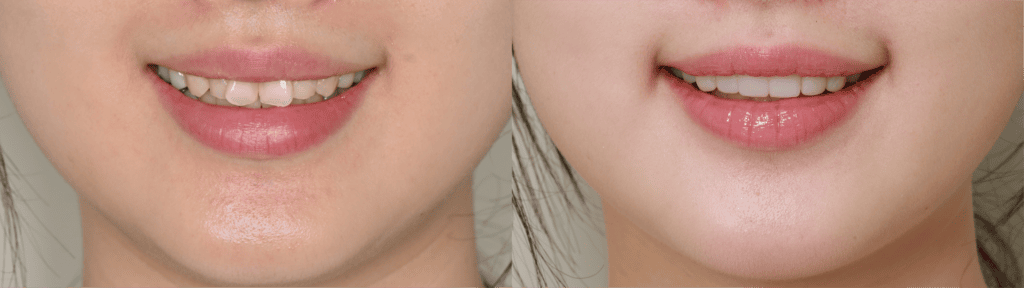
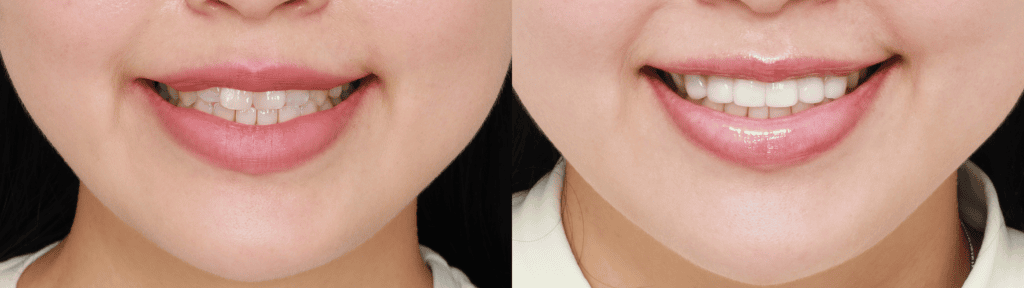
Only now does the tooth get touched. For thin ceramic veneers, a very small amount of enamel is smoothed to make room.
For no-prep veneers, nothing is removed at all. Which one fits depends on the size and position of your natural teeth.
4. Fabrication
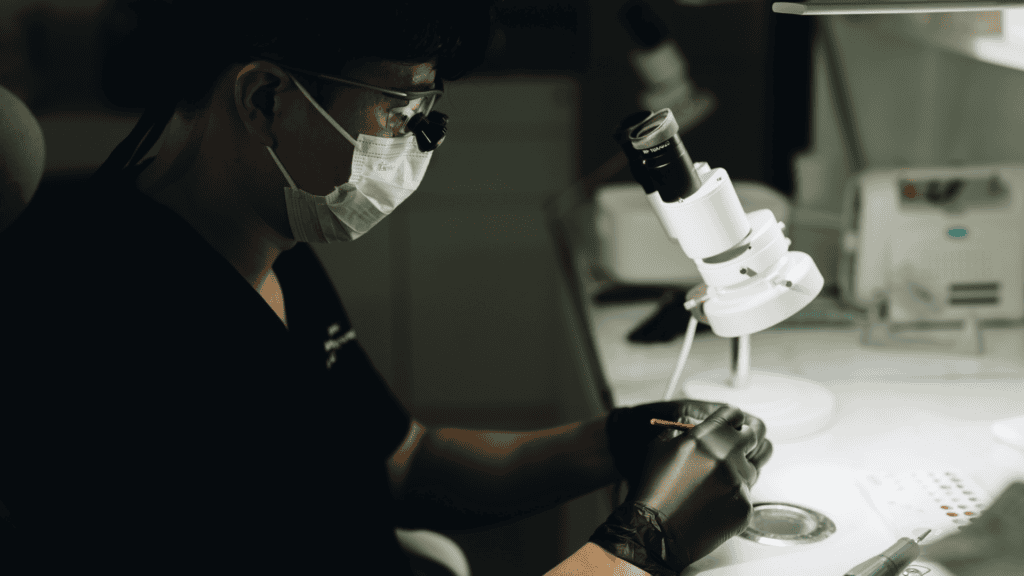
The veneers are made to the approved design. Colour is matched in layers, not painted on a finished shell.
Our lab is inside the clinic, so shade and shape can be adjusted while you are still in the chair.
5. Bonding and bite check
The veneers are cemented, then the bite is checked and refined. Front teeth guide the jaw as it moves forward, so this step matters more than it looks.
How much shaving the veneers process really involves

This is the part people search hardest for. The honest answer is that it depends on your starting point.
If a tooth is small or set back, we may add volume without removing enamel. If a tooth is already crowded forward, some reduction is needed to avoid a bulky result.
Here is the useful rule. Enamel does not grow back, so the amount removed is the one truly permanent part of the process.
| Stage | What happens to the tooth | Typical chair time | Reversible? |
|---|---|---|---|
| Diagnosis | Nothing — measurement only | 30–45 minutes | Yes |
| Smile design | Nothing — planning only | 30–60 minutes | Yes |
| Preparation | Minimal enamel smoothing, or none for no-prep | 30–90 minutes | No, if enamel is removed |
| Fabrication | Temporary protection if needed | Lab time | Yes |
| Bonding | Veneers cemented, bite refined | 60–120 minutes | Removable, but the prepared surface stays prepared |
How long the veneers process takes
Think of it like tailoring a jacket. Measuring and cutting are quick, but the fitting is where the time goes.
Conventional treatment usually splits the work across two or more visits, with lab time in between. A one-day workflow compresses the same stages into a single day by keeping the lab in-house.
Complex cases still get finished in one day. They simply receive more design and adjustment time within that day.
For the full one-day program — technology, pricing, and booking — see our One-Day Veneers page.
What actually changes the price
Three things move the number, and only one of them is obvious.
The first is the ceramic grade. The second is how much diagnosis and design time the case receives.
The third is the bonding system, which rarely appears in a price comparison. We use the Ivoclar adhesive system, which sits at the top of the price range for bonding agents.
We choose it for two reasons. It is biocompatible, and it resists discolouration, so the margins stay clean for longer.
A one-day workflow is priced higher than conventional treatment. Diagnosis, design, fabrication, and fitting are compressed into a single day, with the dentist and the in-house lab team working on your case together.
Our pricing is the same for local and international patients. There is no foreigner surcharge.
Not sure where your case fits? Send two photos — front and smiling — on WhatsApp. We will tell you what is possible before you book any flight.
Before you book
Photos help us give you a realistic answer in advance. A straight-on smile photo and a relaxed lip photo are usually enough for a first opinion.
Our clinic is near Nonhyeon Station in Gangnam, Seoul, with the lab on site. Incheon Airport is about an hour away by car.
If you want to compare durability first, read how long veneers last. If enamel loss is your main worry, do veneers ruin your teeth covers it directly.
For travel logistics and appointment sequencing, see getting veneers in Korea.
Frequently Asked Questions
Does the veneers process hurt?
Preparation is done under local anaesthetic, so the appointment itself is comfortable. Mild sensitivity for a few days afterwards is common and usually settles.
Can the veneers process be done without shaving my teeth?
Yes, when your natural teeth are small, worn, or set back. If teeth are already positioned forward, some reduction gives a more natural result.
What happens to my teeth if I remove veneers later?
No-prep veneers can be removed and the tooth returns to its original shape. If enamel was smoothed, that surface stays prepared and needs to be covered again.
Side effects and individual variation
This article is general information, not a treatment plan. Outcomes vary with gum condition, bite pattern, enamel thickness, and daily habits.
Possible effects include temporary sensitivity, gum irritation, chipping, or debonding. Please confirm anything specific to your teeth with your treating dentist.
A closing note
After ten years of working on front teeth, the regret I hear most is not about material choice. It is about starting before the diagnosis was finished.
Enamel does not grow back, so we prefer to remove less and plan longer. That is the whole reason the early stages of this process take as long as they do.
If you are weighing your options, send us a photo and we will tell you honestly which route fits your teeth.
Written by Kim Tae-hyung, DDS (Director, Blanche Dental Clinic · Seoul National University trained dentist)
What happens at your first consultation
1. We listen first — what bothers you and what you hope for. 2. We walk you through your scan results and every option.
3. You get itemized costs and timing, and you can decide later, even after you fly home. At Blanche, we explain everything at least four times, by principle.
Consultation — Blanche Dental is located between Nonhyeon and Sinnonhyeon stations in Gangnam, Seoul. For a consultation in English, message us on WhatsApp with your photos, and see our pricing page for current fees.

About the author
Dr. Kim Tae-hyung
Chief Director of Blanche Dental Clinic in Gangnam. He holds an M.S. from Seoul National University and trained at the Columbia and UCLA dental hospitals.
He advises SBS “Dr. Oh’s Clinic” and YouTube “Doctor Friends,” and is a Clinical Instructor at Ginza Shirayuri Dental Clinic in Tokyo. His rule of practice: minimal intervention, maximum beauty.