
How Long Do Veneers Last? Real Timelines by Material and Habit

How long do veneers last, really? It is the one question almost every patient asks before booking, and the one that gets the vaguest answers online.
You will see “10 to 15 years” quoted everywhere. That range is not wrong, but it hides the part that actually decides your outcome.
In our clinic, the veneers that fail early and the ones that pass fifteen years are rarely made of different material. They are worn by people with different habits, on teeth that were prepared differently.
This article breaks down realistic timelines by material, what shortens them, what the early warning signs look like, and what replacement involves.
A note from Dr. Kim — Many people who land on this page share one quiet worry: what if I damage healthy teeth for nothing? It is the first question I ask myself with every patient.
Blanche began with that question: why harm a natural tooth worth more than any restoration? That is why our signature Blanche no-prep veneers follow one rule — minimal intervention, maximum beauty.
How long do veneers last by material?
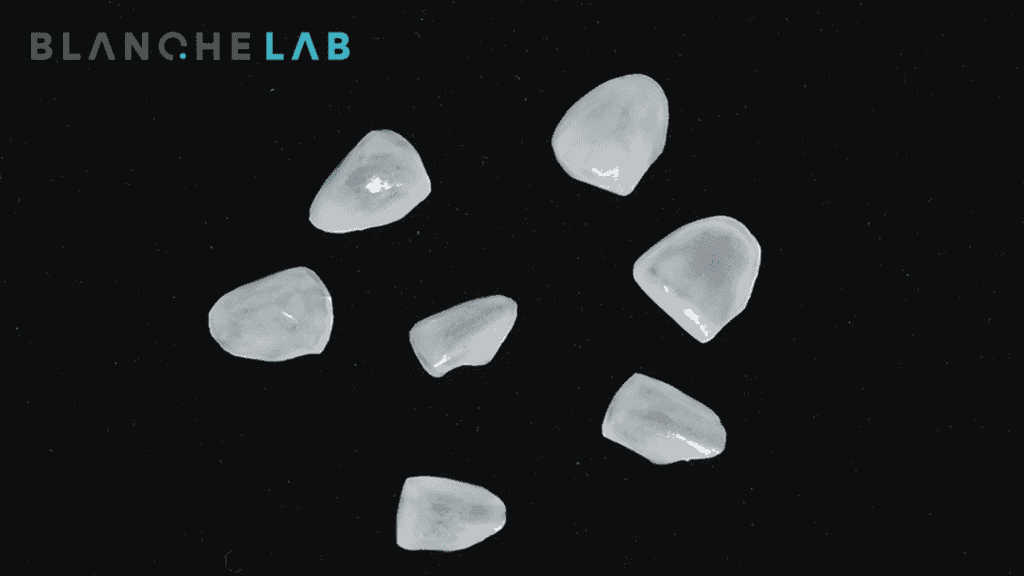
The material sets the ceiling. Your bite and your habits decide how close you get to it.
| Type | Typical service life | Fails first at | Replacement difficulty |
|---|---|---|---|
| Porcelain veneer | 10–15 years or more | Bonded margin | Moderate |
| No-prep porcelain | 10–15 years or more | Margin or edge chip | Easier, tooth is intact |
| Composite bonding | 3–7 years | Staining and surface wear | Easy, often repaired in place |
| Crown on a front tooth | 10–15 years | Gum line and underlying tooth | Harder, more tooth was removed |
Notice the third column. Porcelain itself almost never wears out, but the bond at the edge does.
Think of it like a well-fitted tile floor. The tile outlives the house, yet the grout line needs attention long before the tile does.
That is why the question of how long do veneers last is really a question about margins, not about ceramic.
What actually shortens the lifespan
1. Grinding and clenching
This is the single largest factor we see. Night grinding loads the incisal edge repeatedly, and edges chip.
A night guard is not an upsell here. It is the cheapest insurance available for the work you just paid for.
2. An untreated bite problem
If your front teeth take force that molars should be sharing, the veneers sit in the path of that force. The restoration is not the problem; the load distribution is.
This is why a bite check belongs in the planning stage, not the follow-up.
3. How much tooth was removed
Enamel bonds to porcelain far better than dentin does. When preparation stays inside enamel, the bond is stronger and lasts longer.
Aggressive reduction that cuts into dentin gives a weaker seal. That is a lifespan decision made on day one, and it cannot be undone later.
4. Gum health
Margins sit at the gum line. If the gum recedes, that junction becomes visible and plaque collects there.
Regular cleanings protect the appearance of veneers more than any home product does.
5. Daily habits
Opening packaging with your teeth, chewing ice, biting nails. Each one is a small impact directly on the edge.
Coffee and wine stain composite noticeably. Porcelain resists staining, though the bonding cement at the margin can still discolour over years.
Warning signs that come before failure
Veneers rarely fail without notice. These are the signals worth booking a check-up for.
- A dark or grey line appearing along the gum edge
- Sensitivity to cold that is new, not the settling-in kind
- A rough spot you can feel with your tongue at the margin
- Food catching between two specific teeth
- A small chip on an edge, even one that looks cosmetic
Caught at this stage, many cases need only a polish, a margin repair, or a single unit replaced. Left for a year, the same case often becomes a full replacement.
How long do veneers last before replacement is needed?

When the time comes, the veneer is removed and a new one is bonded. What matters is how much tooth structure is still there to work with.
Patients who had minimal or no preparation usually have straightforward options at replacement. Patients whose teeth were heavily reduced sometimes need a crown instead, simply because less tooth is left to hold a thin shell.
We see this pattern often in second-opinion visits. It is the strongest practical argument for conservative preparation the first time around.
If you are already at that point, our guide on veneer replacement in Korea covers the process and what to expect.
Not sure where your case fits? Send two photos — front and smiling — on WhatsApp. We will tell you what is possible before you book any flight.
Planning for a long-lasting result
Longevity is decided at the planning table more than at the follow-up visit. Three questions are worth asking your dentist directly.
Ask how much enamel will be removed and whether the margin stays inside enamel. Ask whether your bite is being assessed before, not after. Ask where the veneers are fabricated and how adjustments are handled.
At our clinic, veneers are made in our in-house lab near Nonhyeon Station. Shade and contour adjustments happen the same day rather than over a courier cycle.
Pricing is identical for Korean and international patients, and we review photos before you fly so the plan is set before you land.
For the full one-day program — technology, pricing, and booking — see our One-Day Veneers page.
If you are still choosing a material, our comparison of porcelain and composite veneers lays out the trade-offs. Our longevity guide goes deeper on maintenance.
Frequently Asked Questions
How long do veneers last if I grind my teeth?
Expect the shorter end of the range without protection. With a properly fitted night guard worn consistently, most patients stay within the normal timeline.
Do veneers need to be replaced all at once?
Not usually. Single units can be replaced individually, though matching shade to older neighbouring veneers takes extra chair time.
Does the tooth underneath decay while covered?
The covered surface is protected, but the margin and the back of the tooth are not. Decay at the margin is the most common reason for early replacement, and it is preventable with regular cleanings.
Side effects and individual variation
All dental treatment carries possible side effects. Temporary sensitivity, gum irritation during healing, and edge chipping can occur.
Results and service life vary with tooth condition, bite, and daily habits. A clinical examination is required to determine what is appropriate for you.
A note from the dentist
I tell patients the same thing at every consultation. The lifespan of your veneers is mostly written on the day we decide how much tooth to remove.
Keep the enamel, protect the bite, and check the margins once a year. That is the whole formula, and it is not complicated.
If you are weighing your options, send photos and we will tell you honestly what we would and would not do.
What happens at your first consultation
1. We listen first — what bothers you and what you hope for. 2. We walk you through your scan results and every option.
3. You get itemized costs and timing, and you can decide later, even after you fly home. At Blanche, we explain everything at least four times, by principle.
Consultation — Blanche Dental is located between Nonhyeon and Sinnonhyeon stations in Gangnam, Seoul. For a consultation in English, message us on WhatsApp with your photos, and see our pricing page for current fees.

About the author
Dr. Kim Tae-hyung
Chief Director of Blanche Dental Clinic in Gangnam. He holds an M.S. from Seoul National University and trained at the Columbia and UCLA dental hospitals.
He advises SBS “Dr. Oh’s Clinic” and YouTube “Doctor Friends,” and is a Clinical Instructor at Ginza Shirayuri Dental Clinic in Tokyo. His rule of practice: minimal intervention, maximum beauty.