
Natural looking veneers are rarely a question of colour. Almost everyone assumes the giveaway is whiteness, so they ask for a shade half a step darker and hope for the best.
Natural looking veneers are rarely a question of colour. Almost everyone assumes the giveaway is whiteness, so they ask for a shade half a step darker and hope for the best.
Then the result still reads as fake, and nobody can quite say why.
The answer is usually size. A tooth that is two millimetres too long, or a fraction too wide at the neck, will look wrong at any shade.
This article breaks down the four measurements that decide the outcome: length, width, edge shape and surface texture. You will see how each one is chosen, and what to ask before anyone starts.
Think of a well-tailored jacket. The fabric can be beautiful, but if the shoulders sit two centimetres too wide, everyone notices immediately.
Natural looking veneers work the same way. The eye is extremely good at judging proportion and much worse at judging colour.
That is why a slightly bright but correctly proportioned tooth passes as real, while a perfectly matched shade on an oversized tooth does not.
Before any ceramic is made, four numbers are settled. These are the numbers that decide whether the result reads as your own tooth.
The central incisors set the tone. If they are too long, the smile looks artificial even when everything else is right.
Length is judged against the lower lip line during a relaxed smile, and against how much tooth shows when the lips are at rest.
Age matters here too. Natural teeth wear slightly at the edges over decades, so a razor-sharp edge on a patient in their fifties tends to look borrowed.
Width is measured relative to length, not in isolation. Central incisors that are wide and short read as blocky, and the same width on a longer tooth reads as normal.
There is also the neck of the tooth to consider. If the ceramic is thicker than the natural contour at the gum line, the tooth looks pushed forward.
This is the most common reason veneers appear bulky in photographs.
The biting edge is not a straight line on a real tooth. It has a subtle curve, and the corners are slightly rounded to different degrees.
Squared corners read as strong and masculine. Rounded corners read as softer. Neither is right or wrong, but they should match the rest of your face.
Real enamel has faint vertical ridges and a slightly irregular surface. Light scatters off it rather than bouncing back in one flat sheet.
A polished, mirror-flat ceramic surface is the fastest way to make a tooth look artificial under a camera flash.
| What is measured | Judged against | Reads as fake when | Reads as natural when |
|---|---|---|---|
| Length | Lower lip line, tooth shown at rest | Edges sit below the natural lip line | Edge follows the lower lip curve |
| Width | Ratio to length, neighbouring teeth | Blocky, square outline | Slight taper toward the gum |
| Neck contour | Original tooth thickness at the gum | Ceramic sits proud of the gum line | Flush transition, no visible step |
| Edge shape | Face shape and existing teeth | All corners identical | Corners vary slightly, as in nature |
| Surface texture | Enamel of remaining teeth | Flat, uniform gloss | Faint ridges, varied light scatter |
Here is the part that is rarely discussed openly.
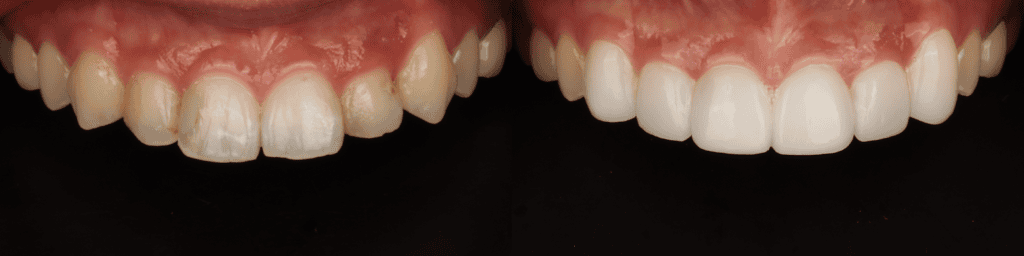
A veneer has to occupy physical space. If no tooth structure is removed, that space has to come from somewhere, and it comes from the front surface moving forward.
On a tooth that is already slightly recessed, this is exactly what you want. On a tooth that is already in a normal position, adding thickness pushes it outward.
That is the honest trade-off between preserving tooth structure and controlling the final contour. A good plan states which one applies to your teeth before anything begins.
We work through this on a case-by-case basis rather than applying one rule to everyone. Preserving enamel is always preferred, but not at the cost of a bulky result.
The design is confirmed before the ceramic is cut, not after.
Photographs are taken with the lips relaxed and in a full smile, then measurements are marked against those images. A mock-up lets you see proposed length and width on your own teeth first.
If the length feels long to you at that stage, it is adjusted at that stage. Changing it after the ceramic is finished means starting over.
Our laboratory is inside the clinic, so the technician can look at your face rather than at a photograph and a written note. Adjustments happen in the same building on the same day.
For the full one-day programme, including the technology, pricing and booking details, see our One-Day Veneers page.
If you want the clinical sequence step by step, we covered that separately in our guide to the veneers process.

A veneer can be perfectly shaped on day one and still stop looking natural after three years. The usual reason is the margin.
The bonding system at the border between tooth and ceramic determines whether that line stays invisible. A cheaper adhesive can discolour, and a fine dark outline appears around each tooth.
We use the Ivoclar bonding system. It sits at the top of the price range for adhesives, but it is well tolerated by the tissue and holds its colour rather than yellowing at the margin.
This is worth knowing when you compare quotes. Two clinics can name the same ceramic and still price differently, because the ceramic grade is only one of the variables. The adhesive is another.
Our pricing is the same for local and international patients, so there is no separate rate to check for.
Rather than describe any individual patient, here are two situations that recur.
The first is someone who brings a celebrity photograph and asks for that exact smile. The proportions in the photograph usually belong to a different face width and lip line, so the numbers are recalculated for their own face and the character of the reference is kept.
The second is someone replacing veneers placed elsewhere five to ten years ago. The complaint is almost never the colour. It is that the teeth feel too long or too thick, which points back to the four measurements above.
That second group is also why how long veneers last is worth reading alongside this.
Q1. Can veneers ever look completely natural?
Yes, when proportion, edge shape and surface texture are matched to your own face rather than to a template. The common failure is not the material but the measurements. Ask to see a mock-up on your own teeth before the ceramic is made, since that is where length and width are still adjustable.
Q2. Why do my veneers look too big?
Usually one of three reasons: the length extends past the natural lip line, the neck contour is thicker than the original tooth, or the outline is too square for the face. Each is a planning decision rather than a manufacturing fault, which is why the design is confirmed in advance.
Q3. Should I choose the whitest shade available?
Shade is a personal decision, but the whitest options tend to have less translucency, and translucency is part of what makes enamel look real. Many patients find that a shade with more depth reads as brighter in daily life than a flat, opaque white. Your remaining teeth and skin tone both factor into the choice.
This article is general information and does not replace an examination.
Results vary between individuals depending on tooth position, enamel condition, gum health and bite. Sensitivity, gum irritation and the need for adjustment can occur with any veneer treatment.
Treatment options and outcomes are decided from your own examination findings, so please discuss them with your dentist before making a decision.
The question I am asked most often is some version of “will people be able to tell?”
What I have learned over the years is that people notice proportion long before they notice shade. Nobody looks at a smile and thinks about ceramic grades. They notice when a tooth is longer than the face expects.
So the most useful thing you can do before treatment is look at photographs of yourself smiling naturally, and pay attention to how much tooth shows. That single observation guides most of the decisions above.
If you are considering treatment and want those measurements checked against your own photographs, you are welcome to send them for a preliminary review before booking any travel.
Author: Dr. Taehyung Kim (Director, Blanche Dental Clinic · Seoul National University-trained dentist)
Consultation — Blanche Dental is located between Nonhyeon and Sinnonhyeon stations in Gangnam, Seoul. For a consultation in English, message us on WhatsApp with your photos, and see our pricing page for current fees.