
Veneers bite questions arrive in our inbox almost daily, usually with a photo attached. Someone sends two front teeth that meet oddly and asks whether porcelain will fix it.
Veneers bite questions arrive in our inbox almost daily, usually with a photo attached. Someone sends two front teeth that meet oddly and asks whether porcelain will fix it.
Sometimes the honest answer is yes. Often the shape can be changed but the meeting point cannot, and knowing which one you are looking at saves a wasted trip.
Most people asking about this have already been told two different things by two different clinics. This guide gives you the measurements behind the answer so you can judge for yourself.
A veneer covers the front surface of a tooth. It can make that surface longer, wider, flatter, or fuller.
What it cannot do is move the root inside the bone. That single distinction is the whole story.
If your complaint is about how a tooth looks where it meets the opposing tooth, porcelain has real room to work. If your complaint is about where the tooth sits in the arch, the root has to move first, and only orthodontics moves roots.
The confusing part is that both complaints often produce the same sentence: “my bite looks wrong.”
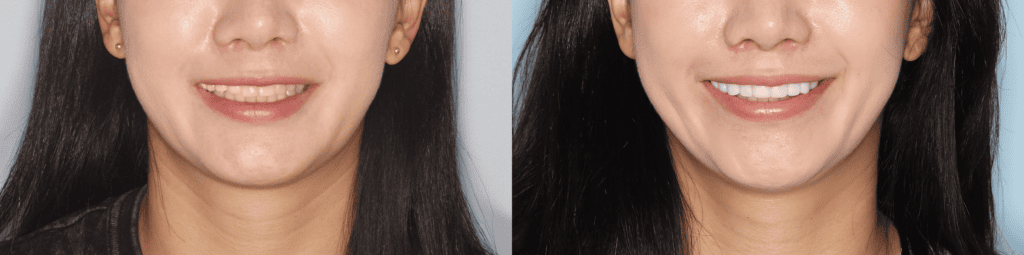
Before anyone talks about materials, these four numbers get taken. They are the same four whether you are in Seoul or anywhere else.
This is how far the upper front teeth sit in front of the lower ones, measured straight back. A small overjet leaves room to add porcelain without crowding.
A large overjet means added thickness pushes the tooth further forward visually. Length can help here. Thickness usually cannot.
This is how much of the lower front tooth is hidden when you close. A deep overlap means the lower edge of the upper tooth is under constant contact.
Porcelain placed on a surface that takes direct closing force needs different thickness planning. Porcelain that sits free does not.
Your teeth do not only meet straight down. Slide your jaw sideways and watch which teeth touch.
If a single front tooth carries the whole sideways movement, that tooth is under a load the veneer will inherit. This is measured with marking paper, not by eye.
Sometimes the front teeth have simply worn shorter, and the jaw has closed to compensate. In that case there is no space at the edge to add anything back.
Space can be created. It is a planning decision made before treatment, not a surprise found halfway through.
A crooked door in a crooked frame can be handled two ways. You can plane the door edge so it closes cleanly, or you can rebuild the frame.
Planing works beautifully when the frame is close to square. It fails when the frame itself is twisted, because every millimetre you shave makes the door thinner without improving the closure.
Veneers plane the door. Orthodontics squares the frame.
| Bite complaint | What is actually off | Realistic approach |
|---|---|---|
| Front teeth look uneven at the edge | Length and shape only | Veneers alone usually work well |
| One tooth sits visibly behind the others | Root position | Alignment first, veneers after |
| Front teeth never touch when closing | Vertical relationship | Assessment first, porcelain rarely enough alone |
| Lower teeth hidden completely on closing | Deep vertical overlap | Possible, with thickness planned around contact |
| Upper and lower edges meet directly | Edge to edge contact | Possible, with edge design and force control |
| Teeth have worn short over years | Lost height plus a habit | Habit addressed first, then restoration |

Common and often workable. The planning question is how much thickness the covered edge can carry, and whether the opposing tooth strikes it directly.
The front teeth do not touch at all. Lengthening with porcelain can close a small gap, but a large one means the cause sits further back in the jaw.
Upper and lower edges meet flush instead of overlapping. Porcelain can be shaped to reduce direct impact, though the underlying contact pattern still needs managing.
One upper tooth sits behind its lower partner. Covering the front does not change which side of the lower tooth it lands on, so this one usually needs alignment first.
None of this is about whether treatment can be finished quickly. Complex cases get more diagnostic and adjustment time inside the same visit, not a different format.
Porcelain bonded onto a tooth that takes an unbalanced sideways load behaves differently from porcelain that sits evenly. The bond line is the part under stress, not the ceramic surface.
This is where the adhesive system matters more than most price lists suggest. We use the Ivoclar bonding system, which sits at the top of the price range among dental adhesives.
We choose it because it holds colour at the margin over time and is well tolerated by the surrounding tissue. Cost differences between clinics rarely come down to ceramic grade alone.
Bonding system, laboratory time, and the design work behind the shape all sit inside that number. If you are weighing full coverage restorations instead, veneers versus crowns for front teeth covers where that line falls.
The clinical sequence itself is set out in the veneers process step by step.

Send photographs before you book. Three angles help most: a straight smile, a relaxed closed bite from the side, and one with the jaw slid gently to each side.
Those three tell us more about your bite than a written description ever does. They also let us tell you honestly whether alignment needs to come first.
Our prices are the same for local and international patients. There is no separate rate for visitors.
Our laboratory is inside the clinic near Nonhyeon Station, roughly an hour from Incheon Airport. Design adjustments happen in the same building rather than by courier.
For the full one-day programme, including technology, pricing, and booking, see our One-Day Veneers page.
The most common pattern is someone who describes a bite problem but actually has uneven edge lengths on four upper teeth. Those cases resolve neatly with shape alone.
The second most common is a single tooth rotated behind its neighbours. There, covering the front makes the arch look better in photographs while leaving the contact pattern untouched, and we say so before anyone books a flight.
They can improve how a deep overlap looks by changing edge length and shape. They do not reduce the skeletal overlap itself, so the answer depends on whether your complaint is appearance or jaw relationship.
Any change to the biting surface changes contact slightly, and adjustment at the fitting stage is part of the process. A well adjusted result should feel unremarkable within days.
Only if root position is the problem. If the roots sit reasonably and the issue is shape, length, or width, alignment first would mean more treatment than the result requires.
This article describes general diagnostic and treatment principles. Outcomes vary with tooth condition, gum health, biting force, and habits such as clenching or grinding.
Temporary sensitivity or a period of adjustment after fitting is possible. A proper assessment requires a clinical examination and radiographs.
The question behind most bite emails is really this: will it look right when I smile and still feel right when I close? Those are two separate checks, and both are worth making before anyone starts shaping a tooth.
Send us three photographs and we will tell you which of the four measurements is driving your case.
Dr. Kim Tae-hyung (Director, Blanche Dental Clinic · Seoul National University-trained dentist)
Consultation — Blanche Dental is located between Nonhyeon and Sinnonhyeon stations in Gangnam, Seoul. For a consultation in English, message us on WhatsApp with your photos, and see our pricing page for current fees.