
Veneers gap teeth searches usually start the same way: a space between the front teeth that you either love or want gone. There is rarely a middle ground.
Veneers gap teeth searches usually start the same way: a space between the front teeth that you either love or want gone. There is rarely a middle ground.
If you want it gone, veneers gap teeth searches will show you a lot of dramatic before-and-after photos. What those photos rarely explain is how the space actually disappears.
Porcelain cannot move a tooth. It can only add width to the tooth that is already there.
That single fact decides almost everything about whether this treatment will look natural on you. This article walks through the four measurements we take before agreeing to close a gap with porcelain, and the point at which we recommend moving the teeth first instead.
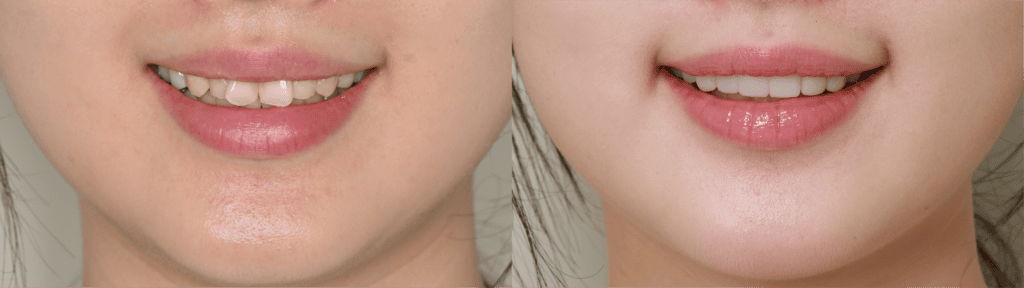
A gap is empty space between two teeth. To fill it with veneers, we make each neighbouring tooth wider.
Split a 3 mm gap between two central incisors and each tooth grows about 1.5 mm. Sometimes we spread the width across four teeth instead of two, so no single tooth carries the whole change.
That is the entire mechanism. There is no stretching, no shifting, and no pulling teeth together.
The question is never “can porcelain fill this space.” It is “will the teeth still look like teeth once they are that wide.”
A natural upper central incisor is roughly 75 to 85 percent as wide as it is tall. Push past that and the tooth starts reading as square rather than as a front tooth.
Most people cannot name the ratio. They just look at the result and say something feels off.
Before we plan a case, we take four numbers. Together they tell us whether porcelain alone will give a natural result.
| Measurement | What we check | Comfortable range | What it changes |
|---|---|---|---|
| Gap width | Total empty space in millimetres | Up to about 4 mm | How much width each tooth must gain |
| Width-to-height ratio | Tooth width divided by tooth height | Stays under about 85% | Whether the tooth still looks natural |
| Root position and angle | Whether roots are parallel or splayed | Roots close to upright | Whether porcelain hides or exaggerates the tilt |
| Gum papilla height | How far gum tissue fills the triangle between teeth | Papilla reaches the contact point | Whether a dark triangle appears at the gum line |
For veneers gap teeth planning, width and ratio are the easy ones. The two that surprise people are the last two.
Two teeth can look parallel at the biting edge and still be splayed apart at the root. Orthodontists call this the “fan” pattern.
If the roots lean away from each other, adding porcelain at the crown only widens the visible part. The tooth ends up thick near the edge and thin near the gum.
You can see that shape in photographs even if you cannot name it. It is one of the most common reasons a technically successful case still looks artificial.

Gum tissue fills the small triangle between two teeth. That tissue is supported by the point where the teeth touch each other.
When a gap has been there for years, the gum has nothing to fill and has often receded. Widen the teeth only at the biting edge and you close the top of the space while leaving a dark triangle underneath.
The fix is to move the contact point downward toward the gum, which means shaping the porcelain lower rather than just wider. That takes planning at the design stage, not adjustment at the fitting appointment.
Think of a doorway with a gap on both sides of the door. You have two options.
You can fit a wider door leaf, or you can move the frame. Veneers are the wider door leaf.
That works beautifully when the gap is modest and the frame is square. It works badly when the frame itself is out of plumb, because a wider leaf then only makes the tilt more obvious.
Orthodontics moves the frame. Porcelain widens the leaf. Knowing which one your case needs is the whole consultation.
We say this openly because the alternative is a result you live with for a decade.
When the gap is wider than roughly 4 mm across two teeth. Each tooth would need more than 2 mm of extra width, and the ratio breaks.
When the roots are clearly splayed. Adding porcelain over a tilted root means either an uneven thickness or removing more enamel on one side to compensate. Neither is a good trade for a healthy tooth.
When a lateral incisor is missing or undersized. The space is not really a gap, it is a missing tooth, and the plan is different.
When gum health is not stable. Porcelain margins sit at the gum line, so inflamed or receding tissue has to be treated first.
In the first two situations we usually recommend aligning the teeth before any porcelain goes on. That recommendation is about preserving tooth structure, not about how long treatment takes. Moving a tooth into the right position means we remove less enamel afterward, or sometimes none at all.
If minimal enamel removal is your priority, our guide to no-prep veneers in Korea explains what qualifies a tooth for that approach.

Two clinics can quote very different numbers for the same number of teeth. The gap between quotes is rarely about the ceramic alone.
Diagnosis and design time. A gap case needs contact-point planning and a check of root angulation, which is more chair time than a straightforward shade change.
The bonding system. We use the Ivoclar adhesive system, which sits at the top of the price range for dental adhesives. It is chosen for biocompatibility and for colour stability, meaning the margins resist staining over time.
That matters more in gap cases than in most others. Widening a tooth lengthens the margin line, so there is simply more bonded edge to keep sealed and stain-free.
Where the work is made. We run an in-house laboratory, Blanche Lab, so contact points can be adjusted with the technician present rather than sent away and returned.
Our pricing is the same for Korean and international patients, with no foreigner surcharge. A full per-tooth breakdown is in our veneers cost guide for Seoul.
One-day veneers are priced above the conventional route. Compressing diagnosis, design, fabrication, and fitting into a single day concentrates the dentist and the in-house lab team on one case for that day, and the fee reflects that.
Most international patients start by sending photographs. Three views help: a straight-on smile, a relaxed lips-apart view, and a close-up of the gap itself.
From those we can usually tell whether the ratio will hold, and we say so before you book flights. If the measurements suggest alignment first, we would rather tell you by email than at the chair.
For the full one-day programme — technology, pricing, and booking — see our One-Day Veneers page.
If a case turns out to need more coverage than a veneer provides, our comparison of veneers versus crowns for front teeth explains where the line falls.
Patients with a modest central gap and upright roots are usually straightforward. Width is spread across four teeth, the contact point is brought slightly lower, and the ratio stays inside the natural range.
Patients with a wide space and fanned roots are the ones we ask to consider alignment first. In those cases the porcelain step afterward is smaller, not larger, because the teeth need less added width.
Both patterns are common. Which one applies to you is a measurement, not an opinion.
Q. Can veneers close a gap permanently, or will it come back? A. The porcelain itself does not move, so the closed space stays closed as long as the veneers are intact. What can change is the position of the teeth underneath, particularly if the original gap was caused by a habit such as tongue thrust. We check for those causes before treatment.
Q. How many teeth need veneers to close one gap? A. Often four rather than two. Spreading the extra width across four teeth keeps each individual tooth closer to its natural proportions, and it usually looks more balanced than making just the two central teeth wider.
Q. Will there be a dark triangle at the gum line afterwards? A. Not if the contact point is planned correctly. The porcelain has to meet lower down, closer to the gum, so the tissue has something to fill against. Where gum recession is already advanced, we discuss that limitation before starting.
All dental treatment carries risks and varies between individuals. Temporary sensitivity, gum adaptation, and a short period of adjusting to the new tooth shape are common after veneer placement.
Results depend on the amount of remaining enamel, bite relationship, gum condition, and daily habits. This article is general information and does not replace an individual diagnosis.
Please seek an in-person examination and consultation for advice specific to your case.
The gap itself is rarely the hard part of these cases. The hard part is deciding how much extra width a tooth can carry before it stops looking like a front tooth.
I have seen results that closed the space perfectly and still did not satisfy the patient, because the proportions moved past what reads as natural. That is why we measure before we promise.
If you are considering closing a gap, send a few photographs and let us check the numbers first. Our clinic is near Nonhyeon Station in Gangnam, and we are glad to tell you honestly if alignment should come before porcelain.
Dr. Kim Tae-hyung (Director, Blanche Dental Clinic · Seoul National University-trained dentist)
Consultation — Blanche Dental is located between Nonhyeon and Sinnonhyeon stations in Gangnam, Seoul. For a consultation in English, message us on WhatsApp with your photos, and see our pricing page for current fees.