
Are Veneers Worth It? A Dentist’s Framework for Deciding
Are veneers worth it? Most people who ask this have already seen the before-and-after photos. What they cannot find is a way to judge whether the trade is fair for their own teeth.
It is a fair question to ask out loud. Veneers are not reversible in the way a whitening session is, and the honest answer depends on facts about your mouth rather than on anyone’s opinion.
In this guide I will give you the same framework I use in the operatory. We will look at what you are actually buying, the four questions that decide the answer, and the situations where I tell patients to wait.
A note from Dr. Kim — Many people who land on this page share one quiet worry: what if I damage healthy teeth for nothing? It is the first question I ask myself with every patient.
Blanche began with that question: why harm a natural tooth worth more than any restoration? That is why our signature Blanche no-prep veneers follow one rule — minimal intervention, maximum beauty.
Are veneers worth it? Start with what you are actually paying for
People assume they are paying for whiteness. Whitening is cheaper and less invasive, so if colour were the only goal, veneers would rarely make sense.
What veneers actually change is shape, proportion and edge position. A chipped edge, a small peg-shaped tooth, a gap, or teeth that look uneven in photos are shape problems, and no bleaching agent moves a shape.
So the first filter is simple. If your only complaint is colour, whitening deserves a trial first.
If your complaint is shape, or shape plus colour, veneers become the reasonable tool. We compare the two directly in our guide on veneers versus whitening.
The four questions that decide whether veneers are worth it

Once shape is the issue, four questions settle the rest. I ask all four before quoting anything.
1. How much natural tooth has to be removed?
Enamel does not grow back. That single fact drives most of the caution in this field.
Some cases can be treated with little or no reduction, and some need a thin layer removed so the ceramic does not sit proud of the neighbouring teeth. The lower the reduction, the better the long-term trade.
Ask any clinic to show you, on your own scan, how much they plan to remove. Our page on no-prep veneers explains when the minimal-reduction route is realistic.
2. Are the teeth in the right position already?
Veneers resurface a tooth. They do not move it.
If teeth are significantly rotated or protrusive, covering them means cutting deeper to fake the alignment. In that situation I recommend orthodontics first, because straightening the teeth usually means less tooth has to be removed afterwards.
This is the most common reason I ask a patient to wait. It is also the advice that saves the most enamel.
3. How long will they last for you?
Bonded ceramic is durable, but it lives in a mouth that clenches, grinds and bites into things. Habits matter more than the brand of ceramic.
Patients who grind at night and wear a guard do well. Patients who grind and do not wear one see chips much sooner, and that changes the arithmetic completely.
We cover the realistic ranges in how long veneers last.
4. What is the yearly cost, not the sticker price?
A single large number is hard to judge. Dividing it across the years you expect to keep the result makes the comparison honest.
The table below shows how the same treatment reads very differently depending on longevity and on how many teeth you treat.
| Scenario | What drives the total | How it reads over time |
|---|---|---|
| Two front teeth, shape only | Smallest scope, colour limited by neighbours | Lowest total, but the colour ceiling is set by untreated teeth |
| Six upper teeth, full smile line | Most common scope | Higher total, spread over more visible surface |
| Grinding, no night guard | Repairs and remakes | Yearly cost rises sharply |
| Orthodontics first, then veneers | Longer timeline, less reduction | Higher upfront, best preservation of natural tooth |
Think of it the way you would think about a roof rather than a haircut. The question is not what it costs today, but what it costs across the years it has to keep working.
When I tell patients that veneers are not worth it yet
There are three situations where I ask people to pause. None of them are about budget.
The first is active gum inflammation or untreated decay. Bonding ceramic to an unstable foundation shortens everything that follows.
The second is unresolved grinding. We treat the habit and fit a guard before, not after.
The third is expectation. If the photos you brought are of a much wider smile line or a different face shape, no amount of ceramic will produce that result, and it is better to say so before treatment than after.
Damage worries deserve a straight answer too, and we give one in do veneers ruin your teeth.
Not sure where your case fits? Send two photos — front and smiling — on WhatsApp. We will tell you what is possible before you book any flight.
What changes the answer if you are treating in Korea
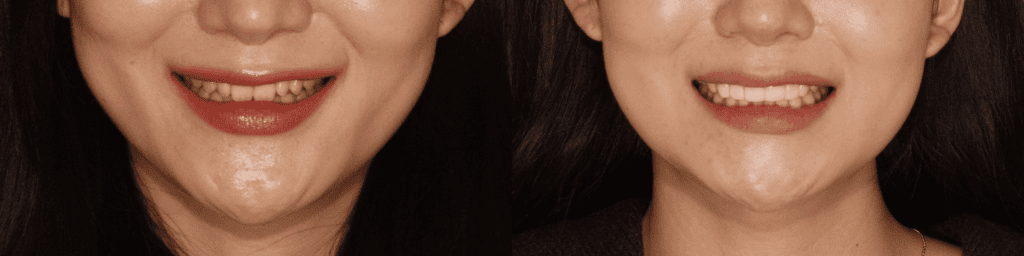
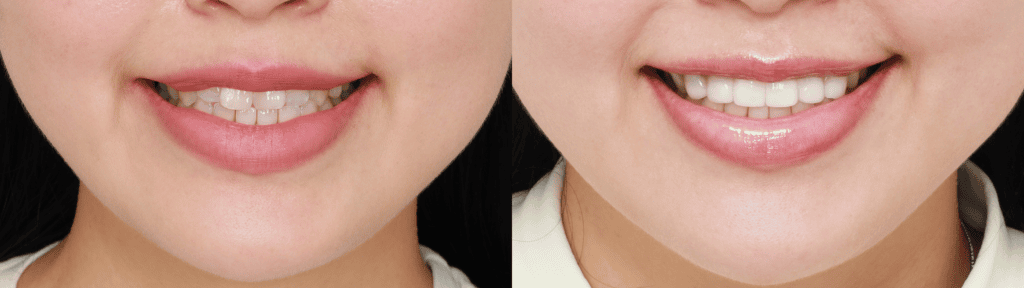
For international patients the arithmetic shifts, because the cost side of the equation is different. Our pricing is the same for local and international patients, so nothing is added for travelling in.
Two practical points matter more than most people expect. We run our own in-house laboratory, which is why shade and shape adjustments can happen the same day rather than across a week of shipping.
We are also a short ride from Gangnam and reachable from both airports, and we can review your photos before you book so you know the likely scope in advance. The step-by-step sequence is set out in our veneers process guide, and per-tooth pricing in veneers Korea cost.
Same-day treatment is priced higher than the conventional route, because the diagnosis, design, fabrication and fine-tuning are compressed into one day with the dentist and the in-house lab team working together. Complex cases are handled by allocating more design and adjustment time within that same day. For the full one-day programme — technology, pricing, and booking — see our One-Day Veneers page.
One cost item is rarely discussed. The bonding system matters as much as the ceramic grade, and we use the Ivoclar adhesive system, which sits at the top of the price range but is biocompatible and highly resistant to discolouration at the margins.
Frequently asked questions
Are veneers worth it if I only dislike the colour of my teeth?
Usually not as a first step. Whitening is less invasive and much cheaper, so it deserves a trial first, and veneers become the better option when shape, edge position or proportion is part of the complaint.
Are veneers worth it long term compared with crowns?
For front teeth with healthy structure, veneers are generally the more conservative choice because far less tooth is removed. Crowns make more sense when a tooth is heavily filled, root-treated or already badly broken down.
What happens if I decide they were not worth it?
Ceramic can be removed and replaced, but any enamel that was reduced does not return. This is exactly why the reduction question belongs at the start of the conversation rather than at the end.
Side effects and individual variation
This article is general information and not a diagnosis. Enamel thickness, bite pattern and gum condition vary, and so do results and longevity.
Temporary sensitivity and gum tenderness are common in the first days. Chipping, margin staining or debonding can occur over time depending on habits and maintenance, so please have your own case assessed by your treating dentist.
A note from the clinic
After ten years of working on front teeth, the patients who regret treatment are rarely the ones who spent more. They are the ones who never got a straight answer about how much tooth was being removed.
So I answer that first, before design, before shade, before any number. If the honest answer is that orthodontics should come first, that is what I say.
Are veneers worth it for you? Send a few clear photos of your smile and we will tell you what the realistic scope looks like, including the option of not treating at all.
Written by Dr. Kim Tae-hyung, Director of Blanche Dental Clinic, Seoul National University trained dentist.
What happens at your first consultation
1. We listen first — what bothers you and what you hope for. 2. We walk you through your scan results and every option.
3. You get itemized costs and timing, and you can decide later, even after you fly home. At Blanche, we explain everything at least four times, by principle.
Consultation — Blanche Dental is located between Nonhyeon and Sinnonhyeon stations in Gangnam, Seoul. For a consultation in English, message us on WhatsApp with your photos, and see our pricing page for current fees.

About the author
Dr. Kim Tae-hyung
Chief Director of Blanche Dental Clinic in Gangnam. He holds an M.S. from Seoul National University and trained at the Columbia and UCLA dental hospitals.
He advises SBS “Dr. Oh’s Clinic” and YouTube “Doctor Friends,” and is a Clinical Instructor at Ginza Shirayuri Dental Clinic in Tokyo. His rule of practice: minimal intervention, maximum beauty.