
Veneers in Korea Pros and Cons: What Nobody Tells You Upfront
Most lists of veneers in Korea pros and cons read like adverts with one small warning added at the end.
So a quiet question remains: “What is nobody telling me?” Adverts talk about results, and travel blogs talk about prices.
This is my attempt at a fair list. I work at a clinic in Seoul, so I am not neutral. Even so, I will put each downside next to each advantage, and say how to reduce it.
A note from Dr. Kim
I would rather you hear the downsides from me now than discover them after your flight home.
“No decision depends on one person’s judgment alone.” That is why I explain Blanche no-prep veneers with their limits as well as their strengths.
Veneers in Korea pros and cons at a glance
| Pro or con | What it means for you | How to reduce the risk |
|---|---|---|
| Pro: no-prep or minimal prep | Little or no enamel removed | Ask how much will be shaved, in millimetres |
| Pro: in-house lab | Your ceramist works with your dentist on site | Ask who makes your veneers |
| Pro: one-day option | Treatment takes 4–5 hours on the day | Still plan 2–3 days in Seoul for the follow-up check |
| Pro: same price for foreigners | No foreigner surcharge | Ask for itemized costs before you book |
| Pro: warranty by tier | 1, 5 or 10 years, depending on the tier | Know what your tier includes |
| Con: travel time and cost | Flights, hotel and days off add up | Send photos before booking flights |
| Con: follow-up is far away | A return trip is harder than a local visit | Plan 2–3 days in Seoul for the follow-up check |
| Con: language and expectation gaps | “Natural” and “white” can mean different things | Consult in your language; ask again |
| Con: not for every tooth | Gums, cavities, grinding or crowding may come first | Get an exam before you commit |
| Con: porcelain can chip | Bad habits stress the edges | Treat grinding first and change habits |
The real advantages, without the gloss
Less tooth removed
At Blanche, we do only fully no-prep veneers, or minimal prep under 0.1 mm. Both cost the same, so there is no price reason to remove more.
That said, no-prep does not suit every tooth, which I cover below.
A lab in the same clinic
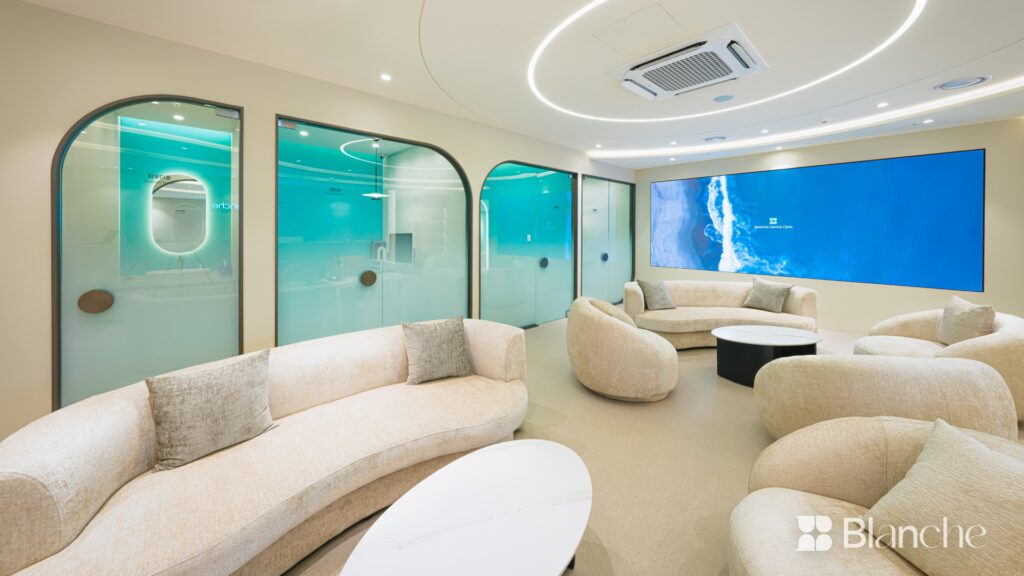
Our in-house lab, Blanche Lab, has ceramists trained in France and Switzerland. BASIC and PLATINUM use Swiss ceramic.
A one-day option
One-day veneers take 4–5 hours on the day, or 5–6 hours for many teeth. You can go out while the lab works.
However, it costs KRW 200,000 more per tooth, because the work is compressed into one day with the dentist and lab fully dedicated to you. For the full one-day program — technology, pricing, and booking — see our One-Day Veneers page.
Same price, clear warranty
Prices are the same for Korean and international patients, from KRW 650,000 per tooth (VAT excluded). Warranties run 1, 5 or 10 years by tier.
Veneers in Korea pros and cons: the downsides people skip
Travel time and cost
The clinic fee is only part of the bill. Flights, hotel nights and time off work all count.
To reduce this, send two photos before you book anything. If the plan does not make sense for your teeth, you have spent nothing.
Follow-up is far away
Once you are home, we are a flight away.
So we recommend one follow-up check after the treatment day, before you leave. If a veneer ever comes off, keep it and bring it. If it is not broken, re-bonding may be possible. Our post on what happens if one chips after you fly home goes through this step by step.
So plan 2–3 days in Seoul. Our guide to how many days a veneer trip needs shows how to fit it in.
Gaps in language and expectations
Words like “natural” and “white” mean different things to different people.
We consult in English, Japanese, Chinese, Thai and Russian. We also repeat every explanation at least four times, and you can decide later, at home.
In short, ask until the answer is clear. Our guide to the two photos to send before you book flights explains how to start that conversation.
“Would the downsides matter much in my case?”
Send us just two photos: one of your face straight on, and one smiling. We will tell you which of these points apply to your teeth, and which do not.
Not for every tooth, and porcelain is not unbreakable
When something else comes first
Small or gapped teeth usually suit no-prep. However, teeth that sit forward, large teeth, or very dark discoloration may need minimal prep.
Gum inflammation, cavities or heavy grinding are treated first. If teeth are significantly crowded, we may suggest orthodontics first, to preserve tooth structure.
Chipping and habits
Porcelain is a bit like a good wine glass. It is strong enough for daily use, but it is not a bottle opener.
So bad habits, like biting hard objects or heavy grinding, can chip the edges. With proper care and regular check-ups, veneers can last over 10 years, and 20–30 years or more, depending on care.
If a veneer needs redoing, we remove it with a laser, without extra shaving. Revision is priced the same as new treatment.
How to weigh it up before you book
First, send two photos on WhatsApp. Then decide at home, without pressure.
The veneers in Korea pros and cons are both real. What changes the outcome is whether you plan around the downsides before you fly.
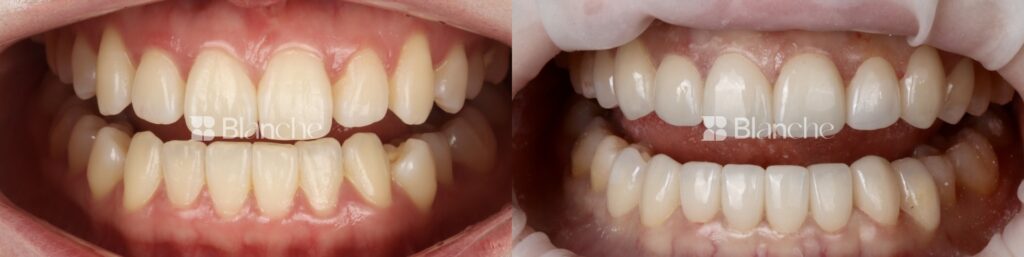
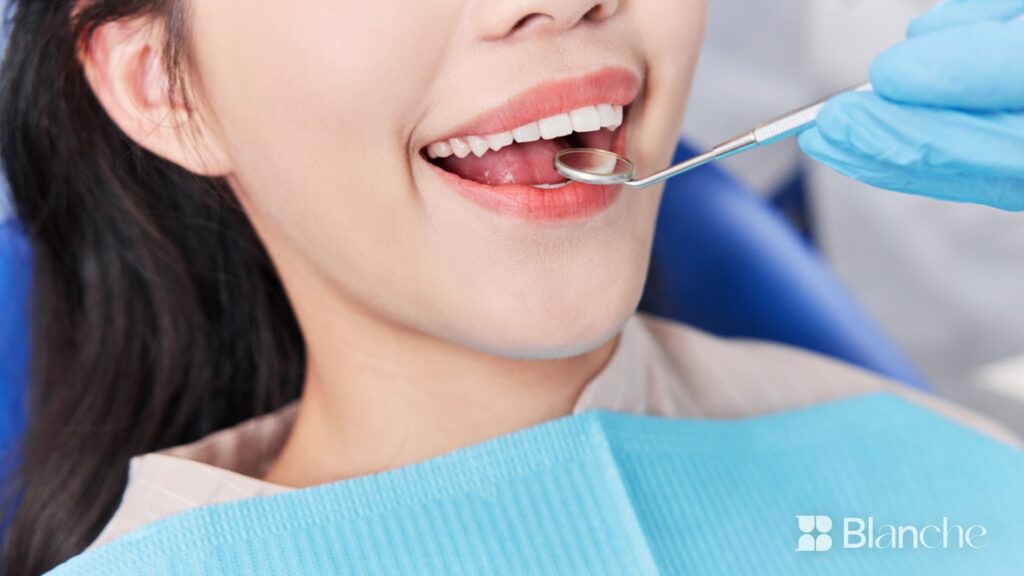
An actual case treated at Blanche Dental Clinic. Results vary with each patient’s dental condition.
Frequently asked questions
What are the main veneers in Korea pros and cons?
The main advantages are a no-prep or minimal-prep approach, an in-house lab, a one-day option, the same price for foreigners and a warranty by tier. The main downsides are travel time and cost, distance from follow-up care, and the need for a check before flying home.
What happens if a veneer comes off after I fly home?
Keep it and bring it. If it is not broken, re-bonding may be possible. Each tier also carries a warranty of 1, 5 or 10 years.
Can every tooth get a no-prep veneer?
No. Small or gapped teeth usually suit no-prep, while teeth that sit forward, large teeth or very dark teeth may need minimal prep under 0.1 mm. Gum inflammation, cavities or heavy grinding are treated first.
Side effects and individual differences
Temporary sensitivity, a foreign-body feeling, or mild gum swelling can occur. Results and longevity vary with each person’s teeth and habits.
When I teach other dentists, I tell them a patient deserves the downsides in the first conversation, not the last. A fair list today is part of a smile that still works twenty years from now.
How your first consultation works
1. We listen to your concerns and the smile you want.
2. Based on your exam, we explain every available option.
3. We give itemized costs and timelines. You are welcome to decide later, at home.
We repeat every explanation at least four times, and no decision depends on one person’s judgment alone.
Consultation — Message us on WhatsApp with two smile photos, or check our pricing. Same pricing for Korean and international patients.