
Digital implants
with a surgical guide
With 3D CT and an intraoral scan, the position, angle and depth are decided on screen before surgery. Where a guide helps, we operate with a surgical template (surgical guide) made to match that plan.
- Planned with 3D CT · intraoral scan
- Guide used where it helps
- Surgery by Dr. Taehyung Kim and Dr. Hayoung Kim
- 2-year warranty, crown included
Implant surgery:
is this what worries you?
A digital implant is planned on a computer screen before surgery, by deciding the implant site in advance. The template that helps carry that plan into surgery is called a surgical guide, and surgery using it is also called guided implant surgery, digital guided surgery or navigation implant surgery.
- You were told the site is close to a nerve or the sinus (the air space in the upper jaw)
- You need several implants and worry whether they will line up well
- It's a front tooth, and you care whether the gumline and shape will look natural
- You were told your bone is thin and wonder whether a bone graft is really needed
- You want to know whether flapless implant surgery, without a large gum incision, is possible
Digital implants and surgical guides:
what's the difference?
The bone is captured with 3D CT and the teeth and gums with an intraoral scanner, and the two data sets are overlaid on one screen. On that image we decide the position, angle and depth of the implant and, if needed, prepare a surgical template that helps the drill follow that plan.
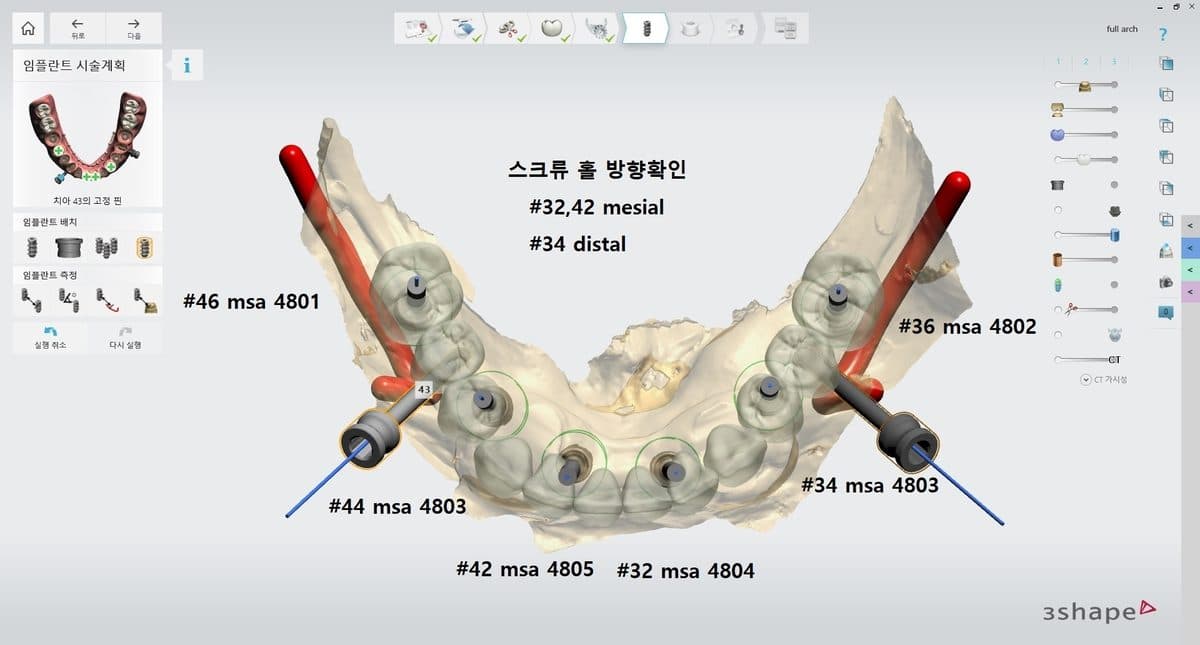
A Blanche Dental digital implant planning screen. The numbers on screen are tooth and component numbers, and the gray cylinders on either side mark the pins that hold the guide in place.
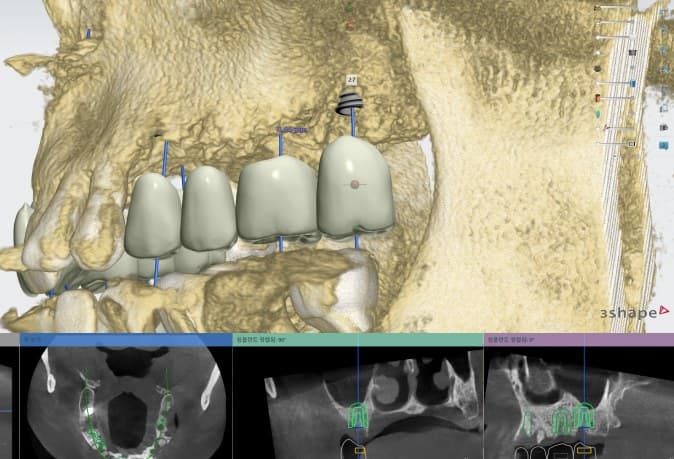
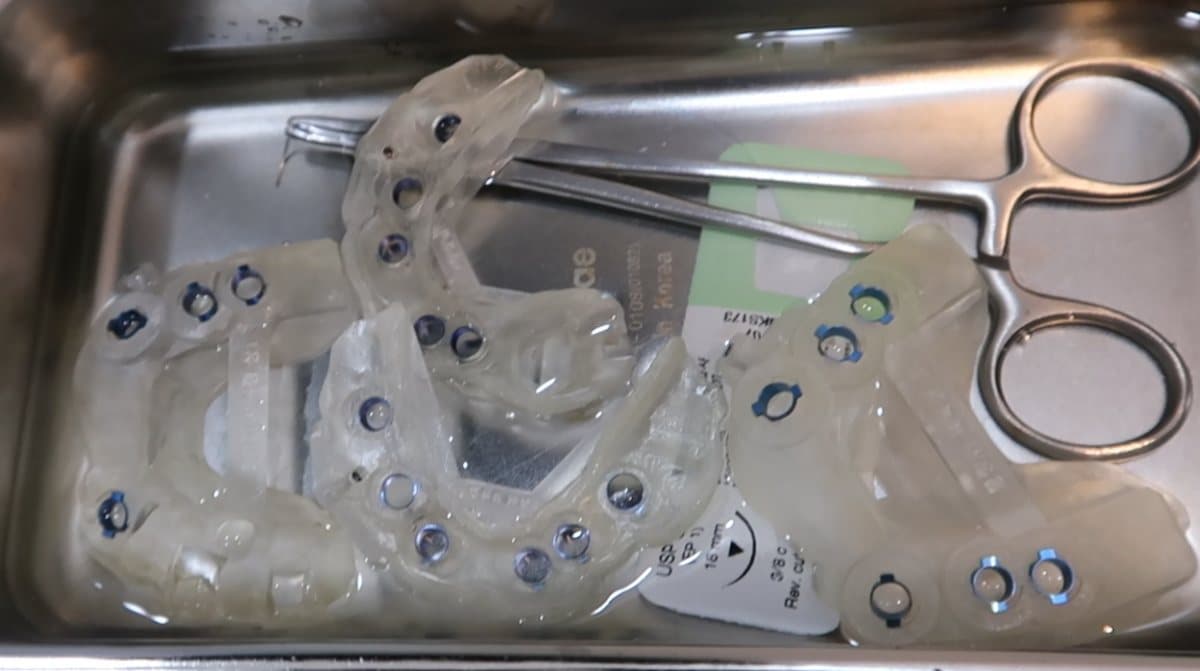
The implant and crown positions planned together on a 3D CT Real surgical guides · clear surgical templates made individually for each patient
3D CT · Bone
We check the height and thickness of the jawbone and the position of nerves and the sinus in 3D.
Intraoral scan · Teeth and gums
Instead of impressions, the teeth and gums are captured with an intraoral scanner and overlaid on the CT.
Surgical guide · Surgical template
A template with holes that let the drill enter at the planned position, angle and depth. During surgery it is fitted over the teeth or gums.
A guide is a tool that helps carry the plan into surgery, not a device that eliminates error. That's why, even with the guide in place, the operating dentist keeps checking the position and bone condition directly throughout the procedure.
Conventional implant surgery
vs. guided implant surgery
Both methods are diagnosed with 3D CT. The difference lies in how the plan is carried out during surgery. Below are the general differences.
This doesn't mean guided surgery is always the better option. Which one fits is decided after reviewing the 3D CT, and we never rely on a single person's judgment.
When digital guided surgery
can help
At Blanche, we don't use a guide for every implant; we use it when it's needed. In general, a guide may help in the following cases.
- 01
When placing several implants
Several implants need to stand parallel so the crowns or connected restorations on top can be made without strain, so we align their spacing and direction together on screen.
- 02
Visible sites such as front teeth
With front teeth, even a small change in position can affect the gumline and crown shape, so we set the final tooth shape first and plan from there.
- 03
Close to a nerve or the sinus
Where the site is close to the lower jaw nerve canal or the upper jaw sinus, deciding the depth and direction in advance may help.
- 04
When the bone is thin or narrow
We look on screen for a direction that stays within the remaining bone and decide together whether a bone graft is needed.
- 05
When considering flapless surgery
Without opening the gum widely, it's hard to see the bone directly, so a guide can serve as the reference when flapless surgery is considered.
- 06
Revision · Re-placement
In difficult conditions, such as a site where a previous implant was removed, we re-plan the position and angle with a guide if needed. See Implant Revision
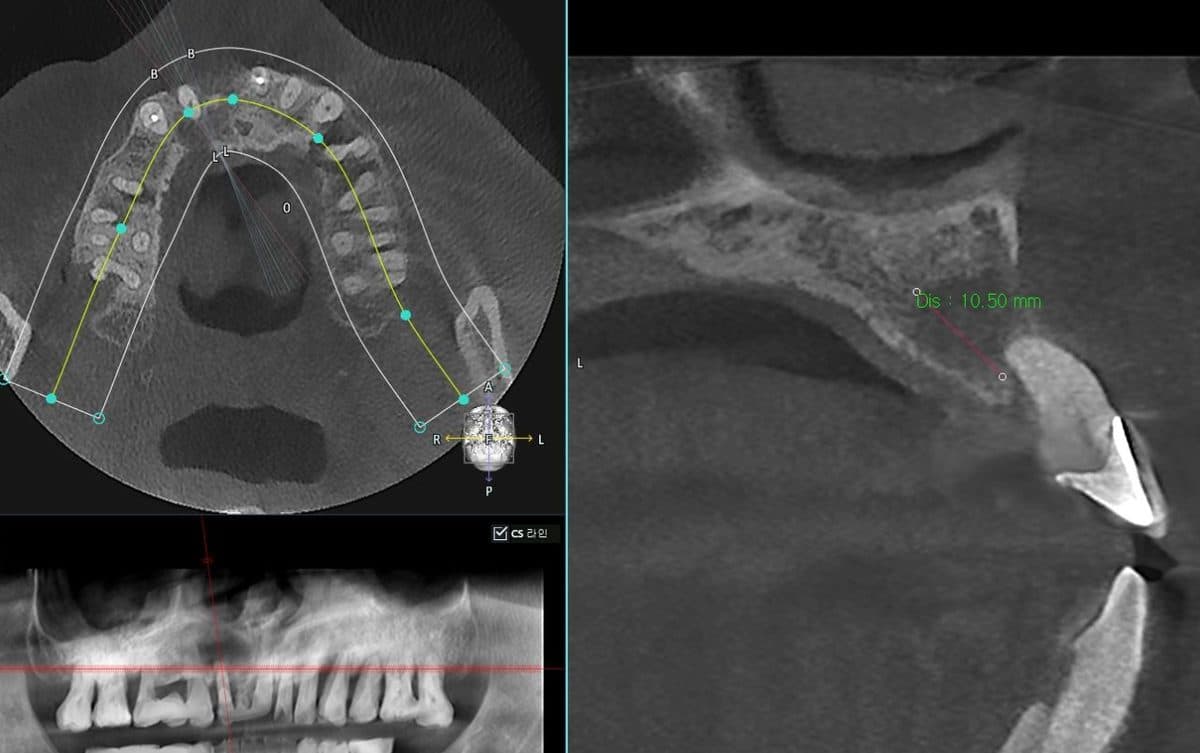
3D CT screen · cross-sections of the whole jaw and the nerve position viewed together 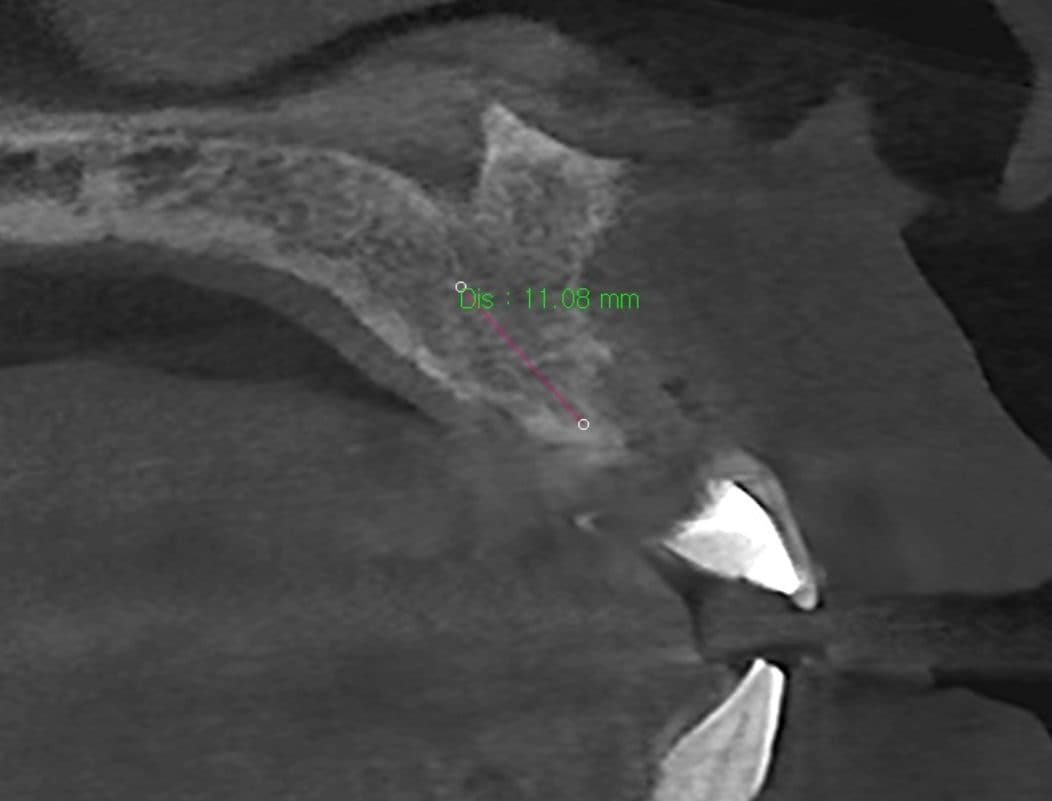
3D CT cross-section · measuring bone height and thickness at the implant site
What to expect from a guided implant,
and what to accept
How it may help
- The position, angle and depth are set before surgery, and the guide helps place the implant close to that plan
- The distance to nerves and the sinus can be checked in advance
- The position can be decided based on the final crown shape
- If conditions allow, a smaller incision may reduce swelling after surgery
What you should know before choosing
- Even with a guide, small differences between the plan and the result can occur
- A guide may be hard to use if you can't open your mouth wide, or for back molar sites
- If the guide doesn't fit well during surgery or the bone differs from what was expected, we may switch to conventional surgery
- An intraoral scan and guide preparation are added
- Swelling, bruising, pain or temporary changes in sensation may occur after surgery, and recovery varies from person to person
Flapless implants:
when a guide makes them possible, and when not
A flapless implant is placed through a small opening without opening the gum widely. A guide widens the range of cases where it can be considered, but it isn't possible in every case.
When flapless may be considered
- The 3D CT shows ample bone height and width
- There is enough firm gum (keratinized gingiva) at the site
- No bone graft, or only a very small one, is needed
When an incision may be needed
- The bone is thin or narrow and needs a graft
- The gum shape needs refining too, as with front teeth
- Firm gum is lacking and needs to be repositioned
When plans may change during surgery
- The bone shape under the gum differs from what the CT showed
- The guide doesn't sit stably in the mouth
- The bone needs to be seen and checked directly
We tell you whether flapless surgery is possible after reviewing the 3D CT and your gum condition. Even if flapless surgery was planned, an incision may become necessary during surgery depending on the bone.
Digital guided implant process and timeline
Only a planning step is added; the time for bonding with the bone and the crown process are the same as for conventional implants.
- 01
Consultation · 3D CT
We check bone height and thickness and the position of nerves and the sinus, and see whether the site calls for a guide.
- 02
Intraoral scan
Instead of impressions, the teeth and gums are captured with an intraoral scanner and overlaid on the CT.
- 03
Planning on screen
We set the final tooth shape first, then decide the position, angle and depth.
- 04
Guided surgery
With the guide made for the plan in place, Dr. Taehyung Kim or Dr. Hayoung Kim places the implant personally. For front teeth, a same-day temporary tooth can be fitted.
- 05
Stitches · Healing
About a week later the stitches are removed, followed by 4–6 months for the implant to bond with the bone.
- 06
Scan · Crown
We take a scan instead of impressions, and a week later connect a zirconia crown made at Blanche Lab, our in-house lab.
Usually four visits from surgery to crown · surgery → stitches about a week later → scan 4–6 months later → crown a week later
- If you are traveling from abroad or from outside Seoul, treatment can be done in two trips. If a bone graft or sinus lift is done at the same time, the timeline may change, which we explain at the consultation.
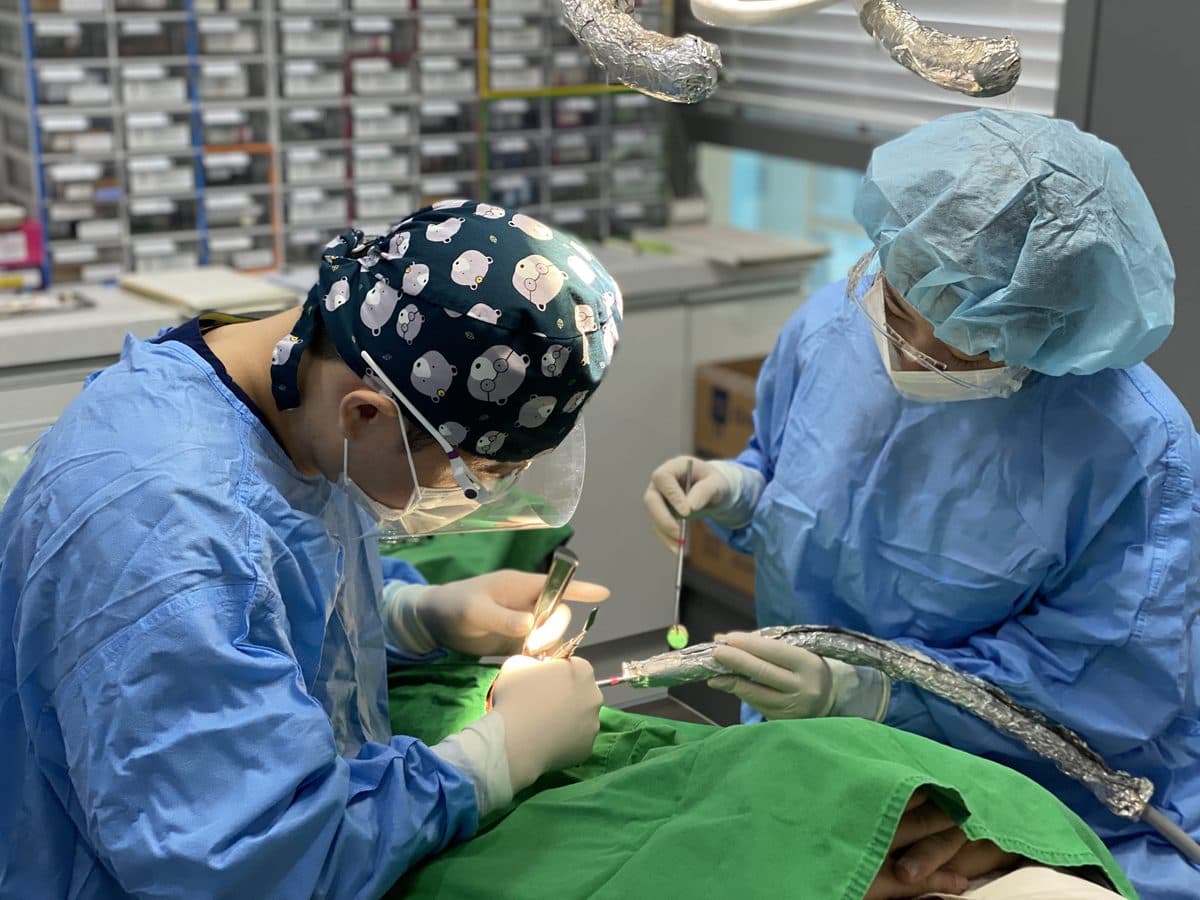
Swelling, bruising, pain or temporary changes in sensation may occur after surgery, and recovery time and results vary from person to person. If surgery makes you nervous, it can be done under IV sedation (conscious sedation) (KRW 400,000 (≈ USD 295) per session, charged separately).
Real Blanche implant cases
X-rays right after placement and after crown placement. Drag left and right to compare.
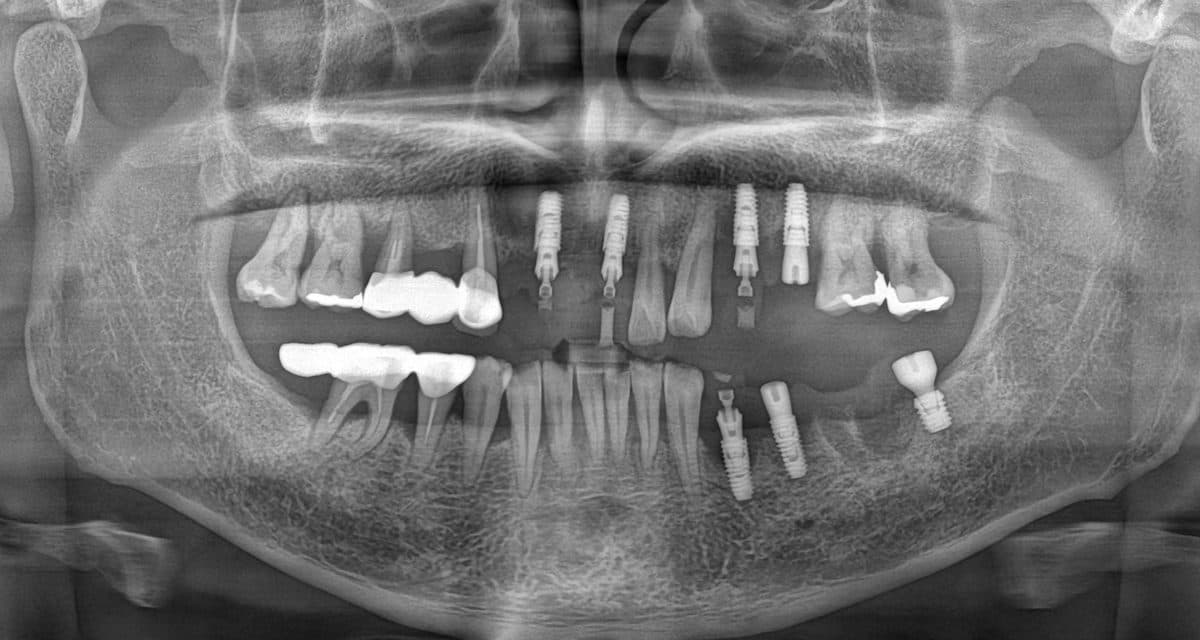
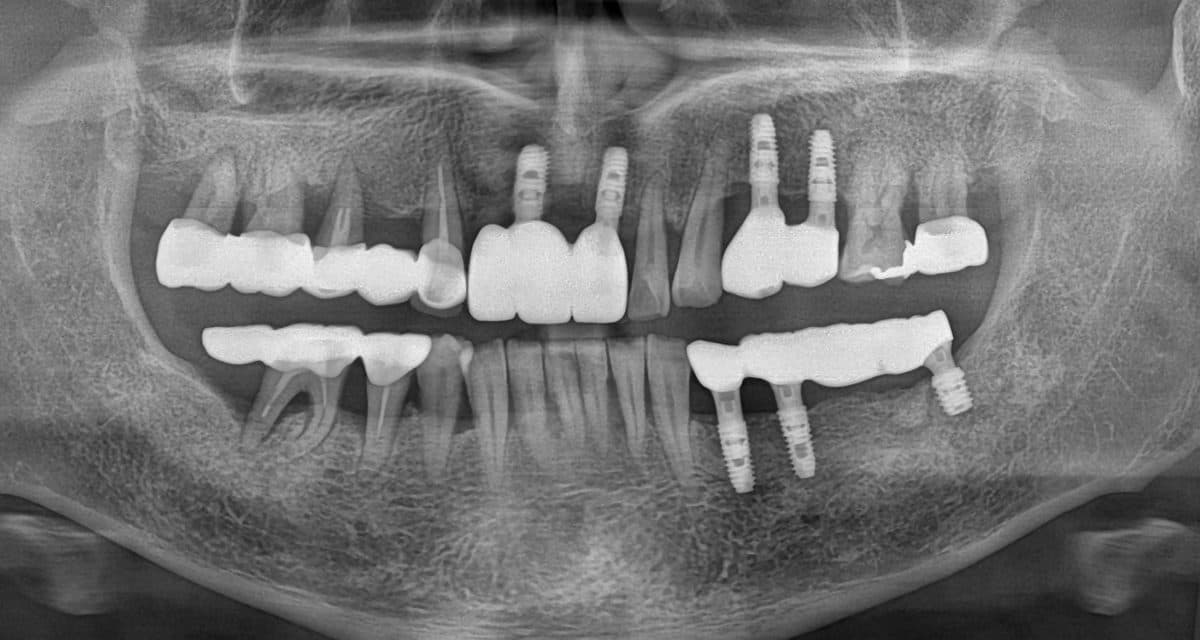
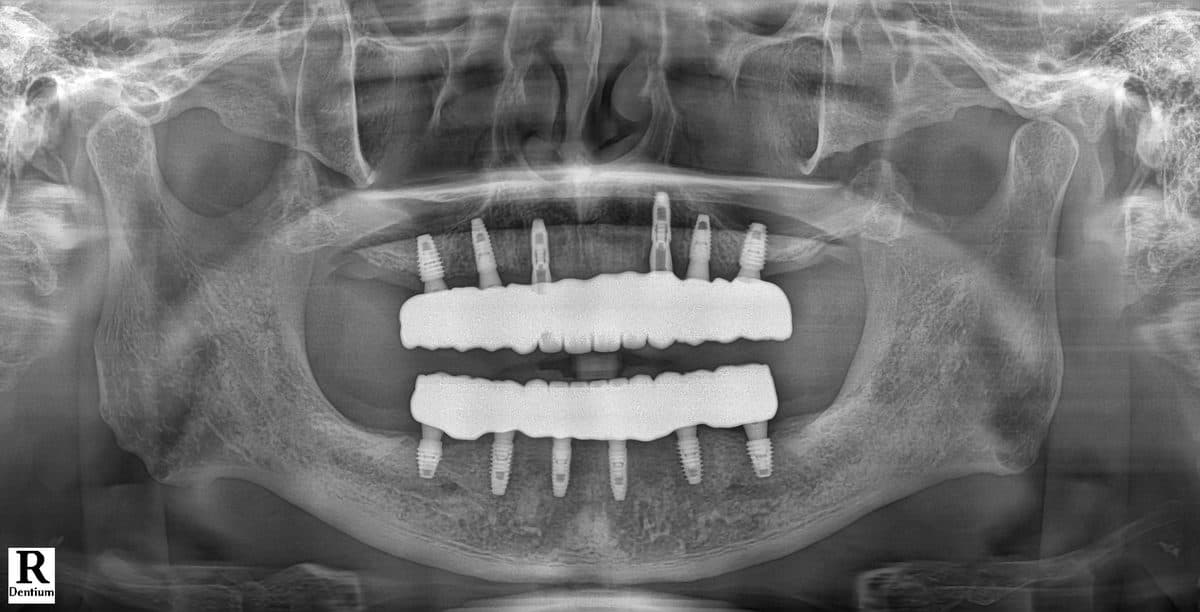
Real Blanche Dental cases, published with the patients' consent. The surgical method, including whether a guide was used, differs from case to case. Swelling, bruising, pain or temporary changes in sensation may occur after surgery, and recovery time and results vary from person to person.
Digital implant prices
Implant prices are per implant and include the 3D CT, abutment, zirconia crown and same-day temporary front tooth. All three brands come with a 2-year warranty that includes the crown.
- The implant price includes the 3D CT, abutment, a zirconia crown made at Blanche Lab, our in-house lab, and a temporary tooth on the day of front tooth surgery.
- Bone grafts and sinus lifts are added only when the 3D CT shows they are needed.
- Learn more: Straumann Implants · Full-Arch Implants (All-on-X)
- Prices for all treatments are on our full price list.
When comparing quotes, first check whether the crown, CT and bone graft are included. Every explanation is repeated at least four times, so you can make your decision at home.


Dr. Taehyung Kim and Dr. Hayoung Kim
perform the surgery themselves
Blanche implant surgery is performed by Dr. Taehyung Kim, Chief Dentist, and Dr. Hayoung Kim. The dentist who performs the surgery takes responsibility for the plan you heard at the consultation. Both dentists can treat patients in English.
- Dr. Taehyung Kim, Chief Dentist · Seoul National University College of Dentistry and School of Dentistry graduate, Master of Dental Science, Seoul National University
- Training at Columbia and UCLA dental hospitals, USA
- Advisor to SBS 'Dr. Oh's Clinic' and the YouTube channel 'Doctor Friends'
- The clinic that placed the most Straumann BLX implants in Gangnam in 2024
- Invited to the 70th anniversary event of the Embassy of Switzerland in Korea
Common questions about digital guided implants
What are digital implants and surgical guides?
Are navigation implants and guided implants the same thing?
Does Blanche use a guide for every implant?
Does a guide eliminate error?
What happens if the guide doesn't fit?
Does digital guided surgery make flapless implants possible?
Are guided implants less painful, with less swelling?
I was told the site is close to a nerve. Can I still get an implant?
Can I have guided surgery if my bone is insufficient?
How much do digital implants cost?
Is there a separate fee for the digital guide?
Do you use a scan instead of impressions?
How long does treatment take, and how many visits are needed?
If a front tooth is placed with a guide, will I have a gap that day?
Is there a warranty?
Can I get guided implants if I live abroad?
Reviewed by Dr. Taehyung Kim, Chief Dentist (Seoul National University School of Dentistry graduate, Master of Dental Science; training at Columbia and UCLA dental hospitals, USA) · Last updated
Blanche Dental Clinic, Nonhyeon Station, Gangnam
A 30-second walk from Exit 4 of Nonhyeon Station, on Gangnam-daero.
Subway
Address
Phone
Hours
Whether your site needs a guide,
we decide together from the CT
Send us a recent panoramic X-ray or CT if you have one, or photos of your mouth if not. A dentist will review them personally and reply.
Send us a front photo and a smiling photo — a dentist will review them and reply.
Chat on WhatsAppCall +82-1877-2882