
Choosing a veneers shade is the moment almost every consultation reaches. A chart comes out, a row of ceramic tabs is held against your teeth, and you are asked to pick one.
Choosing a veneers shade is the moment almost every consultation reaches. A chart comes out, a row of ceramic tabs is held against your teeth, and you are asked to pick one.
Most patients point at the brightest tab and hope for the best. A few say “whatever looks natural” and leave the decision to the dentist.
Neither approach uses the information the chart is actually giving you. The codes on those tabs are not a simple brightness ranking.
This article explains how a veneers shade guide is organised, what A1, B1 and BL really describe, and which four things decide whether the number you choose still looks right in five years.
The chart most clinics use is arranged in four families, each identified by a letter. The letter describes the undertone, and the number describes how strong that undertone is.
This is the part that surprises people. A1 and B1 are not two steps on the same ladder — they are two different colours that happen to be similarly bright.
Think of it like paint chips at a hardware store. “Warm white” and “cool white” can be equally light, but one has yellow in it and the other does not.
| Family | Undertone | Typical range | Who it usually suits |
|---|---|---|---|
| A | Reddish-brown, warm | A1 to A4 | The most common natural tooth family |
| B | Reddish-yellow | B1 to B4 | Patients wanting brightness with warmth retained |
| C | Grey | C1 to C4 | Often seen in older teeth, rarely chosen for veneers |
| D | Reddish-grey | D2 to D4 | Uncommon as a target shade |
| BL (bleach) | Very low saturation, cool | BL4 to BL1 | Patients wanting a distinctly bright result |
Within each family, a lower number means less saturation, so B1 is lighter than B4. The bleach range sits outside the classical families and runs brighter than any of them.
B1 is often described as the brightest natural shade. BL shades go further, and they are the ones that read as obviously treated in photographs.
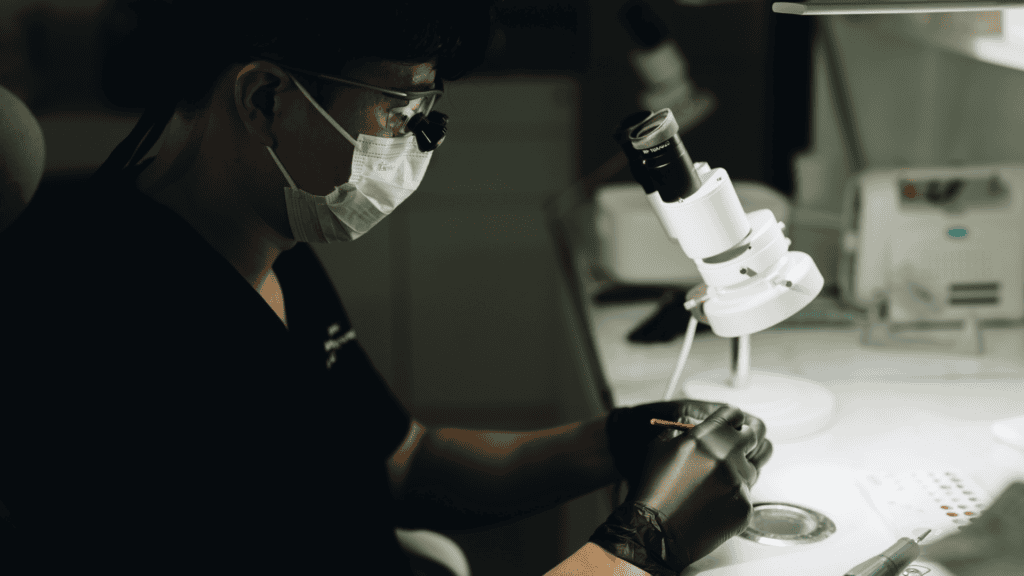
A veneers shade code describes colour. It does not describe translucency, and translucency is what makes enamel look alive.
Natural teeth let light pass into the surface and scatter before it comes back out. The biting edge is more translucent than the neck, which is why real teeth look slightly grey-blue at the tip.
The brightest shades are the most opaque ones. Push far into the bleach range and you gain whiteness but lose that depth, which is why very white veneers can look flat under a camera flash.
That trade-off is worth stating plainly before you choose. A slightly less bright shade with good translucency often reads as brighter in daily life than a flat, opaque white.
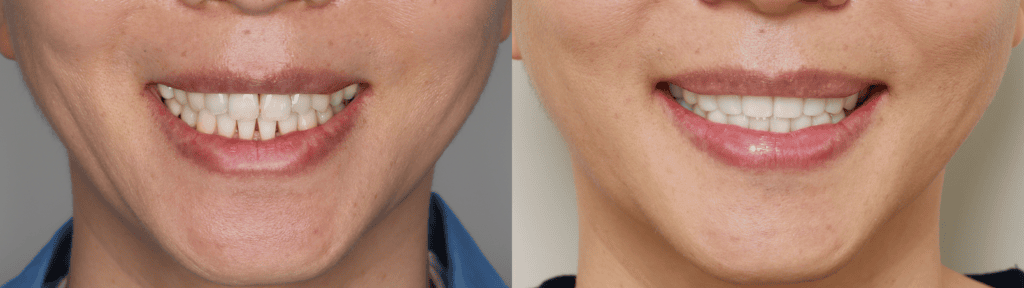
If only the front four are being restored, the shade has to blend with the canines and premolars beside them. That constrains the choice considerably.
When ten teeth are treated, the reference point moves outward to the lower teeth and the whole smile can shift brighter without a visible step.
A veneer is thin, so the colour underneath shows through. A tooth darkened by a root canal will pull a bright shade downward unless the ceramic is made more opaque or the base is masked first.
This is why two people choosing the same code can end up with visibly different results. The number on the tab is a target, not a guarantee.
Teeth are never seen in isolation. They are read against lips, skin and the sclera of the eye.
A useful reference point is to hold the shade tab near the eye. When teeth are noticeably brighter than the whites of the eyes, the result tends to read as artificial to observers even if they cannot say why.
Porcelain holds its colour. Your remaining natural teeth do not, and they darken gradually over the years.
Choosing a very bright shade for four front teeth means the contrast with your untreated teeth widens over time. Planning for that gap is part of the decision, not an afterthought. Realistic timelines are covered in how long veneers last.
Shade selection happens before preparation, not after. Once teeth have been prepared they dehydrate slightly and appear lighter, which makes any tab held against them misleading.
Lighting matters too. Ask to check the tab by a window as well as under the clinic light, because ceramic and enamel can match under one light source and separate under another.
If any whitening is planned for your untreated teeth, it is done first. The veneers are then matched to the whitened result, since porcelain cannot be lightened afterwards.
The full clinical sequence is set out in our guide to the veneers process, step by step.
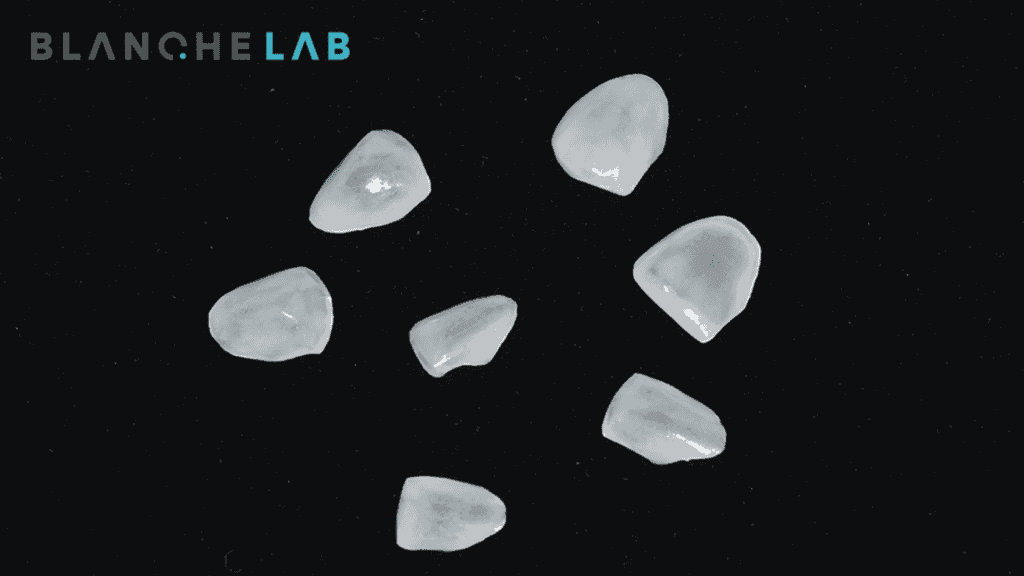
Shade is one of the few parts of dentistry that a written instruction cannot fully carry. A note saying “A1” tells a technician the target but nothing about how the light behaves on your particular teeth.
Our laboratory, Blanche Lab, is inside the clinic in Nonhyeon, Gangnam. The technician sees your face, not a photograph and a code.
That also means adjustments happen the same day rather than across a courier route. For the full one-day programme — technology, pricing, and booking — see our One-Day Veneers page.
One-day treatment is priced above the staged route, because compressing diagnosis, design, fabrication and adjustment into a single day places the dentist and the in-house lab team on your case for that whole day.
Our pricing is identical for Korean and international patients, with no foreigner surcharge. A per-tooth breakdown is in our veneers cost guide for Seoul.
One thing worth knowing when quotes differ: the bonding system is part of the price. We use the Ivoclar adhesive system, which sits at the top of the range for dental adhesives and is chosen for biocompatibility and for colour stability at the margin, where discolouration shows first.
Patients who arrive asking for the brightest available shade often revise that choice after seeing a mock-up in daylight. The most common landing point is one or two steps back from where they started.
The opposite pattern is also common. Patients replacing older restorations frequently want brighter, because the original shade was matched to teeth that have since darkened around it.
Both are reasonable. Outcomes vary with the underlying tooth colour, the number of teeth treated and the light you are usually seen in.
Q. What is the most popular veneers shade? A. Requests cluster around BL2 to BL3 and around A1 to B1. The bleach shades read as distinctly bright, while A1 and B1 sit at the top of the natural range. Which one suits you depends on your skin tone, how many teeth are being treated, and the colour of the teeth that will remain untreated.
Q. Is A1 or B1 whiter? A. They are close in brightness but different in undertone. A1 is slightly warmer with a reddish-brown base, while B1 leans reddish-yellow and often reads marginally brighter. Comparing the two tabs against your own teeth in daylight is more reliable than comparing the codes.
Q. Can the shade be changed after veneers are made? A. Not on the finished ceramic. Porcelain colour is fixed once fired, so a change means remaking the veneers. That is why the shade is confirmed at the design stage, and why any whitening of the remaining teeth is completed beforehand.
All dental treatment carries potential side effects and varies between individuals. Temporary sensitivity, gum adaptation and a short adjustment period are common after veneer placement.
The final appearance depends on the underlying tooth colour, remaining enamel, gum condition and bite. This article is general information and does not replace an individual diagnosis.
Please seek an in-person examination for advice specific to your case.
The veneers shade conversation is the part of treatment patients remember most, and the part they most often rush.
What I have learned is that people rarely regret a shade for being too natural. The regrets I hear about are almost always in the other direction, and they surface a year later in photographs rather than on the day.
If you are planning treatment, send a photograph taken in daylight rather than under indoor lighting. That single image tells us more about the right starting point than any code on a chart.
Dr. Kim Tae-hyung (Director, Blanche Dental Clinic · Seoul National University-trained dentist)
Consultation — Blanche Dental is located between Nonhyeon and Sinnonhyeon stations in Gangnam, Seoul. For a consultation in English, message us on WhatsApp with your photos, and see our pricing page for current fees.