
Korean Celebrities Veneers: What That On-Screen Smile Actually Involves

Search for korean celebrities veneers and you will find endless before-and-after collages, but almost no explanation of what was actually done. That gap is why so many patients arrive at a consultation with a screenshot and no vocabulary.
Roughly speaking, the request is never really about one tooth. It is about a whole impression: brightness, edge line, and how much of the smile shows when someone laughs.
This article breaks that impression into the design choices behind it. You will see which parts are veneer work, which parts are lighting and camera, and what the treatment realistically involves in Seoul.
A note from Dr. Kim — Many people who land on this page share one quiet worry: what if I damage healthy teeth for nothing? It is the first question I ask myself with every patient.
Blanche began with that question: why harm a natural tooth worth more than any restoration? That is why our signature Blanche no-prep veneers follow one rule — minimal intervention, maximum beauty.
Korean Celebrities Veneers: What People Are Actually Asking For

When a patient shows me a photo, we rarely talk about the person in it. We talk about four measurable things.
- Shade — bright, but not flat white. The tooth still lets light through near the edge.
- Edge line — the curve formed by the tips of the upper front teeth, which usually follows the lower lip.
- Width ratio — how wide each front tooth looks compared with the one beside it.
- Gum display — how much gum shows at a full smile.
Only the first three are shaped by veneers. Gum display is a separate matter and sometimes needs a different approach entirely.
I should be direct about one thing. No clinic can tell you which public figure has had dental work, and I will not speculate about individuals here.
What we can do is read the design language of a photo and describe it in clinical terms. That is a far more useful starting point than a name.
Why the Photo Is Never the Whole Story
Think of a stage set. Under theatre lighting, a painted backdrop reads as marble; in daylight it reads as plywood.
Teeth behave the same way. Ring lights, editing, and camera angle all push shade and shape further than any ceramic can.
A shade that looks natural on a screen may look chalky across a dinner table. This is the most common source of disappointment I see, and it has nothing to do with the ceramic.
So we test the target shade in daylight before anything is bonded. If the goal shade only works under a ring light, it is the wrong goal.
How the Korean Celebrities Veneers Look Gets Designed
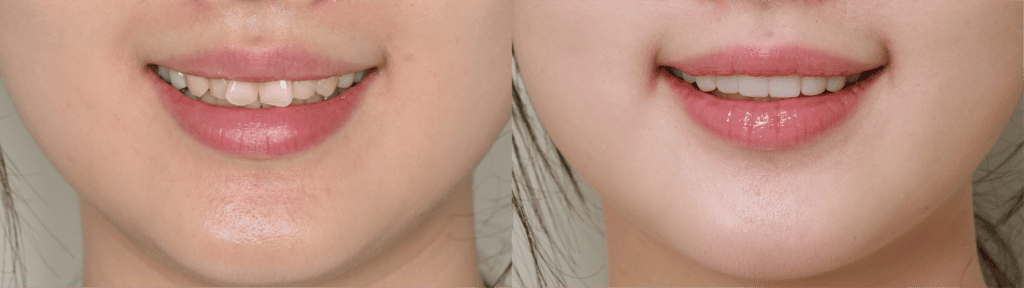
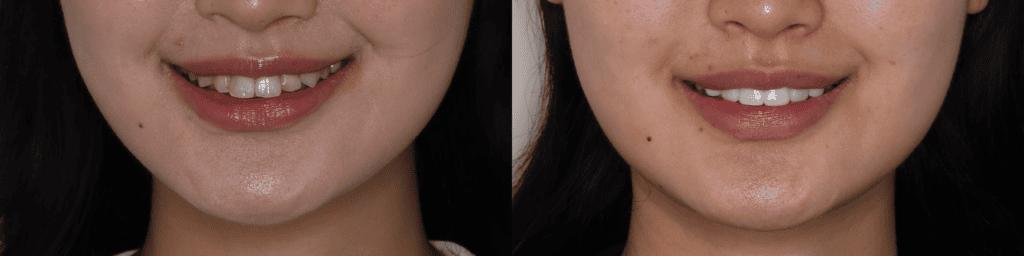
Step 1. Reading your face, not the reference
Lip length, midline, and the curve of the lower lip differ from person to person. A tooth shape that flatters one face can look heavy on another.
We measure those first, then decide how much of the reference image is even transferable.
Step 2. Previewing the shape before any preparation
A digital scan and a mock-up let you see the proposed shape on your own teeth. This is where most of the useful arguments happen.
Patients often ask for shorter or less rounded edges once they see the preview in a mirror rather than a photo.
Step 3. Deciding how much enamel to touch
Bright, uniform results on darker or crowded teeth usually need some preparation. Minimal-preparation options exist and suit certain cases well.
We cover the trade-offs in our guide to no-prep veneers in Korea.
Step 4. Choosing the material
Porcelain and composite behave differently in light transmission, stain resistance, and longevity. Our comparison of porcelain and composite veneers sets out where each one fits.
Screen Look vs Daylight Look
| Element | How it reads on camera | How it reads in person | What we design for |
|---|---|---|---|
| Shade | Lighting pushes it brighter | Yellow-grey tones return | Daylight-checked shade |
| Edge line | Angle flattens the curve | Curve is clearly visible | Follows the lower lip |
| Surface texture | Editing removes it | Texture catches light | Fine texture retained |
| Tooth width | Wide lens exaggerates | True proportion shows | Measured ratios |
Patients who bring a reference photo and accept these adjustments tend to be the happiest a year later. Those who insist on matching the screenshot exactly are the group most likely to return asking for a change.
Not sure where your case fits? Send two photos — front and smiling — on WhatsApp. We will tell you what is possible before you book any flight.
Korean Celebrities Veneers: What It Costs and How Long It Takes

Cost in Seoul depends on the number of teeth, the material, and how much design and adjustment time the case needs. Our guide to veneer costs in Korea breaks down per-tooth pricing.
Two points matter for international patients. First, our pricing is the same for local and overseas patients, with no foreigner surcharge.
Second, you can send photos before you fly so we can discuss a realistic plan and the number of visits. Our clinic sits beside Nonhyeon Station in Gangnam, about an hour from Incheon Airport by bus or taxi.
Ceramic work is made in our in-house lab, which shortens the wait between design and fitting. Longevity expectations are covered in our laminate lifespan guide.
Frequently Asked Questions About Korean Celebrities Veneers

Can I bring a photo of a Korean actor or idol to my consultation?
Yes, and it helps. We use it to identify the shade, edge line, and proportions you like, then check which of those suit your own lip line and face.
Will my teeth look obviously fake?
That usually comes from a shade chosen for camera rather than daylight, plus a surface with no texture. Both are design decisions made before bonding, so they can be avoided.
How many teeth do I need to treat?
It depends on how far your smile line extends when you laugh. Some cases need only the two central teeth, while others need four to eight for symmetry.
Side Effects and Individual Variation
Veneer treatment may involve reshaping the tooth surface. Temporary sensitivity, gum irritation, and chipping or debonding of the restoration are possible.
Results and treatment plans vary with tooth condition, gum health, bite, and habits. This article is general information and does not replace an in-person examination.
In my chair, the most useful moment is usually when a patient puts the phone down and looks in the mirror instead. The reference photo tells me what they admire; the mirror tells me what will suit them.
My job is to translate between the two, and to say clearly when part of the reference will not transfer.
If you would like that translation done properly, you are welcome to send us your photos and questions before you travel.
Written by Dr. Kim Tae-hyung, Director of Blanche Dental Clinic, Gangnam, Seoul (Seoul National University trained dentist).
What happens at your first consultation
1. We listen first — what bothers you and what you hope for. 2. We walk you through your scan results and every option.
3. You get itemized costs and timing, and you can decide later, even after you fly home. At Blanche, we explain everything at least four times, by principle.
Consultation — Blanche Dental is located between Nonhyeon and Sinnonhyeon stations in Gangnam, Seoul. For a consultation in English, message us on WhatsApp with your photos, and see our pricing page for current fees.

About the author
Dr. Kim Tae-hyung
Chief Director of Blanche Dental Clinic in Gangnam. He holds an M.S. from Seoul National University and trained at the Columbia and UCLA dental hospitals.
He advises SBS “Dr. Oh’s Clinic” and YouTube “Doctor Friends,” and is a Clinical Instructor at Ginza Shirayuri Dental Clinic in Tokyo. His rule of practice: minimal intervention, maximum beauty.