
Porcelain vs Composite Veneers in Korea: Cost, Lifespan, and How to Choose (2026)

Porcelain vs composite veneers — if you are comparing the two in Korea, you are at the fork in the road. It decides your budget, your timeline in Seoul, and how your smile looks in five years. Both are legitimate treatments — but they are built for different situations, and clinics do not always explain the difference before quoting. Here is the comparison we walk every international patient through.
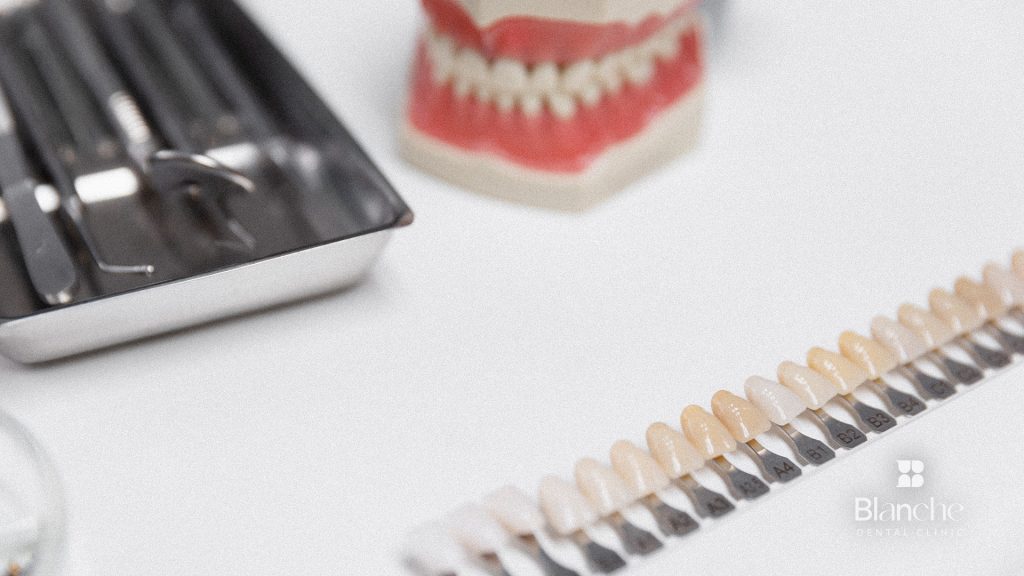
A note from Dr. Kim — Many people who land on this page share one quiet worry: what if I damage healthy teeth for nothing? It is the first question I ask myself with every patient.
Blanche began with that question: why harm a natural tooth worth more than any restoration? That is why our signature Blanche no-prep veneers follow one rule — minimal intervention, maximum beauty.
Porcelain vs Composite Veneers in 60 Seconds
Porcelain veneers (including laminate veneers) are thin ceramic shells custom-fabricated in a dental lab, then bonded to the tooth. Composite veneers are resin — the same family of material used for tooth-colored fillings — sculpted directly onto the tooth by the dentist in one sitting, or occasionally lab-made.
Porcelain is harder, more stain-resistant and more lifelike under light. Composite is cheaper, faster and easier to repair, but dulls and stains over time and rarely matches ceramic’s translucency on front teeth. That trade-off is the heart of the porcelain vs composite veneers decision.
Porcelain vs Composite Veneers in Korea: Side-by-Side
| Porcelain (laminate) veneer | Composite veneer | |
|---|---|---|
| Typical Seoul price per tooth | ₩300,000–₩900,000 | ₩100,000–₩350,000 |
| Typical lifespan | 10+ years with care | 3–7 years |
| Stain resistance | High | Low — dulls with coffee, wine, smoking |
| Repair | Usually replace the veneer | Easy chairside repair |
| Chair time in Korea | Same-day possible with in-house lab | Single visit |
| Enamel removal | None to ~0.7 mm depending on technique | Minimal to none |
Prices vary widely by clinic and case — our full pricing guide, Veneers Korea Cost: What You Really Pay Per Tooth in Seoul, explains what drives the ranges.

When Porcelain Veneers Make Sense in Korea
If you are flying to Seoul specifically for your smile, porcelain is almost always what you came for: it photographs naturally, resists staining for years, and — the part that surprises many patients — no longer requires a two-week wait. At clinics with an in-house lab, laminate veneers can be fabricated and bonded the same day; the workflow is detailed in One Day Veneers in Korea: How Same-Day Treatment Works.
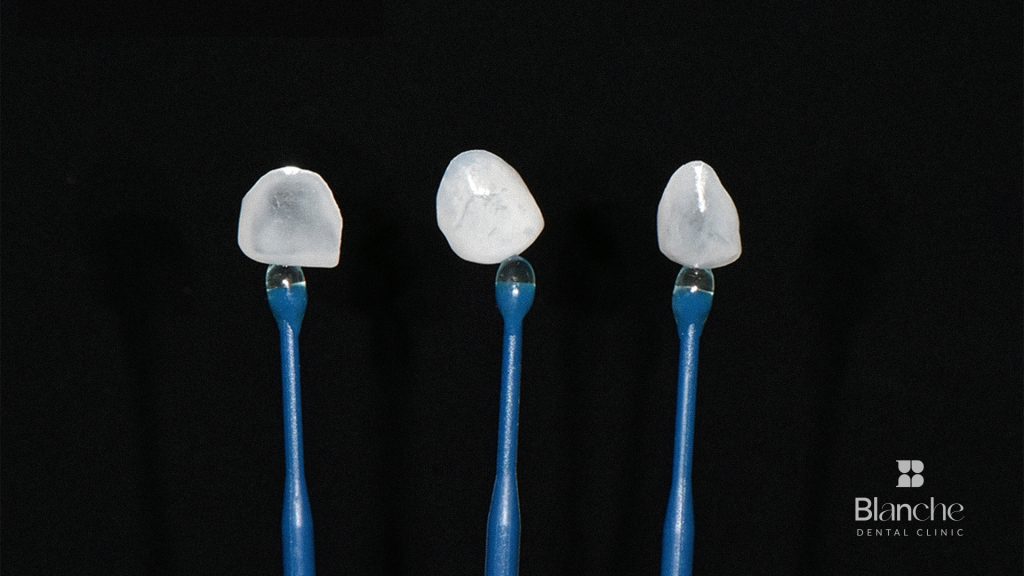
The Korean “ultra-thin laminate” difference
Much of what is searched as “Korean thin veneers” refers to no-prep or minimal-prep laminates around 0.2–0.3 mm thick, bonded with little or no enamel removal. On the right case — small, gapped or inward-positioned teeth — this preserves your natural tooth while delivering ceramic aesthetics. Eligibility depends on your exam and scan.
When Composite Makes Sense
Composite is a reasonable choice for a single chipped edge, a trial of a new shape before committing to ceramic, younger patients whose teeth are still changing, or a strict budget. Go in with realistic expectations: plan for polishing touch-ups, and expect earlier replacement — especially if you drink coffee or red wine daily.
Porcelain vs Composite Veneers: A 5-Point Checklist
- Is this a long-term investment in your front teeth, or a short-term fix? Long-term favors porcelain.
- How many teeth are involved? Full smile-line cases usually justify ceramic; a single chip may not.
- Do you drink coffee, tea or wine daily? Composite will show it within a couple of years.
- How much time do you have in Korea? Both can be single-visit — porcelain only if the clinic has an in-house lab.
- Has the dentist examined your bite and enamel, and offered you both options with reasons — not just the more expensive one?

Not sure where your case fits? Send two photos — front and smiling — on WhatsApp. We will tell you what is possible before you book any flight.
Comparing Options for Your Trip to Seoul?
Blanche Dental Clinic in Gangnam focuses on no-prep and minimal-prep porcelain laminates fabricated at our in-house lab, Blanche Lab, with over 30,000 accumulated laminate cases. We are a government-registered institution for international patients, open Sundays, one minute from Nonhyeon Station Exit 4 (7F, B722 Building, 531 Gangnam-daero, Seocho-gu, Seoul). English consultations: +82-1877-2882 or blanche.kr/en.
Frequently Asked Questions
Which is better for front teeth, porcelain or composite?
For visible front teeth where translucency and stain resistance matter, porcelain generally ages better. Composite can still be appropriate for small repairs or budget-first situations.
Can composite veneers be upgraded to porcelain later?
Usually yes. Composite is often removable without additional enamel loss, which is why some patients use it as an interim step. Confirm with your dentist based on how the composite was placed.
Why is porcelain more expensive in Korea?
Ceramic work involves lab fabrication by a ceramist, higher material costs and more precise bonding. In-house labs shorten the timeline but the craftsmanship cost remains.
Do porcelain veneers stain at all?
Glazed ceramic itself resists staining well; the bonding margins can discolor over many years, which is one reason margin precision and regular checkups matter.
Can I get porcelain veneers in one day in Korea?
Suitable cases can be completed in a single day at clinics with an in-house lab. Complex cases may still need two visits — this is confirmed at your exam and scan.
This column was medically reviewed by the dental specialists of Blanche Dental Clinic (Dr. Taehyung Kim, DDS, Seoul National University). Treatment outcomes vary by individual, and both porcelain and composite veneers carry potential side effects such as sensitivity, chipping or debonding.
What happens at your first consultation
1. We listen first — what bothers you and what you hope for. 2. We walk you through your scan results and every option.
3. You get itemized costs and timing, and you can decide later, even after you fly home. At Blanche, we explain everything at least four times, by principle.
Consultation — Blanche Dental is located between Nonhyeon and Sinnonhyeon stations in Gangnam, Seoul. For a consultation in English, message us on WhatsApp with your photos, and see our pricing page for current fees.

About the author
Dr. Kim Tae-hyung
Chief Director of Blanche Dental Clinic in Gangnam. He holds an M.S. from Seoul National University and trained at the Columbia and UCLA dental hospitals.
He advises SBS “Dr. Oh’s Clinic” and YouTube “Doctor Friends,” and is a Clinical Instructor at Ginza Shirayuri Dental Clinic in Tokyo. His rule of practice: minimal intervention, maximum beauty.