
Zirconia Veneers Pros and Cons: An Honest Look From a Seoul Dentist
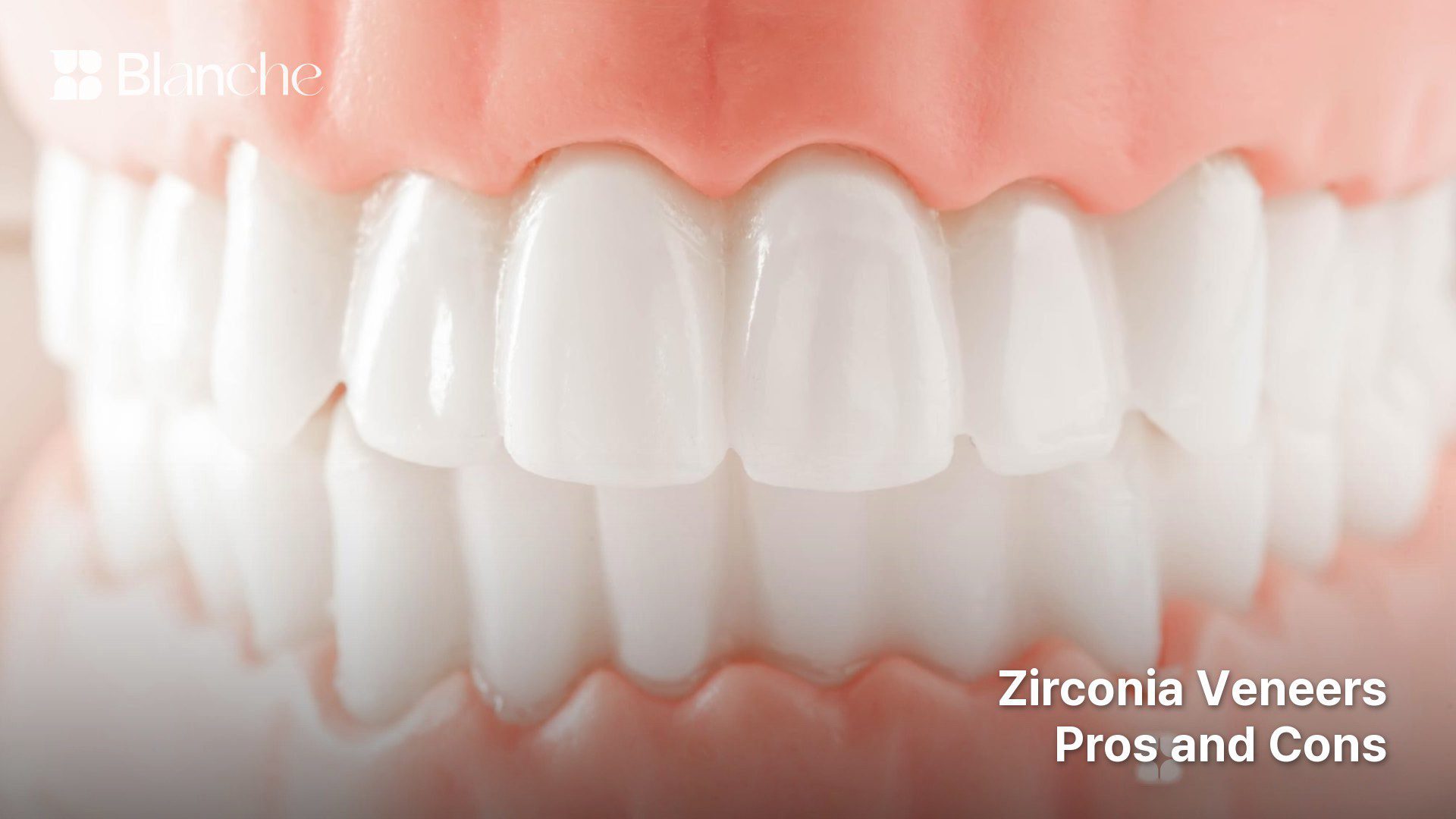
If you are reading about zirconia veneers pros and cons, you have probably met two opposite stories. One says zirconia is close to indestructible. The other says it always looks flat and opaque.
The worry behind the search is not really about chemistry. You want to know which choice you will regret less, five or ten years from now.
So here is an honest list, a few cases where a full crown may fit better, and how Blanche (BLANCHE), the treatment we do in Gangnam, compares.
A note from Dr. Kim
I understand wanting a straight answer before you trust any material with your front teeth.
Why damage a tooth worth more than you can price? Blanche started from that question.
That answer is Blanche, Front Tooth Reinforcement Therapy.
Zirconia veneers pros and cons at a glance
Zirconia is a dense, crystal-based ceramic. In dentistry it is widely used for crowns, bridges and implant crowns. As a thin piece on a front tooth, it brings real strengths and some trade-offs.
The table below sums up zirconia veneers pros and cons in general. Products differ, so your dentist should name the exact type.
| Pros (in general) | Cons (in general) |
|---|---|
| Very high fracture resistance | Often more opaque than glass-based ceramics |
| Can hide dark tooth color underneath | Usually needs some thickness, which can mean more shaving |
| Contains no metal, so no grey edge | Cannot be etched like glass ceramics; it needs its own bonding protocol |
| Handles heavy chewing loads | More translucent types generally give up some strength |
| A proven choice for crowns and implant teeth | A solid block leaves less room for hand-layered shade detail |
The pros, explained
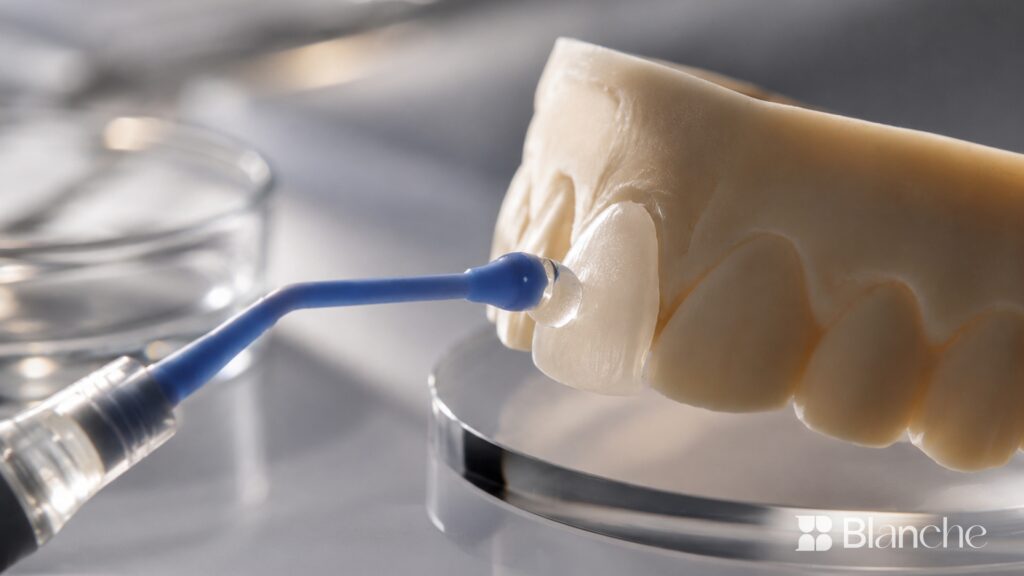
Fracture resistance
Zirconia’s main advantage is how hard it is to break. That is why it is a common choice where chewing forces are high, such as back teeth and implant crowns.
Masking color
Because it lets less light through, zirconia can cover a dark tooth underneath. For some heavily discolored teeth, that helps.
No metal
Zirconia contains no metal. So there is no grey line showing through at the gumline, which older metal-based crowns sometimes had.
The cons, explained
A flatter look on some types
Front teeth have slightly see-through edges. A dense material can look a little flat next to natural enamel, although newer zirconia types let more light through.
Think of frosted glass and clear glass in a window. Both are glass, but only one lets you watch the light change through the day.
Thickness and shaving
Zirconia generally needs some thickness to work well. On a front tooth, making room for that thickness can mean shaving more enamel, and enamel does not grow back.
Bonding
Glass-based ceramics can be etched so the adhesive grips them closely. Zirconia cannot be etched the same way, so it relies on a different protocol. It is one more thing worth asking about.
None of these zirconia veneers pros and cons is a verdict on the material. They describe how it behaves as a thin layer on a front tooth.
When a zirconia crown may fit better than a thin layer
Sometimes the honest answer is not a thin layer at all. If a tooth has lost a large part of its structure, a full crown may be the right call, and zirconia is a good material for crowns.
- A large fracture or a very large filling
- A tooth that needs full coverage after major damage
- A missing tooth replaced with an implant: our implant crowns and full-arch bridges are zirconia
Heavy grinding is a separate case, and we treat it first, before any ceramic is planned. Our post on veneers and teeth grinding explains why. For crowns, our guide to zirconia crowns in Korea covers when one is needed.
Weighing zirconia veneers pros and cons against Blanche
Blanche is not an ordinary veneer. It’s Front Tooth Reinforcement Therapy. It adds a thin layer onto the teeth you already have: a shield for chipped and worn front teeth, design for healthy ones.
Every Blanche is made by Blanche Lab from the Blanche Block, in Swiss feldspathic ceramic rather than zirconia. The reason is the job, not a ranking of materials.
Blanche goes on fully no-prep, or with minimal prep under 0.1 mm. So the material has to work as a thin layer bonded to enamel. A glass-based ceramic that can be hand-layered and etched fits that job, while zirconia fits a different one.
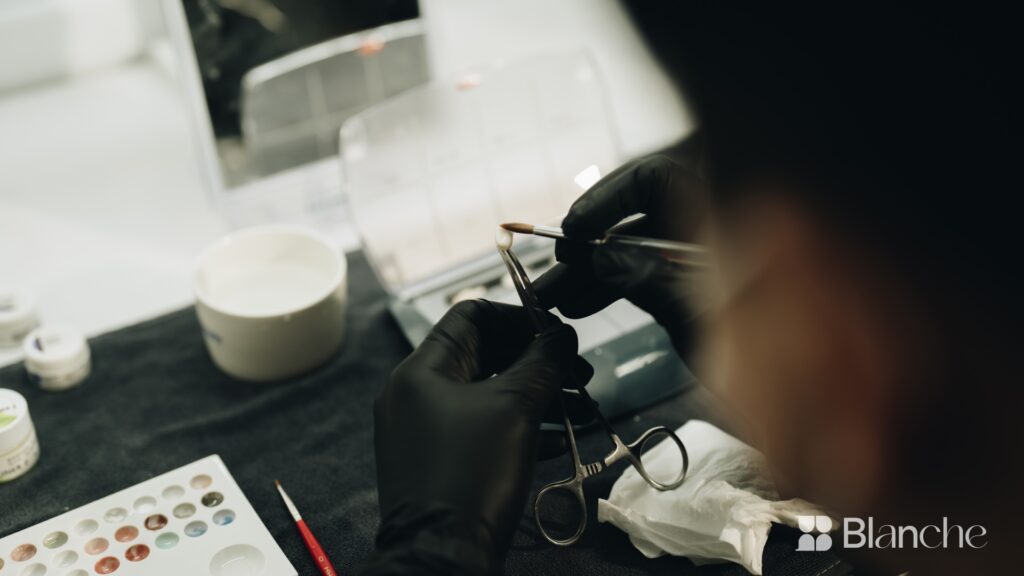
We bond Blanche with an Ivoclar adhesive system, which is biocompatible and resists edge discoloration. At PLATINUM, a senior ceramist hand-layers the ceramic and fires it at about 800°C, with advanced shade layering.
If it is ever damaged, only Blanche is replaced. Old pieces come off with a laser, with no extra shaving and no separate removal fee. Our page on Front Tooth Reinforcement Therapy explains more.
Would my teeth need a crown, or just a thin layer?
Send us just two photos: one of your face straight on, and one smiling. We’ll tell you honestly whether a crown looks likely, or whether your teeth may need no shaving at all.
Price, warranty and planning a visit
Blanche is priced per tooth, VAT excluded. BASIC is KRW 650,000 with a 1-year warranty, PLATINUM is KRW 850,000 with 5 years, and Signature PLATINUM is KRW 1,500,000 with 10 years.
The price is the same for Korean and international patients, with no foreigner surcharge. No-prep and minimal-prep also cost the same.
We are a 30-second walk from Nonhyeon Station Exit 4 in Gangnam, about an hour from Incheon Airport. First send photos, then plan flights.
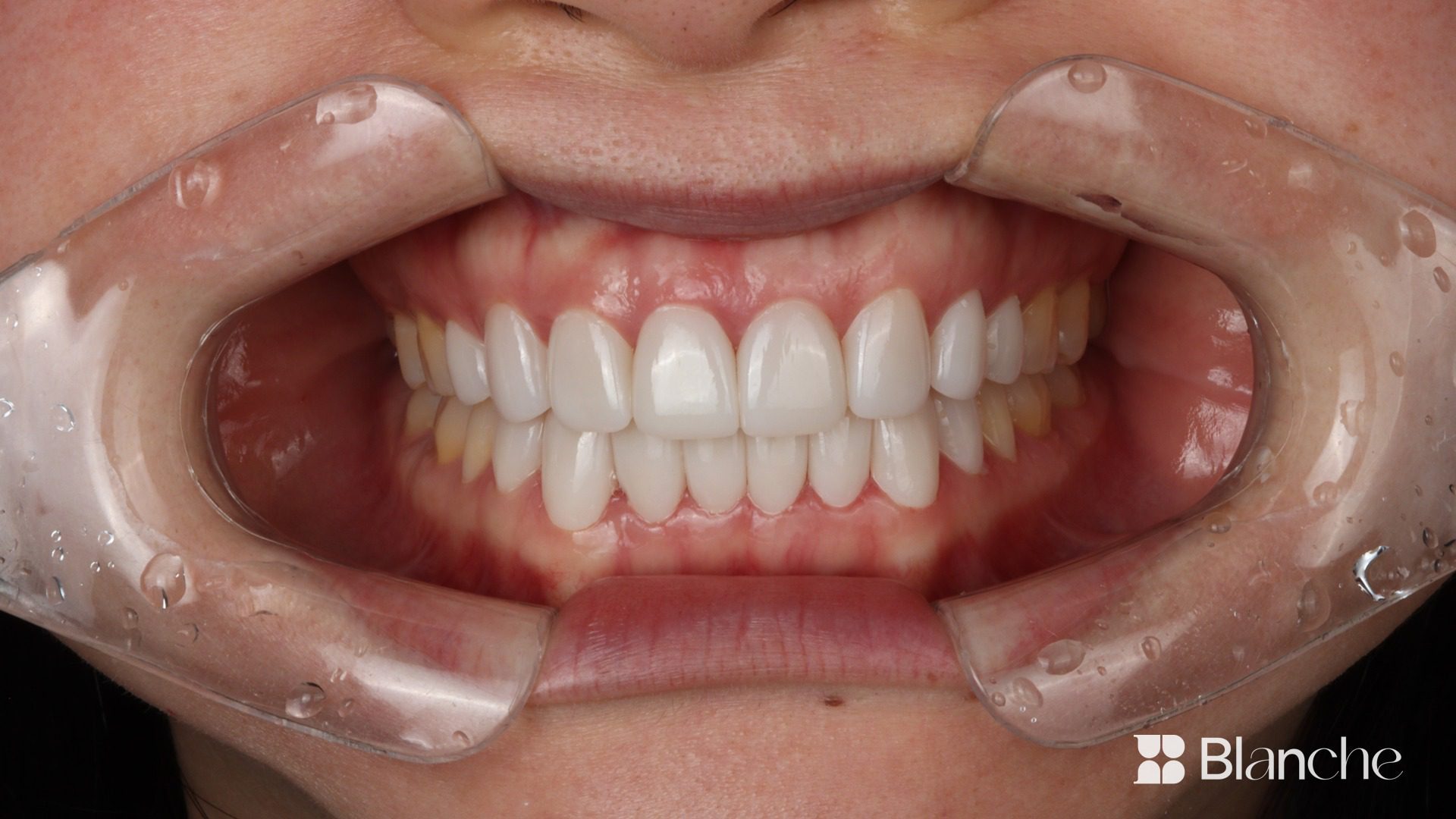
An actual case treated at Blanche Dental Clinic. Results vary with each patient’s dental condition.
Frequently asked questions
What are the main zirconia veneers pros and cons?
In general, the pros are high fracture resistance, color masking and no metal. The cons are a more opaque look on some types, the thickness it often needs, and a different bonding protocol.
Is zirconia a good material for teeth?
Yes, for crowns. We use it for implant crowns and full-arch implant bridges. The only question is whether it suits a thin layer on a front tooth.
Should a badly broken front tooth get a crown instead?
Sometimes. If a large part of the tooth is gone, a full crown may fit better. Send photos and any recent X-ray, and the exam decides.
Side effects and individual differences
Temporary sensitivity, a foreign-body feeling, or mild gum swelling can occur. Results and longevity vary with each person’s teeth and habits.
When I teach dentists, I list a material’s weaknesses as carefully as its strengths. Every ceramic has both. What matters is choosing the one that lets your own tooth stay, so your smile still works twenty years from now.
How your first consultation works
1. We listen to your concerns and the smile you want.
2. Based on your exam, we explain every available option.
3. We give itemized costs and timelines. You are welcome to decide later, at home.
We repeat every explanation at least four times, and no decision depends on one person’s judgment alone.
Consultation — Message us on WhatsApp with two smile photos, or check our pricing. Same pricing for Korean and international patients.