
Veneers in Korea vs USA: Compare the Quote, the Lab, and the Follow-Up, Not the Country
If you are weighing veneers in Korea vs USA, you probably have a quote from home in one tab and flights in another. Then the doubts start.
What if one quote leaves things out? What happens if a veneer chips after you are back home? And the question people rarely say out loud: “Is the savings worth a long flight?”
I will not pick a country for you. Instead, here is how to compare the two systems, line by line.
A note from Dr. Kim
I trained at Columbia and UCLA dental hospitals, so I understand why leaving a dentist you trust at home feels like a big step.
“Why damage a tooth worth more than you can price? Blanche started from that question.” It is the question behind Blanche no-prep veneers, and a fair one to ask any dentist.
Veneers in Korea vs USA: compare the system, not the country
Careful dentists and careless ones exist in every country. Many American dentists do excellent, conservative veneer work, and a Seoul address alone tells you little.
So the useful question is not “Korea or the USA?” It is “which clinic’s system?” Ask both the same questions, and write the answers down.
It is like comparing two moving companies. One quote looks lower until you notice it leaves out packing. So compare line by line, not the bottom number.
Start with two written, itemized quotes

First, ask your local dentist for a written quote. Ask for every line: exam, scans, veneers, temporaries, follow-up visits, and warranty in years.
Then ask us for the same. Our prices per tooth, VAT excluded:
- BASIC, KRW 650,000: 1-year warranty, Swiss ceramic CAD/CAM.
- PLATINUM, KRW 850,000: 5-year warranty, hand-layered Swiss ceramic.
- Signature PLATINUM, KRW 1,500,000: 10-year warranty, Dr. Kim Tae-hyung in charge.
The one-day option adds KRW 200,000 per tooth. The price is the same for Korean and international patients, with no foreigner surcharge.
Why prices differ between clinics
Bonding is one reason, in any country. For example, we use an Ivoclar adhesive system, among the highest-priced bonding systems. It resists edge discoloration.
How much tooth is removed, and who makes the veneers
Tooth removal, in millimetres
Ask every dentist for a number. At Blanche, we do only fully no-prep veneers, or minimal prep under 0.1 mm. No-prep and minimal-prep cost the same, so there is no price reason to remove more.
Small or gapped teeth usually suit no-prep. However, teeth that sit forward, large teeth, or very dark discoloration may need minimal prep. Usually there is no anesthesia and no temporaries.
Who designs them, and who makes them
Ask where the lab is. Ours, Blanche Lab, is in-house, with ceramists trained in France and Switzerland and a 3D intraoral scanner.
That set-up makes one-day veneers possible: about 4–5 hours on the day, or 5–6 hours with many teeth.
Veneers in Korea vs USA: questions to ask both clinics

| Question | Why it matters | Our answer at Blanche |
|---|---|---|
| Can I have the quote in writing, line by line? | Missing lines change the total | Yes; itemized costs and timelines |
| How many millimetres will you remove? | Enamel does not grow back | None, or under 0.1 mm |
| Who designs and makes the veneers? | Affects timing and fine adjustment | Our dentists with in-house Blanche Lab |
| Is a one-day option available? | Sets how long you stay | Yes, for any case; plus KRW 200,000 per tooth |
| What is the warranty, in years? | Shows what the clinic stands behind | 1, 5 or 10 years by tier |
| What if one comes off after I fly home? | The worry you will have later | Keep it and bring it; if unbroken, re-bonding may be possible |
| Do foreign patients pay more? | Hidden surcharges | No; same pricing for everyone |
Follow-up after you fly home
This is the honest weak point of any treatment abroad. Your local dentist is a drive away; we are a long flight away. So plan for it.
First, we recommend one follow-up check after the treatment day, before you leave Seoul. Second, if a veneer comes off, keep it and bring it. If it is not broken, re-bonding may be possible.
If one ever needs redoing, we remove it with a laser, with no extra shaving and no separate removal fee. Revision costs the same as new treatment and can be done in one day. Our guide to veneer warranty after flying home covers the details.
Veneers are not something you must replace every few years. With proper care and check-ups, they can last over 10 years, or 20–30 years or more, depending on care.
“Would my teeth even need shaving?”
Send us just two photos: one of your face straight on, and one smiling. We will tell you whether no-prep looks realistic for you, so you can compare quotes before you book a flight.
Is the savings worth a long flight?
This is the question under the whole comparison. A lower per-tooth price only counts as a saving if it survives the whole trip.
So when you compare veneers in Korea vs USA, add up the Seoul side honestly: the treatment quote, flights, a hotel, meals, and days off work. Then set it beside your written local quote. If the gap is small, staying home may suit you better. That is a perfectly good answer.
Because the flight is long, we keep the stay short. We are a 30-second walk from Nonhyeon Station Exit 4 in Gangnam, about an hour from Incheon Airport. Plan 2–3 days in Seoul: the treatment day plus one follow-up check.
For the full one-day program — technology, pricing, and booking — see our One-Day Veneers page. Our article on where the saving in Korea is real goes further.
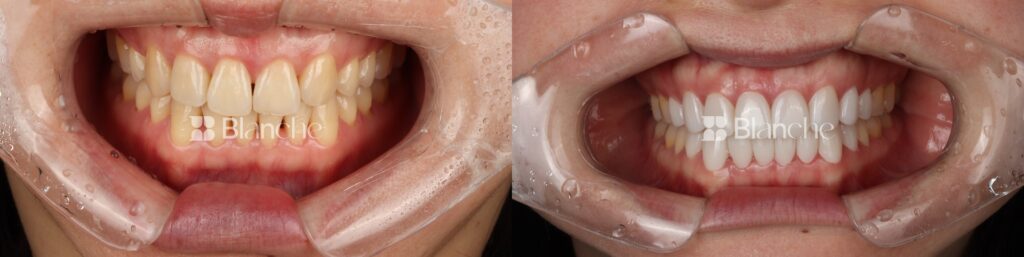
An actual case treated at Blanche Dental Clinic. Results vary with each patient’s dental condition.
Frequently asked questions
Are veneers in Korea vs USA really cheaper?
It depends on your own numbers. Get a written, itemized local quote, then compare it with our per-tooth price plus flights, a hotel and 2–3 days in Seoul.
What happens if a veneer has a problem after I fly home?
Keep it and bring it; if it is not broken, re-bonding may be possible. The warranty runs 1, 5 or 10 years by tier, and revision costs the same as new treatment.
How many days do I need in Seoul for veneers?
Plan 2–3 days. One-day treatment takes about 4–5 hours, or 5–6 hours with many teeth, and we recommend one follow-up check afterwards.
Side effects and individual differences
Temporary sensitivity, a foreign-body feeling, or mild gum swelling can occur. Results and longevity vary with each person’s teeth and habits.
When I lecture to dentists, I repeat one idea: the enamel we leave untouched is the enamel the patient needs later. Wherever you go, choose a dentist who thinks that way, for a smile that still works twenty years from now.
How your first consultation works
1. We listen to your concerns and the smile you want.
2. Based on your exam, we explain every available option.
3. We give itemized costs and timelines. You are welcome to decide later, at home.
We repeat every explanation at least four times, and no decision depends on one person’s judgment alone.
Consultation — Message us on WhatsApp with two smile photos, or check our pricing. Same pricing for Korean and international patients.