
Smoking and Dental Implants Korea: Can You Still Have One?
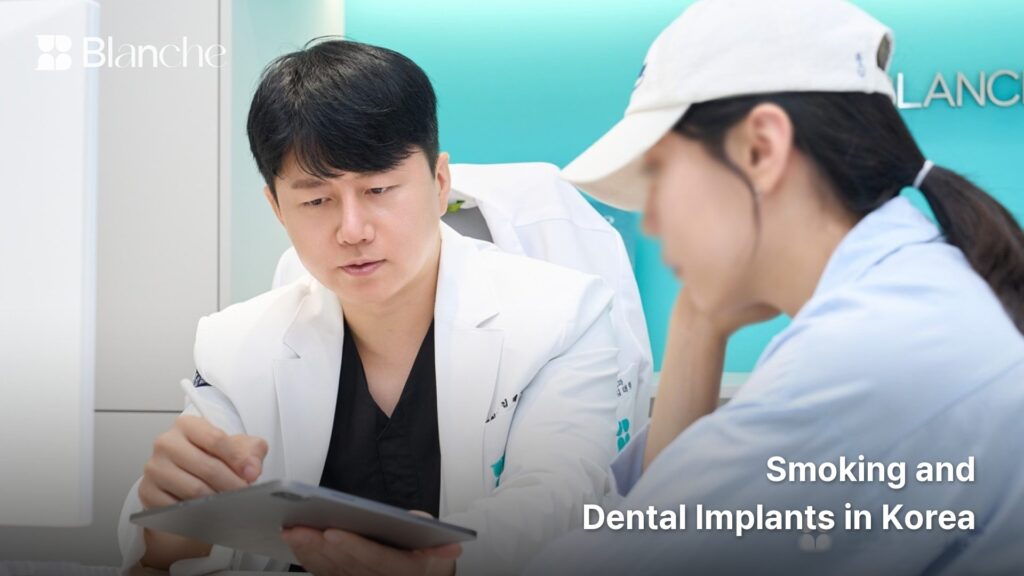
If you searched smoking and dental implants Korea, there is probably a question behind it that feels awkward to ask.
Will a clinic turn me away because I smoke? And if it doesn’t, will the implant fail anyway?
Both worries are understandable. You won’t get a lecture here. Instead, you’ll get a plain explanation of how smoking affects healing, what we ask, and how to plan your trips.
A note from Dr. Kim
I know it can feel uncomfortable to talk about smoking with a dentist, so please know you can tell me openly.
“A smile that still works twenty years from now.” Honest planning around smoking is part of that.
Smoking and dental implants Korea: the short answer
Smoking on its own does not automatically rule out an implant. However, it can affect how your gums and bone heal, so we plan with it in mind.
The real questions are how much you smoke, how healthy your gums are, and whether you can cut down or stop around surgery.
Your own doctor is the right person to help with that last part. Our job is to look at your mouth and plan around your real situation.
How smoking can affect implant healing
Blood flow to the gums
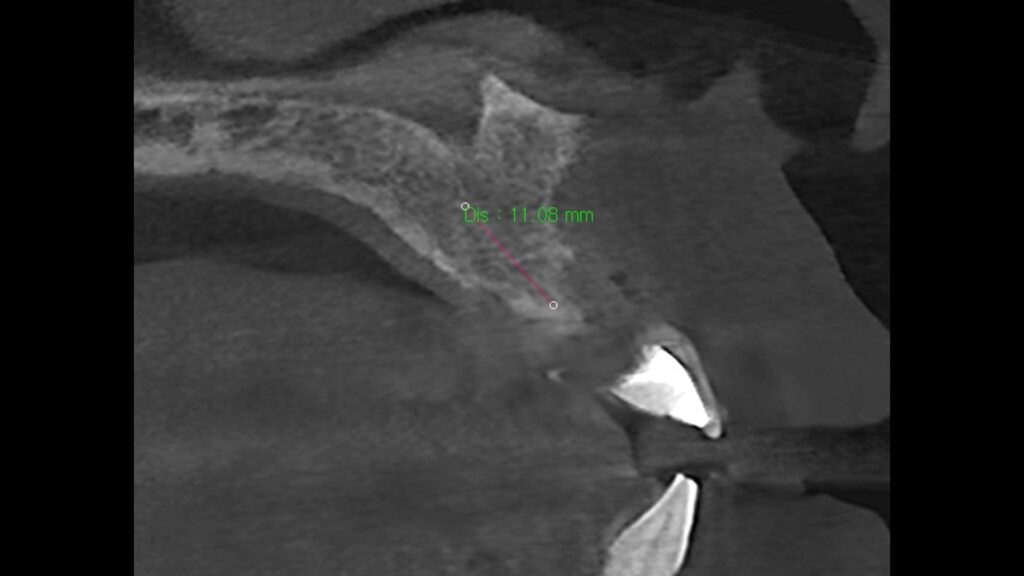
After surgery, bone slowly grows onto the implant surface. Dentists call this osseointegration, and it is why the crown comes months later.
Healing tissue needs a good blood supply. Nicotine can narrow small blood vessels, and smoke brings heat and chemicals right to the wound.
Think of a garden hose watering new grass. Smoking is like stepping on the hose: water still flows, but less of it reaches the roots.
Gums around the implant, long term
Smoking is linked with gum disease. The gum and bone around an implant can become inflamed too.
Smoking can also make early warning signs, such as bleeding gums, harder to notice. That is one reason regular check-ups matter.
If your gums already need attention, see our article on dental implants with gum disease.
An implant cannot decay, but the tissue around it still needs daily care. For habits that protect it, see our guide to implant longevity and daily care.
What we ask about smoking before implant surgery
| What we ask | Why it matters |
|---|---|
| How much you smoke, and for how long | It helps us judge your gums and plan healing time |
| Vaping, heated tobacco or nicotine gum | These often contain nicotine too, so we want the full picture |
| Other health conditions and medicines | Diabetes, blood pressure and some medicines can also affect healing and sedation |
| Whether you plan to cut down or stop | It helps us talk through timing; your own doctor can help with the how |
| A recent X-ray, if you have one | It shows us your bone before you book flights |
Please answer honestly. With smoking and dental implants Korea planning, we are not keeping score; we plan around your real situation.
If you have diabetes as well, our article on dental implants for diabetics in Korea covers what to check before you fly.
Cutting down or stopping around surgery
In general, dentists advise avoiding smoking before surgery and during early healing. The first days after surgery, while the gum is closing, matter a great deal.
We won’t tell you how to quit; that conversation belongs with your own doctor. Ask them about cutting down or stopping around your surgery date, and what support would suit you.
Even a break around surgery and early healing is worth discussing. If you can’t stop, tell us anyway. We would rather know than guess.
If you choose sedation
Sedation, for anxious patients, costs KRW 400,000 per session, and a dentist administers and monitors it.
It needs 6 hours of fasting and an ECG check, and a companion is recommended. Tell us about your smoking during that check, too.
Planning smoking and dental implants Korea trips
International patients usually need 4 visits. Surgery comes first, then stitches out about a week later. A digital scan follows 4–6 months later, then the crown about a week after.
If you can stay about a week each time, that means only 2 trips to Korea. Between trips, the implant heals at home, and that is where your habits matter most.
For front teeth, a same-day temporary tooth is possible. For back teeth, no temporary tooth is placed after surgery. If a wide area is missing, we provide a temporary removable denture, billed separately.
“Would my smoking change the plan in my case?”
Send us a recent X-ray if you have one, or just two photos: one of your face straight on, and one smiling. We will tell you what we can see about your gums and bone, and what to discuss with your own doctor before you book.
What implants cost at Blanche
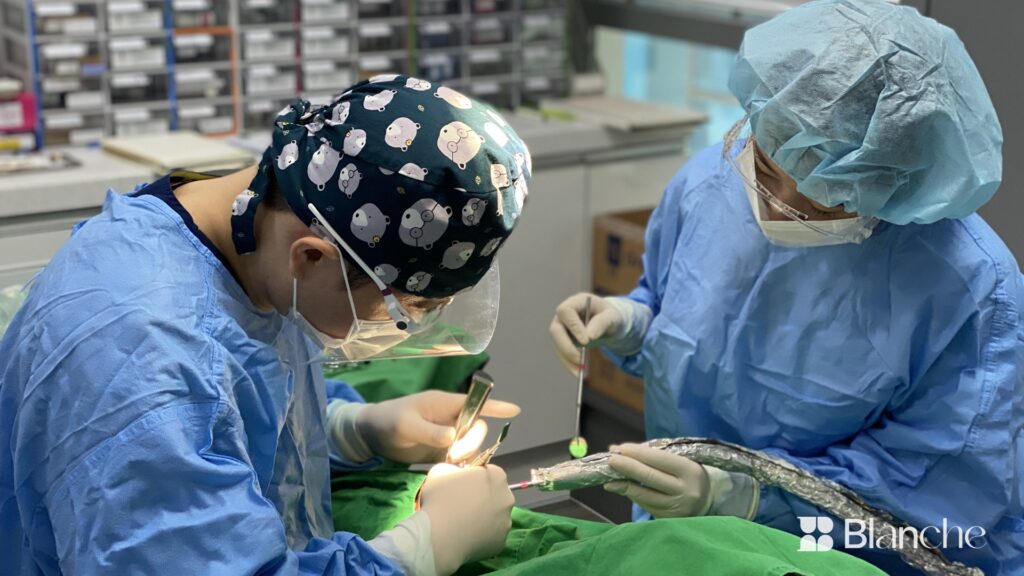
Fees per implant include the abutment and a zirconia crown: Megagen AnyOne KRW 1,000,000, Megagen BlueDiamond KRW 1,500,000, and Straumann KRW 2,300,000.
Bone grafts (KRW 300,000 simple, KRW 500,000 complex, per site) are added only if your CT shows they are needed. Korean and international patients pay the same.
We are a 30-second walk from Nonhyeon Station Exit 4, about an hour from Incheon Airport. Your implant has a 2-year warranty that covers the crown.
If a problem comes up after you return home, we help you get follow-up care in your own country.
Frequently asked questions
What should smokers know about smoking and dental implants Korea trips?
Smoking on its own does not automatically rule out an implant, but it can slow healing and affect your gums. Tell us how much you smoke, send an X-ray if you have one, and ask your own doctor about cutting down or stopping around surgery.
Can I smoke after implant surgery?
In general, dentists advise avoiding smoking while the gum and bone heal, especially in the first days. Your own doctor can help you plan how to manage that.
Does vaping count?
Please tell us about it. Many vapes contain nicotine, and the heat and vapor still reach the healing area, so we plan with the full picture.
Side effects and individual differences
Swelling, bruising, mild pain, or temporary numbness can occur after implant surgery, and healing time varies. Results and longevity depend on each person’s bone, gums, health, and habits.
When I teach other dentists, I tell them that a patient who smokes needs honest planning, not a lecture. We keep your own teeth whenever we can. When an implant is the right answer, we plan it for a smile that still works twenty years from now.
How your first consultation works
1. We listen to your concerns and what you want to be able to eat and smile with again.
2. Based on your 3D CT and exam, we explain every available option, including whether a bone graft is really needed.
3. We give itemized costs and a visit schedule. You are welcome to decide later, at home.
We repeat every explanation at least four times, and no decision depends on one person’s judgment alone.
Consultation — Message us on WhatsApp with a recent X-ray or two photos, or check our fee schedule. Same pricing for Korean and international patients.