
Dental Implants for Diabetics in Korea: What to Check Before You Fly
Dental implants for diabetics Korea: if that is what you typed, you are probably asking two things at once.
Will a clinic abroad turn me away? And if it doesn’t, will the implant fail because of my blood sugar?
Both worries are reasonable. However, diabetes on its own does not automatically rule out implants. What matters most is how well it is controlled, and how your gums and bone look.
A note from Dr. Kim
I know how tiring it is when every medical conversation starts with your sugar levels, so I will keep this practical.
“No decision depends on one person’s judgment alone.” With diabetes, that includes the doctor who already knows you at home.
Dental implants for diabetics Korea: the short answer
When blood sugar stays high, the body can heal more slowly and fight infection less well. That matters for an implant, because bone has to bond to it over months.
So the real question is: how steady has it been lately, and what does your own doctor say?
How diabetes can affect implant healing
Bone needs time to bond
After surgery, bone slowly grows onto the implant surface. Dentists call this osseointegration, and it is the reason the crown comes months later.
Think of planting a young tree. The tree is the implant, the soil is your bone, and blood sugar is the weather during the first season. In steady weather, roots take hold. In a long storm, they can struggle.
Gums and infection
Diabetes and gum disease are closely linked. Inflamed gums around an implant can affect the bone that holds it, so we check your gums carefully first.
If gum disease is active, treating it before implant surgery is generally the safer order.
What to bring to your first consultation
Before you plan dental implants for diabetics Korea trips, gather a few things.
| What to bring | Why it helps |
|---|---|
| A list of every medication you take, with doses | Some medicines affect bleeding, healing, or how you fast before sedation |
| Your most recent blood test results (including HbA1c, if you have it) | HbA1c reflects your average blood sugar over recent months, not just one morning |
| Notes on other conditions (heart, kidney, blood pressure) | These can change how surgery and sedation are planned |
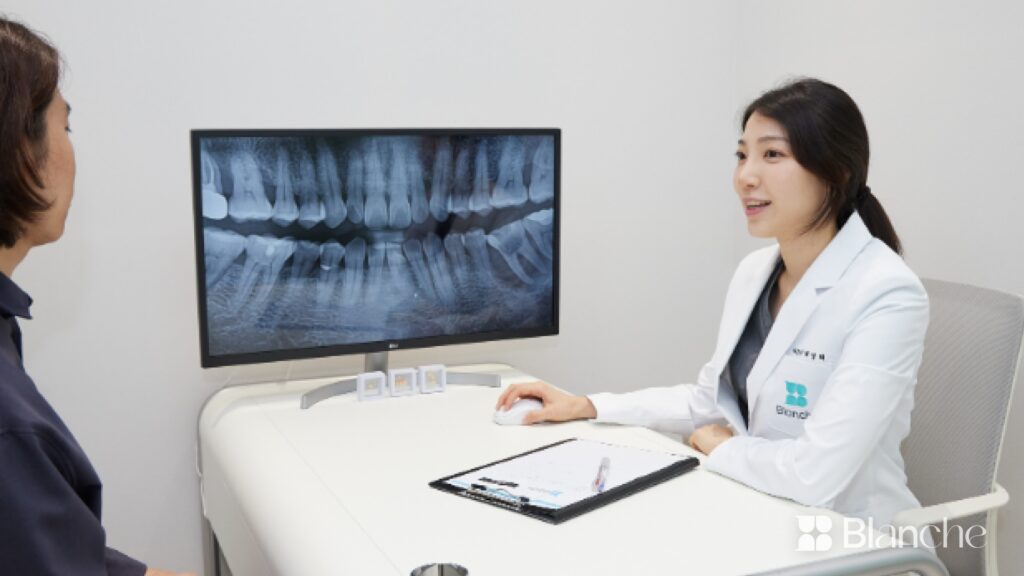
| A recent panoramic X-ray or CT, if you have one | It shows us your bone before you book flights |
Your own doctor is the right person to say whether your control is steady enough for surgery right now.
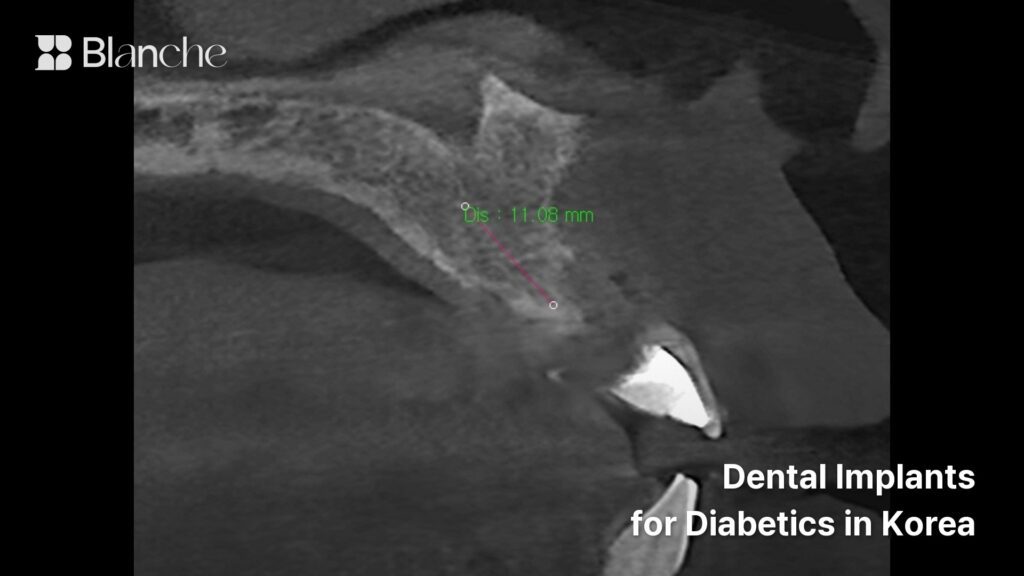
Our 3D CT in Seoul then shows the bone itself; it is included in the implant price.
Sedation, fasting and meals on surgery day
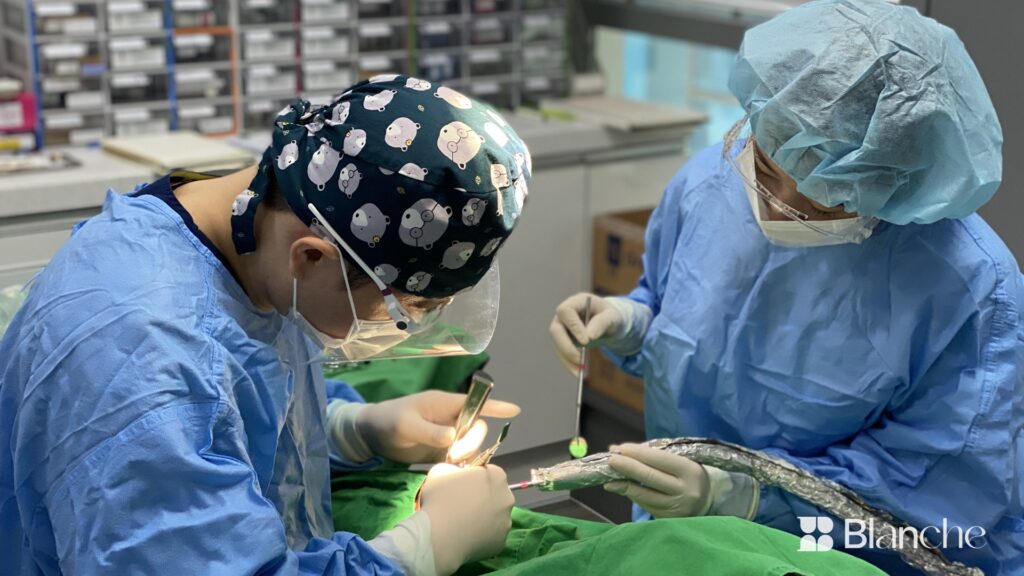
Sedation, for anxious patients, costs KRW 400,000 per session; a dentist administers and monitors it.
Sedation needs 6 hours of fasting, an ECG check, and ideally a companion. For anyone on diabetes medication, that fast needs a plan.
Some medicines can push blood sugar too low when you skip meals. So before you fly, ask your own physician how to time your meals and medication around a 6-hour fast.
On the day, tell us what you took and when you last ate, and say straight away if you feel shaky.
Afterwards, plan soft, regular meals that keep your blood sugar steady. Our guide to sedation for dental implants in Seoul covers the rest of the day.
Planning dental implants for diabetics Korea trips
For international patients, there are usually 4 visits. First comes surgery, then stitches out about a week later. A scan follows 4–6 months later, then the crown about a week after.
Staying about a week each time means only 2 trips to Korea. Between trips, the implant heals at home.
With diabetes, that home stretch matters most. Keep your usual check-ups with your own doctor, keep meals regular, and clean around the area as instructed.
For front teeth, a same-day temporary tooth is possible, so you don’t fly home with a gap. For back teeth, ask us what applies to your case.
What it costs
Fees are per implant and include the abutment and a zirconia crown: Megagen AnyOne KRW 800,000, Megagen BlueDiamond KRW 1,000,000, and Straumann KRW 2,300,000.
Bone grafts are added only if needed. Korean and international patients pay the same.
We are near Nonhyeon Station Exit 4, about an hour from Incheon Airport. Our guide to why four visits usually mean two trips shows the timing.
“Would my diabetes change the plan in my case?”
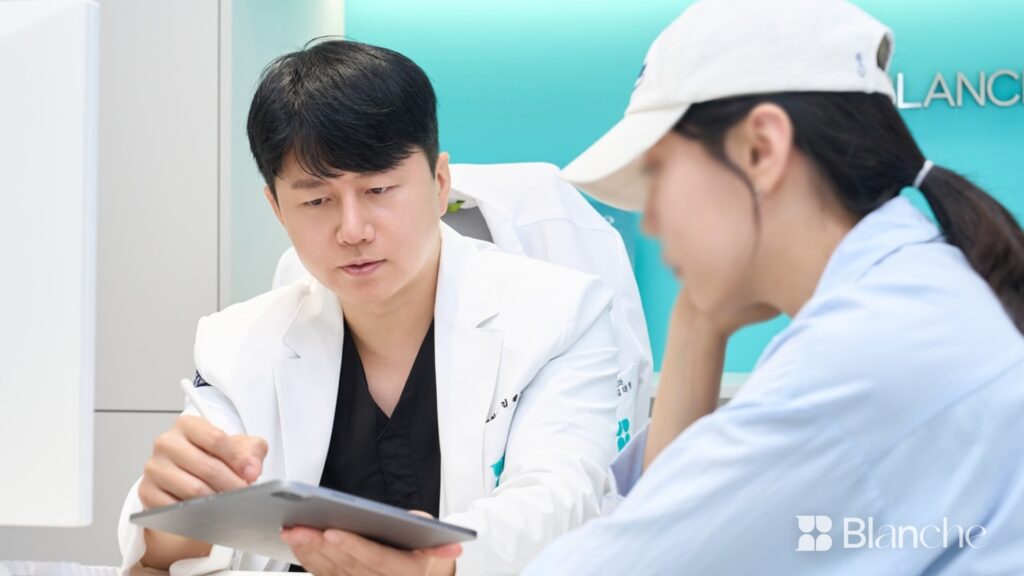
Send us a recent X-ray if you have one, or just two photos: one of your face straight on, and one smiling. We will tell you what we can see about your bone and gums, and what to ask your own doctor before you book.
Looking after an implant with diabetes, long term
An implant cannot decay, but the gum and bone around it can become inflamed. With diabetes, daily cleaning and check-ups at home matter even more.
Your implant has a 2-year warranty, the same for all three brands, and it covers the crown. If a problem comes up after you return home, we help you get follow-up care in your own country.
For daily habits, see our article on implant longevity and daily care.
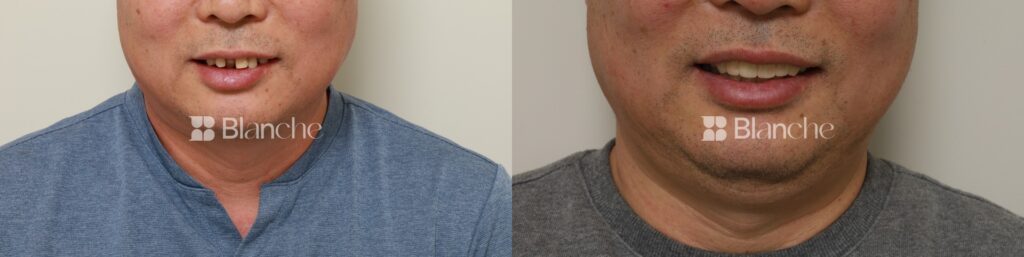
An actual case treated at Blanche Dental Clinic. Results vary with each patient’s dental condition.
Frequently asked questions
What should I know about dental implants for diabetics Korea trips?
Diabetes on its own does not automatically rule out implants; control matters most. Bring your medication list and recent test results, talk to your own doctor first, and plan meals around any sedation fasting.
Will I need a bone graft because I have diabetes?
Not because of diabetes alone. A graft depends on how much bone you have, which we check on our 3D CT. If one is needed, it is KRW 300,000 (simple) or KRW 500,000 (complex) per site.
Can I have sedation for implant surgery if I have diabetes?
Ask your own physician first. Sedation needs 6 hours of fasting and an ECG check, so your doctor should tell you how to manage meals and medication around that fast.
Side effects and individual differences
Swelling, bruising, mild pain, or temporary numbness can occur after implant surgery, and healing time varies. Results and longevity depend on each person’s bone, gums, health, and habits.
When I teach other dentists, I tell them that a patient with diabetes needs more listening, not a quick no. We keep your own teeth whenever we can. When an implant is the right answer, we plan it for a smile that still works twenty years from now.
How your first consultation works
1. We listen to your concerns and what you want to be able to eat and smile with again.
2. Based on your 3D CT and exam, we explain every available option, including whether a bone graft is really needed.
3. We give itemized costs and a visit schedule. You are welcome to decide later, at home.
We repeat every explanation at least four times, and no decision depends on one person’s judgment alone.
Consultation — Message us on WhatsApp with a recent X-ray or two photos, or check our fee schedule. Same pricing for Korean and international patients.