
Invisalign in Korea: 2026 Cost, Timeline, and What Foreign Patients Should Know

If you live in Korea — or visit often enough — you have probably heard that orthodontic treatment here costs a fraction of what it does in the U.S., with some of the highest case volumes for Invisalign in Asia. It is true, but orthodontics is not a souvenir: it is a 6–24 month medical relationship. As a board-certified orthodontist practicing in Gangnam, let me walk you through what Invisalign in Korea actually costs in 2026, how the visit schedule works if you travel, and — honestly — who should and should not start treatment here.

A note from Dr. Baek — Orthodontic treatment takes a year or more, so it is natural to hesitate before you start. I believe good treatment begins by never rushing that decision.
At Blanche, no plan rests on one person’s judgment. Specialists from several fields review each case and plan for your teeth twenty years ahead.
How Much Does Invisalign Cost in Korea? (2026)
Korean clinics price Invisalign by package tier, which corresponds to how far your teeth need to move. In the U.S., comprehensive Invisalign commonly runs $4,500–$8,000; in Seoul the same treatment is typically 30–50% less.
| Package | Typical case | Duration | Price range in Seoul |
| Invisalign Express | Minor relapse, small gaps | 3–6 months | ₩2,000,000–₩3,000,000 |
| Invisalign Lite | Mild crowding, front teeth | 6–12 months | ₩3,000,000–₩4,500,000 |
| Invisalign Comprehensive | Moderate to complex bites | 12–24 months | ₩4,500,000–₩7,000,000 |
Two pricing details matter more than the headline number. First, ask whether the quote is all-inclusive — diagnosis, attachments, refinements (additional aligner sets), and retainers can add ₩1,000,000 or more if billed separately. Second, ask what happens if your treatment needs mid-course correction; at reputable clinics refinements are included in the package.
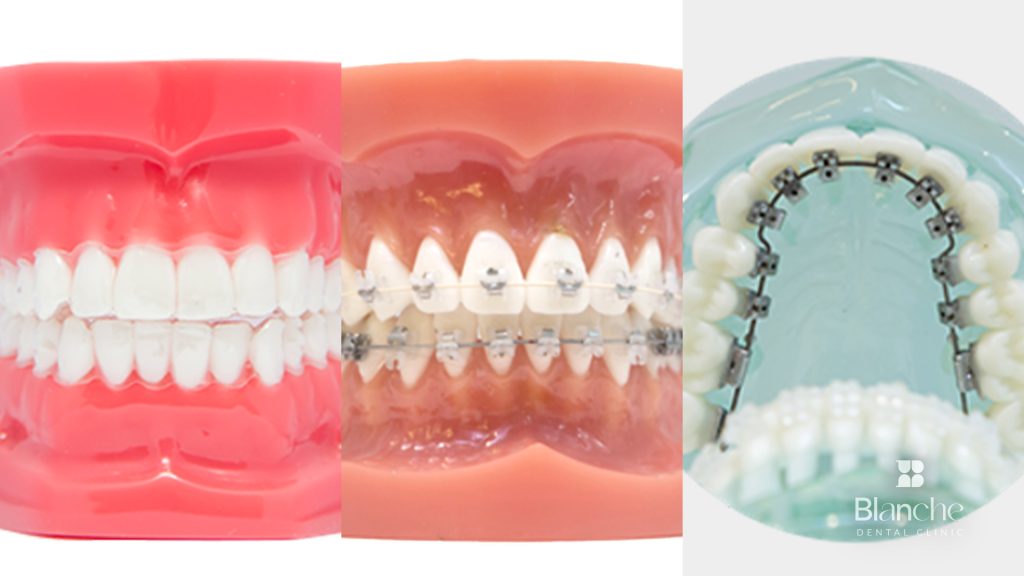
Invisalign vs. Braces in Korea
Korean clinics offer the full spectrum, and conventional braces remain significantly cheaper. Which one fits you depends less on budget than on your lifestyle and your bite.
| Invisalign (clear aligners) | Ceramic / self-ligating braces | Lingual (hidden) braces | |
| Visibility | Nearly invisible | Visible, tooth-colored | Invisible from outside |
| Visit interval | 6–12 weeks | 3–6 weeks | 4–6 weeks |
| Eating & hygiene | Removable — no restrictions | Food restrictions, careful brushing | Food restrictions, speech adaptation |
| Discipline needed | 20+ hours/day wear | None (fixed) | None (fixed) |
| Typical Seoul price | ₩3,000,000–₩7,000,000 | ₩3,500,000–₩5,500,000 | ₩5,000,000–₩8,000,000 |
The longer visit interval is why Invisalign has become the default choice for foreign residents: fewer chair visits, and several aligner sets can be dispensed ahead of a long trip home.
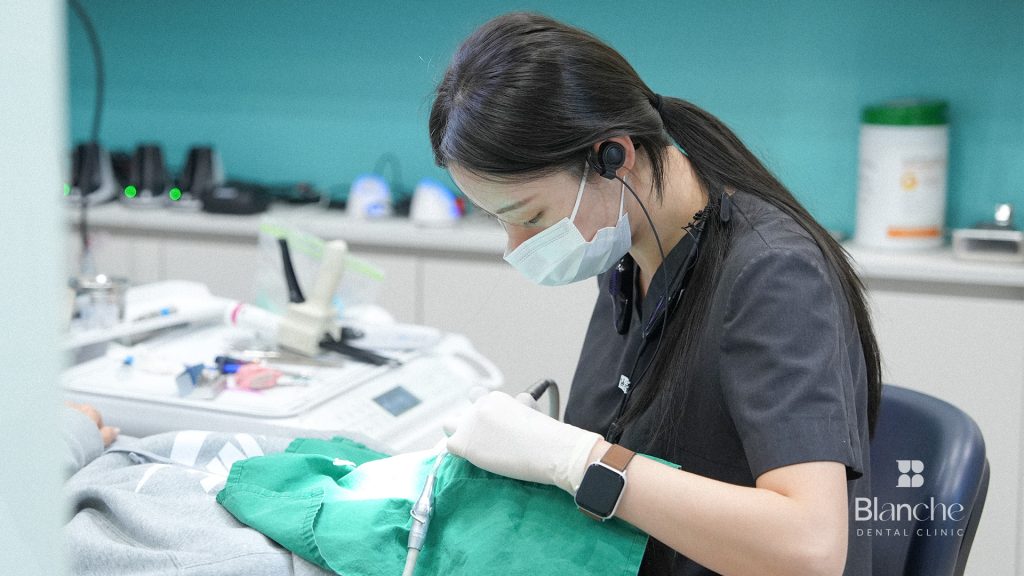
Your Treatment Timeline, Visit by Visit
- Visit 1 — Diagnosis (60–90 min): panoramic and cephalometric X-rays, 3D intraoral scan, bite analysis. This is where a specialist decides whether aligners can actually achieve your goal, or whether you would be paying for a compromise.
- Visit 2 — Treatment plan review: you see the simulated tooth movement (ClinCheck) and the confirmed total price before committing.
- Visit 3 — Delivery: attachments are bonded, first aligners fitted, wear instructions given.
- Every 6–12 weeks — Progress checks: tracking is verified and the next aligner sets are dispensed. Photo-based remote monitoring can substitute some visits for patients who travel.
- After treatment — Retention: retainers are not optional. Teeth drift back without them, regardless of how well the active phase went.
Can You Do Invisalign in Korea If You Don’t Live Here?
Honest answer: a one-time tourist should not start comprehensive orthodontic treatment in Korea. Aligners need supervision, and no responsible orthodontist will hand you two years of trays and wish you luck. But three groups make it work very well:
- Expats, students, and military personnel based in Korea — the straightforward case; you simply pay Korean prices for world-class care.
- Frequent visitors — if you fly to Seoul every 2–3 months for work or family, the 6–12 week Invisalign check-up rhythm fits your schedule naturally.
- Regional residents — patients from Japan and Southeast Asia increasingly combine quarterly check-ups with short trips, using remote monitoring in between.
If you are only in Seoul once and want a cosmetic improvement to your front teeth, ask about alternatives with a defined endpoint instead — see our colleagues’ guide to one-day veneers in Korea for what can and cannot be solved without
moving teeth.
Not sure where your case fits? Send two photos — front and smiling — on WhatsApp. We will tell you what is possible before you book any flight.
4 Things to Check Before Choosing an Orthodontist in Seoul
- Is the doctor a board-certified orthodontic specialist? In Korea, any dentist may legally offer aligners. A 교정과 전문의 (orthodontic specialist) has completed years of additional accredited training in tooth movement — ask directly, and expect a clear yes.
- Will the same doctor manage your case start to finish? High-volume “factory” clinics rotate doctors; treatment plans rarely survive the handoff intact.
- Is the total cost fixed in writing? Including refinements, retainers, and monthly visit fees.
- How are foreign patients supported? English consultation, records you can take with you, and a transfer protocol in case you relocate mid-treatment.
Side Effects and Honest Limitations
Orthodontic treatment can involve temporary discomfort, speech adaptation, root resorption in rare cases, and relapse if retainers are neglected. Aligners depend heavily on wear-time compliance, and results vary between individuals. Some bites — significant skeletal discrepancies, severely rotated teeth — are better served by braces or combined treatment, which is exactly why diagnosis by a specialist matters more than the brand of plastic.
If you are weighing Invisalign in Korea, start with a proper diagnosis rather than an online quote. I see international patients at Blanche Dental Clinic, a government-registered international patient facility at Nonhyeon Station Exit 4 (Line 7) — 7F, B722 Building, 531 Gangnam-daero, Seocho-gu, Seoul. We are open on Sundays, and you can book an English consultation at +82-1877-2882 or through the English consultation page.
Frequently Asked Questions
Is Invisalign cheaper in Korea than in the U.S.?
How often would I need to visit the clinic during Invisalign treatment?
Can I start Invisalign in Korea and continue in another country?
Does it matter that any dentist can offer Invisalign?
This column was reviewed and supervised by Dr. Joohee Baek, board-certified orthodontic specialist at Blanche Dental Clinic with 20+ years dedicated to orthodontics. It is general information, not a diagnosis; individual results vary and suitability must be confirmed by clinical examination.
What happens at your first consultation
1. We listen first — what bothers you and what you hope for. 2. We walk you through your scan results and every option.
3. You get itemized costs and timing, and you can decide later, even after you fly home. At Blanche, we explain everything at least four times, by principle.
Consultation — Blanche Dental is located between Nonhyeon and Sinnonhyeon stations in Gangnam, Seoul. For a consultation in English, message us on WhatsApp with your photos, and see our pricing page for current fees.

About the author
Dr. Baek Ju-Hee
Orthodontic specialist at Blanche Dental Clinic, with 22 years of practice and over 10,000 orthodontic cases.
She completed her residency and master’s at Kyung Hee University Dental Hospital and has presented non-extraction cases at Osaka Dental University.