
Can Veneers Get Cavities? Where Decay Hides, and What We Do About It
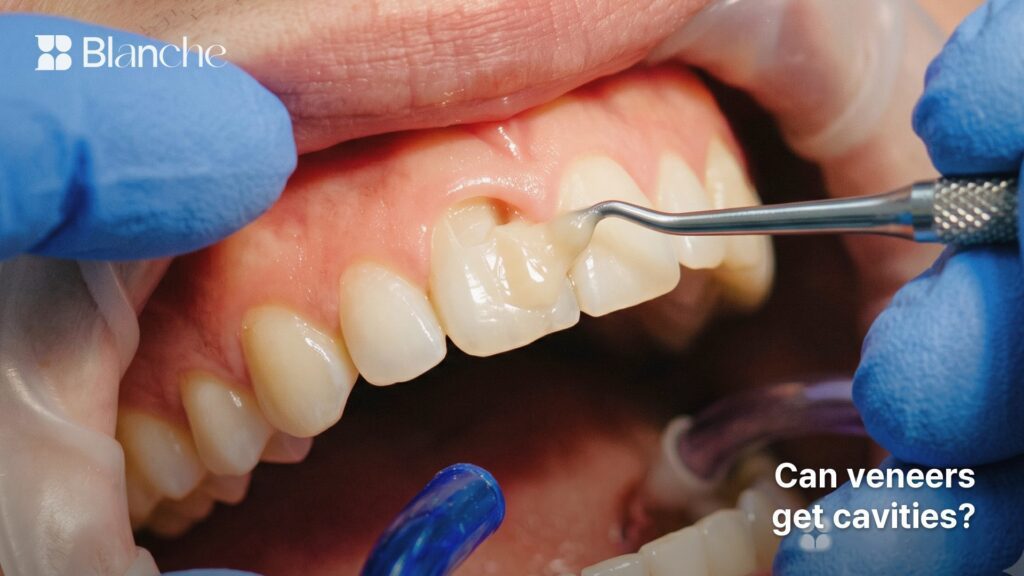
Can veneers get cavities? The ceramic itself cannot decay, but the natural tooth around and under its edge still can.
That is the honest answer, and it leads to a quieter worry. You may be picturing decay spreading where nobody can see it, months after you fly home.
Here is where decay starts, the early signs, and what we do about it, including where Blanche (BLANCHE) fits.
A note from Dr. Kim
I understand the fear of paying for a beautiful smile and then losing the tooth underneath it.
Minimal intervention, maximum beauty. That answer is Blanche, Front Tooth Reinforcement Therapy.
Can veneers get cavities? What decays and what does not
Dental ceramic is not living tissue, so bacteria cannot rot it. The veneer itself never gets a cavity.
However, a veneer covers only the front of a tooth. The back, the sides between teeth and the area near the gum stay natural tooth, and those surfaces can decay like any other.
Think of a tiled bathroom wall. The tiles never rot, but water can still seep into the grout line or the wall behind it. With veneers, the grout line is the edge where ceramic meets tooth.
Where decay usually starts around a veneer
The edge, or margin
The margin is the thin line where the veneer ends and your tooth begins. Plaque collects there more easily than on a smooth surface. When people ask me can veneers get cavities, this edge is what I point to.
Between the teeth
A toothbrush does not reach the contact points between teeth. Decay here often starts out of sight, which is why flossing and X-rays matter.
Along the gum line
If gums pull back over the years, a strip of root surface can show above the veneer. Root surface is softer than enamel, so it can decay more easily.
Early signs, and why check-ups and X-rays matter
Early decay is often silent. That said, a few signs are worth a check-up:
- New sensitivity to sweets or cold on one tooth.
- Floss that catches or shreds at the same spot.
- A dark spot or line at the edge that was not there before.
A dark edge is not always decay. It can be surface staining, a change in the gum line or an older bonding material. Only an exam and an X-ray can tell the difference.
Ceramic also hides what is happening behind it from the eye. An X-ray, however, can show decay between teeth before it hurts.
So keep regular check-ups at home, as often as your dentist advises. For many people that is once or twice a year. Tell your dentist which teeth have veneers, so they can look closely at those edges.
Daily care for the tooth under your veneer
The care is the same as for any natural tooth, with extra attention at the edges.
| Habit | Why it matters | Simple tip |
|---|---|---|
| Brushing twice a day | Cleans plaque from the margins | Use a soft brush and angle it toward the gum line |
| Fluoride toothpaste | Helps the natural tooth resist decay | Spit, but do not rinse straight away |
| Floss or interdental brushes daily | Reaches the contact points | If floss catches, slide it out sideways |
| Fewer sugary snacks and drinks | Frequent sugar feeds decay bacteria | Keep sweets to mealtimes and sip water after |
| Night grinding care | Heavy force stresses the edges | Ask your dentist about a night guard |
| Check-ups with X-rays | Finds decay early | Follow the schedule your dentist suggests |
For the first week and first year after treatment, see our guide to veneers aftercare.
We bond Blanche with the Ivoclar adhesive system, which is biocompatible and resists edge discoloration. Even so, no bonding replaces brushing, flossing and check-ups.
Can veneers get cavities underneath? What we do if decay appears

Sometimes decay still appears under or beside a veneer. If it does, the veneer usually has to come off so the tooth can be treated properly.
At our clinic, we remove old veneers with a laser, without extra shaving and without a separate removal fee. We treat the decay, then make and bond a new piece.
Revision is priced the same as a first-time Blanche, and it can be done in one day. So a cavity under a veneer is a repair job, not the end of your smile.
If a small spot sits only at an exposed edge, a filling may be enough. We decide that after the exam. Our guide to front-tooth cavity filling explains that route.
Cavities found at your first visit
If we find decay at your consultation, we treat it first. Then we cover the tooth with Blanche.
Blanche is not an ordinary veneer. It’s Front Tooth Reinforcement Therapy. Instead of shaving your teeth down to cover them, Blanche adds a thin layer onto the teeth you already have.
Blanche does not stop decay on its own, and no veneer does. So can veneers get cavities after years of good care? It is possible, which is why check-ups still matter.
Is that dark edge on my veneer decay?
Send us just two photos: one of your face straight on, and one smiling. We will tell you what we can see, and whether an X-ray and an exam are the next step.
Planning a check or a redo from abroad
Start with photos on WhatsApp. If you have a recent X-ray from home, send that too.
If a redo is needed, the one-day option takes 4–5 hours on the day. We recommend one follow-up check afterwards, so plan 2–3 days in Seoul.
For the full one-day program — technology, pricing, and booking — see our One-Day Veneers page.
We are a 30-second walk from Nonhyeon Station Exit 4 in Gangnam, about an hour from Incheon Airport. We consult in English, Japanese, Chinese, Thai and Russian.
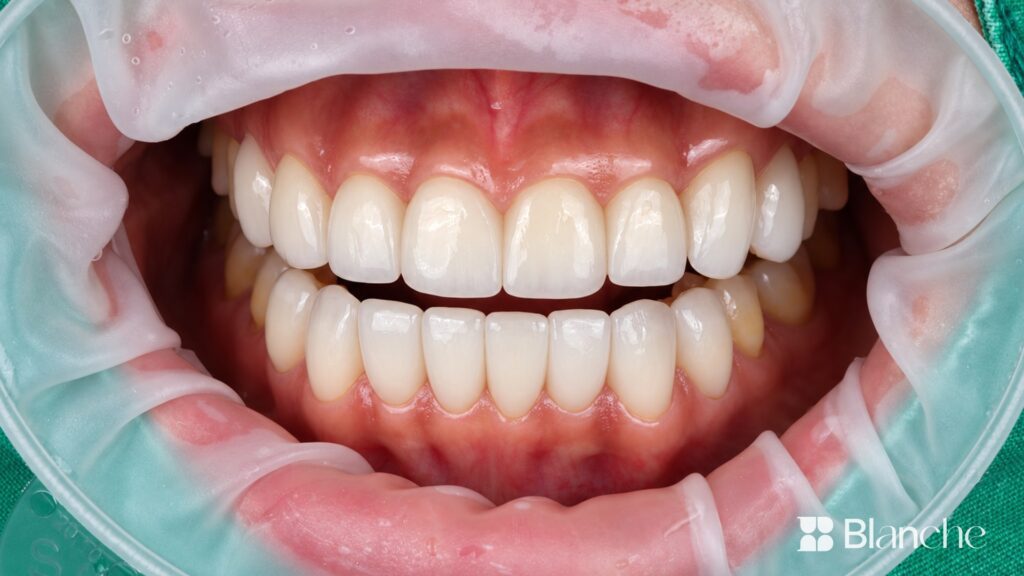
An actual case treated at Blanche Dental Clinic. Results vary with each patient’s dental condition.
Frequently asked questions
Can veneers get cavities if I brush well?
The ceramic cannot decay, but the tooth at its edges can. Good brushing helps a great deal, and flossing and check-ups cover the spots a brush misses.
Will my dentist at home be able to see decay under a veneer?
Decay between teeth or at the edge often shows on an X-ray. Tell your dentist which teeth have veneers, so they can check those edges closely.
Does the whole veneer need replacing if decay appears?
Usually yes, so the tooth can be treated properly, though a small spot at an exposed edge may only need a filling. With us, removal is by laser, and revision costs the same as a first-time Blanche.
Side effects and individual differences
Temporary sensitivity, a foreign-body feeling, or mild gum swelling can occur. Results and longevity vary with each person’s teeth and habits.
When I teach dentists, I tell them the edge is where a veneer succeeds or fails. Keep that edge clean, and your smile can still work twenty years from now.
How your first consultation works
1. We listen to your concerns and the smile you want.
2. Based on your exam, we explain every available option.
3. We give itemized costs and timelines. You are welcome to decide later, at home.
We repeat every explanation at least four times, and no decision depends on one person’s judgment alone.
Consultation — Message us on WhatsApp with two smile photos, or check our pricing. Same pricing for Korean and international patients.