
Are Veneers in Korea Good? Where to Look for Cut Corners
Are veneers in Korea good, or, if the quote is lower than at home, where exactly is the corner being cut?
That is the worry behind the question, even when nobody types it. Nobody wants to fly home with teeth that look fine in photos but chip, darken at the edges, or leave no one to call.
So, are veneers in Korea good? My honest answer is that the country does not make a veneer good or bad. The material, the bonding, the lab, the person who designs it, and the follow-up do.
Here is the checklist I would use in your seat, with our own answers next to each item.
A note from Dr. Kim
I would rather you check every corner of our work than trust a country label, ours included.
“Minimal intervention, maximum beauty.” That is the standard I hold Blanche no-prep veneers to, item by item.
Are veneers in Korea good? Start with the right checklist
A veneer’s quality comes from a handful of decisions you rarely see on a quote.
| What to check | Why it matters | What we do |
|---|---|---|
| Material | Strength, depth and shade | Swiss ceramic (CAD/CAM at BASIC, hand-layered at PLATINUM) |
| Bonding | How well the edge stays sealed and clean-looking | Ivoclar adhesive system |
| Tooth removal | Enamel does not grow back | No-prep, or minimal prep under 0.1 mm |
| Lab | How closely dentist and ceramist work | In-house Blanche Lab |
| Who designs | Your shape and shade | Dentist-led at every tier |
| Warranty | What happens if something fails | 1, 5 or 10 years by tier |
| Pricing | Whether foreigners pay more | Same pricing for Korean and international patients |
Material: what your veneers are made of
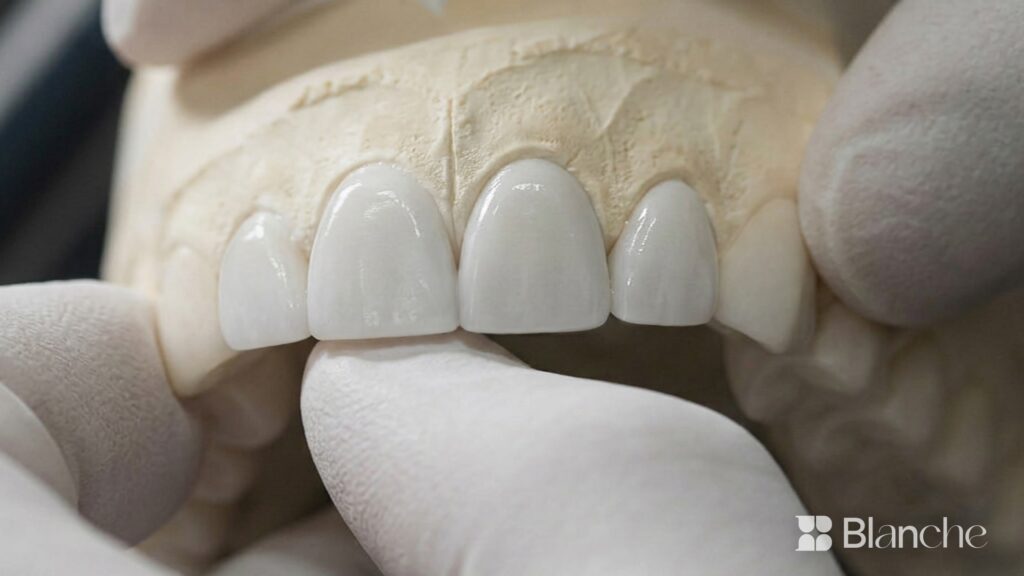
First, ask which ceramic will be used, and whether it is milled by machine or layered by hand. Both can work well; they suit different goals.
Our BASIC tier uses Swiss ceramic made with CAD/CAM. At PLATINUM, a senior ceramist hand-layers Swiss ceramic fired at about 800°C, with advanced shade layering for more depth.
Our post on how porcelain veneers in Korea differ in price and make goes into more detail.
Bonding: the corner nobody can see
If I had to name one place where a corner could be cut quietly, it would be bonding. You cannot see the adhesive in a photo, yet it holds the veneer to your tooth and seals the edge.
We use the Ivoclar adhesive system, which is among the highest-priced bonding systems. It is biocompatible and resists edge discoloration. Bonding quality is one reason prices differ between clinics.
Think of the glue in a good pair of shoes. Nobody looks at it in the shop, but it decides whether the sole stays on after a year of walking.
So ask directly: “Which bonding system will you use?”
Who designs and makes your veneers
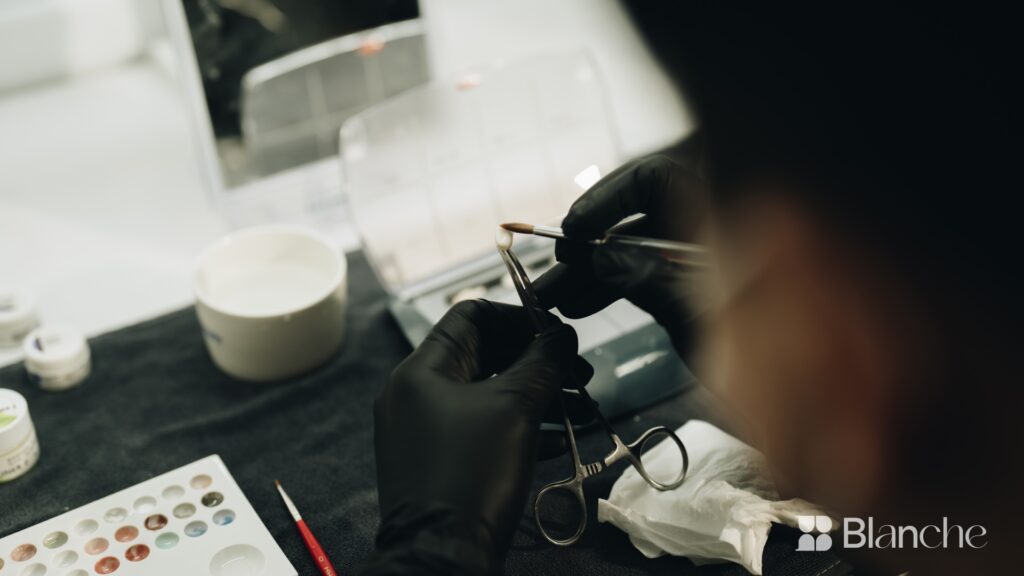
An in-house lab
When the lab is in another building, the dentist and the ceramist work through notes and photos. In-house, they can look at your teeth together.
Our lab, Blanche Lab, is part of the clinic. Its ceramists trained in France and Switzerland, and we use a 3D intraoral scanner.
Who is in charge at each tier
At BASIC, treatment is dentist-led with a Blanche Lab ceramist. At PLATINUM, the chief dentist works with a senior ceramist.
At Signature PLATINUM, I take charge personally, with a dedicated ceramist and hygienist. Gum contouring and other supporting treatments are included.
How much tooth is removed
We do only fully no-prep veneers or minimal prep under 0.1 mm, and both cost the same. Small or gapped teeth usually suit no-prep.
However, teeth that sit forward, large teeth or very dark discoloration may need minimal prep. Gum inflammation, cavities or heavy grinding are treated first.
“Would my teeth need any shaving at all?”
Send us just two photos: one of your face straight on, and one smiling. We will tell you whether no-prep is likely for you, and which tier fits the result you want.
Warranty and follow-up after you fly home
This is the second hidden worry: what if something goes wrong when you are far from Seoul?
First, every tier has a warranty: 1 year for BASIC, 5 years for PLATINUM and 10 years for Signature PLATINUM. Second, we recommend one follow-up check after the treatment day, before you leave, so plan 2–3 days in Seoul.
If a veneer comes off, keep it and bring it. If it is not broken, re-bonding may be possible.
If one ever needs redoing, we remove it with a laser, without extra shaving or a separate removal fee, at the same price as new treatment.
Our post on what happens if one chips after you fly home walks through each step.
With proper care and regular check-ups, veneers can last over 10 years, and 20–30 years or more, depending on care.
Are veneers in Korea good value, or is something missing from the price?
A lower quote is only good news if nothing important was left out. So compare what each quote includes, not just the total.
Our prices per tooth, VAT excluded, are KRW 650,000 for BASIC, KRW 850,000 for PLATINUM and KRW 1,500,000 for Signature PLATINUM. The one-day option adds KRW 200,000 per tooth.
Korean and international patients pay the same. There is no foreigner surcharge.
Whether that is lower than at home depends on where home is. That said, the checklist above matters more than the gap. Our guide to no-prep veneers in Korea and who qualifies is a useful next read.
The clinic is a 30-second walk from Nonhyeon Station Exit 4 in Gangnam, about an hour from Incheon Airport. In short, start with two photos, then decide at home.
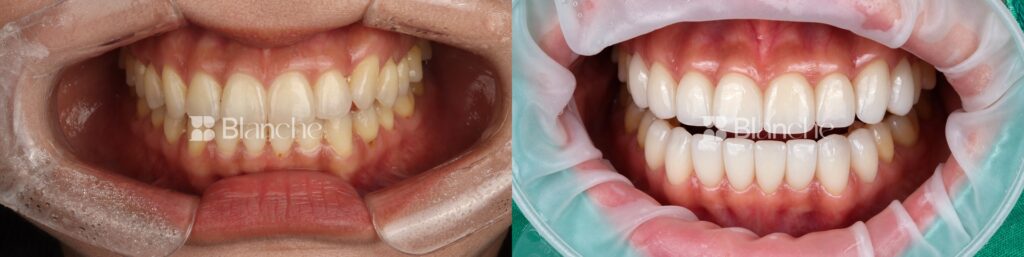
An actual case treated at Blanche Dental Clinic. Results vary with each patient’s dental condition.
Frequently asked questions
Are veneers in Korea good quality?
They can be, but quality depends on the clinic, not the country. Check the ceramic, the bonding system, how much tooth is removed, who designs and makes the veneers, and what the warranty covers.
Do foreigners pay more for veneers at Blanche?
No. Korean and international patients pay the same, from KRW 650,000 per tooth, VAT excluded. There is no foreigner surcharge.
What happens if a veneer has a problem after I fly home?
Keep the veneer and bring it; if it is not broken, re-bonding may be possible. Each tier carries a warranty of 1, 5 or 10 years.
Side effects and individual differences
Temporary sensitivity, a foreign-body feeling, or mild gum swelling can occur. Results and longevity vary with each person’s teeth and habits.
When I teach dentists, I stress the parts patients never see: the bonding, the edges, the enamel left behind. That is where a veneer earns its place as “a smile that still works twenty years from now”.
How your first consultation works
1. We listen to your concerns and the smile you want.
2. Based on your exam, we explain every available option.
3. We give itemized costs and timelines. You are welcome to decide later, at home.
We repeat every explanation at least four times, and no decision depends on one person’s judgment alone.
Consultation — Message us on WhatsApp with two smile photos, or check our pricing. Same pricing for Korean and international patients.