
Full Mouth Dental Implants Korea: Keep, Replace, or Full Arch?
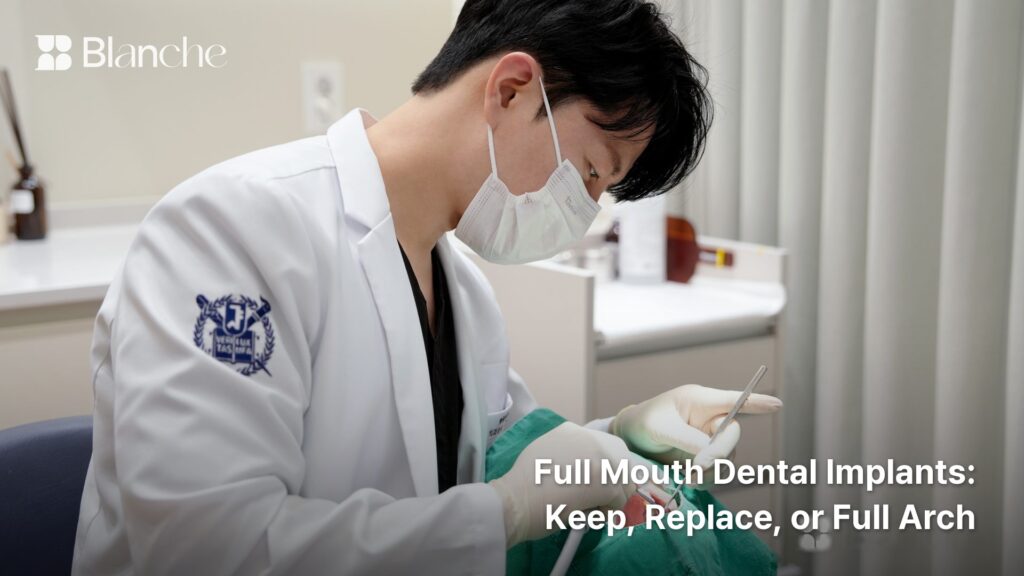
Searching “full mouth dental implants Korea” usually means something has been building for years. Maybe a denture slips when you talk. Maybe several teeth hurt, wobble or keep breaking. You want to eat properly, laugh in photos, and stop thinking about your mouth.
Underneath, there are usually two fears. One is losing every tooth you have left. The other is a bill that keeps growing after you land.
This guide covers the decision before any surgery: which teeth can be kept, single implants or a full arch, and how the costs are built.
A note from Dr. Kim
I understand how frightening it is to hear that all your teeth must come out, so I always start by asking which ones we can keep.
“Why damage a tooth worth more than you can price? Blanche started from that question.”
Full mouth dental implants Korea: which teeth can be kept?
“Full mouth” sounds like everything goes. It does not have to. A healthy tooth with good support is worth protecting, even when the teeth around it are failing.
We do not remove teeth that can be kept. That principle comes straight from the question Blanche started with. Sometimes the answer is a few implants beside your own teeth. Sometimes it really is a full arch. The exam decides, not the search term.
Think of an old house. Some rooms need rebuilding, but you would not knock down a sound wall just because it stands next to a cracked one. Your healthy teeth are those sound walls.
Single implants or a full arch?
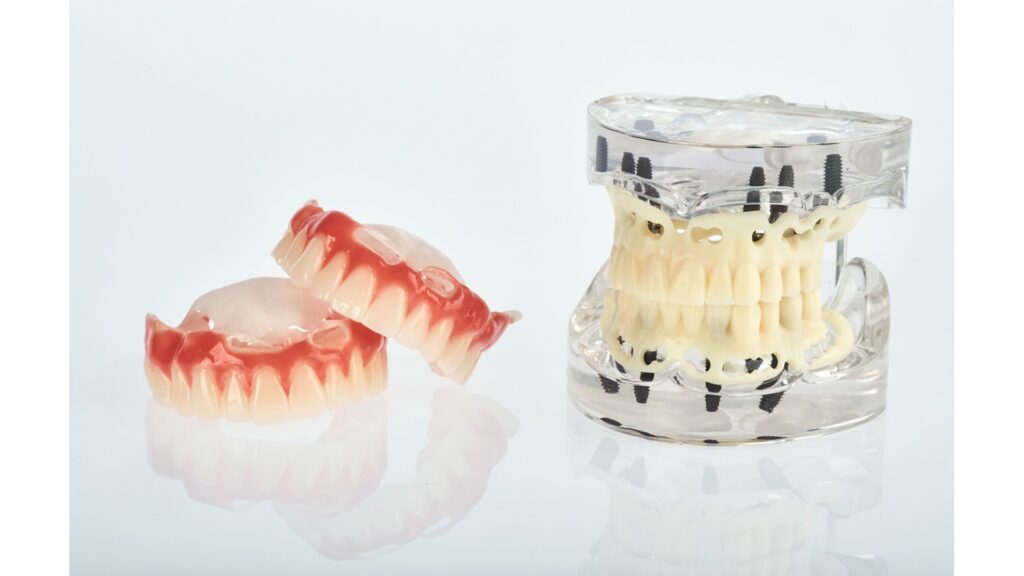
Individual implants
Individual implants replace missing teeth one by one. Each implant carries its own crown. This works well when you still have healthy teeth to keep between the gaps.
A full-arch bridge
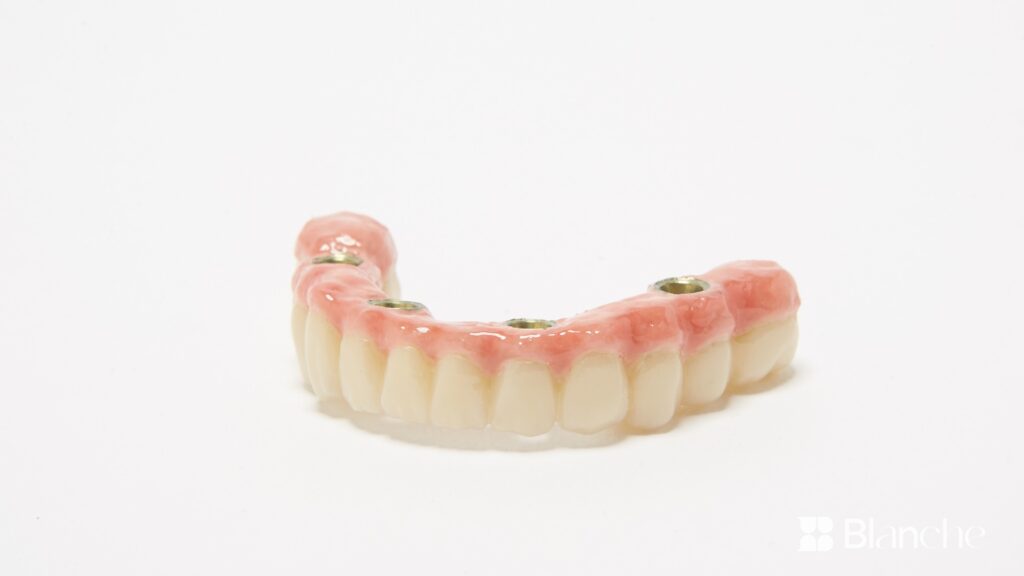
A full-arch bridge replaces a whole jaw of teeth with one fixed bridge on a small number of implants. You may know it as All-on-4 or All-on-X. It suits people with few or no savable teeth in that jaw, or those ready to leave a removable denture behind. Our All-on-4 guide explains the difference between the two names.
| Individual implants | Full-arch bridge (per arch) | |
|---|---|---|
| Cost structure | KRW 800,000–2,300,000 per implant, abutment and zirconia crown included | KRW 10,000,000 per arch (one jaw) |
| Number of surgeries | Depends on how many teeth, and where; planned from your CT | Implants for one jaw are planned together; your CT sets the schedule |
| Cleaning | Brush and floss around each crown, much like natural teeth | Clean around and under the bridge every day |
| Who it suits | People with healthy teeth worth keeping | People with few or no savable teeth in a jaw, or tired of a denture |
Full mouth dental implants Korea: how the cost is built
Unpredictable bills come from unclear structure. Here is ours, in plain numbers.
Single implants cost KRW 800,000 (Megagen AnyOne), KRW 1,000,000 (Megagen BlueDiamond) or KRW 2,300,000 (Straumann). Each fee includes the abutment and the zirconia crown.
A full-arch bridge costs KRW 10,000,000 per arch. Both upper and lower arches together come to KRW 20,000,000.
Extras exist, and we would rather you know them now. A simple bone graft is KRW 300,000, and a complex one is KRW 500,000. A sinus lift is KRW 500,000 per tooth with the crestal approach, or KRW 2,000,000 per site with the lateral approach.
Whether you need any of these is decided by the 3D CT. Our article on avoiding unnecessary bone grafts explains how we make that call. Pricing is the same for Korean and international patients, and you receive an itemized estimate before you decide.
How long it takes, and how trips work
For single implants, the usual schedule is four visits. First comes surgery, then stitches out about a week later. A digital scan follows 4–6 months later, and the crown is fitted about a week after that. If you can stay about a week each time, that means only two trips to Korea.
Full-arch treatment is usually completed in 2–6 months. The exact visit plan is set after your CT, and it typically includes a surgery trip and a final-teeth trip.
For a single front tooth, a same-day temporary tooth is possible, so you don’t fly home with a gap. For a full arch, what you wear between trips is planned after your 3D CT.
Blanche is a 30-second walk from Nonhyeon Station Exit 4 in Gangnam, about an hour from Incheon Airport.
How many of my teeth can actually be saved?
Send us a recent X-ray if you have one, or just two photos: one of your face straight on, and one smiling. We will tell you whether single implants or a full arch looks more likely, and roughly what the cost structure would be.
What to send before you fly
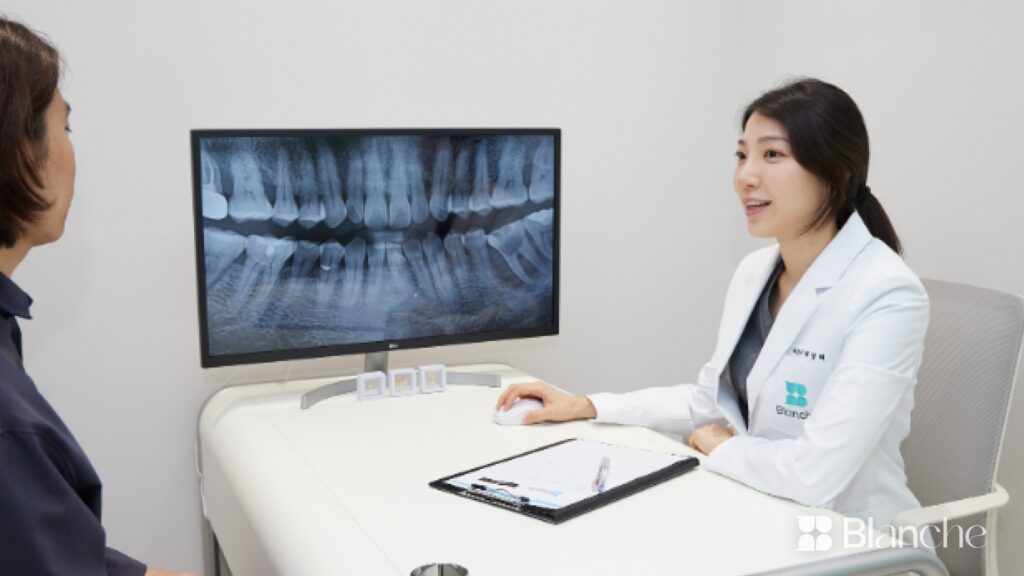
A full mouth dental implants Korea plan starts with what you send. On WhatsApp, send:
- A recent panoramic X-ray or CT, if you have one.
- If not, two photos: your face straight on, and smiling.
- A short note on what bothers you most, such as chewing, pain, a loose denture, or appearance.
From these, we can suggest which direction looks likely. The final plan, however, always needs our own 3D CT in Seoul. Dr. Kim Tae-hyung and Dr. Kim Ha-young perform implant surgery, and both consult in English.
After treatment, your implants have a 2-year warranty. If a problem comes up once you are home, we help you get follow-up care in your own country.
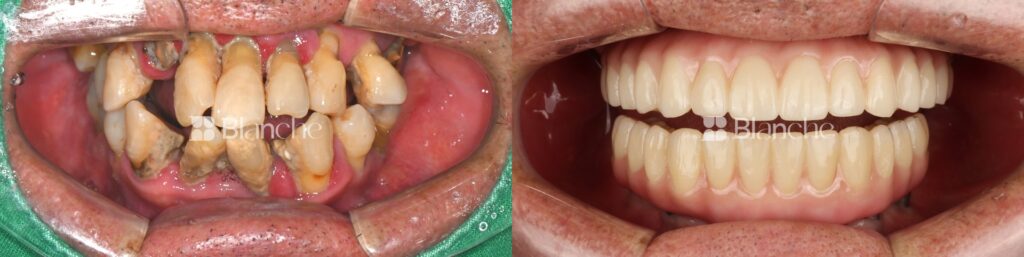
An actual case treated at Blanche Dental Clinic. Results vary with each patient’s dental condition.
Frequently asked questions
Full mouth dental implants Korea: do all my teeth have to come out?
No. We do not remove teeth that can be kept. Your 3D CT and exam show which teeth are worth saving, and the plan is built around them.
What does a full arch cost compared with single implants?
Single implants cost KRW 800,000–2,300,000 each, abutment and zirconia crown included. A full-arch bridge costs KRW 10,000,000 per arch, or KRW 20,000,000 for both. Extras such as bone grafts are decided by the CT and itemized first.
How long does full-arch treatment take?
It is usually completed in 2–6 months. The exact visit plan is set after your CT, and it typically includes a surgery trip and a final-teeth trip.
Side effects and individual differences
Swelling, bruising, mild pain, or temporary numbness can occur after implant surgery, and healing time varies. Results and longevity depend on each person’s bone, gums, health, and habits.
When I teach other dentists, the first lesson is simple: count what can be saved before counting what must be replaced. Keeping your own teeth when possible, and replacing only what is truly lost, is how we aim for a smile that still works twenty years from now.
How your first consultation works
1. We listen to your concerns and what you want to be able to eat and smile with again.
2. Based on your 3D CT and exam, we explain every available option, including whether a bone graft is really needed.
3. We give itemized costs and a visit schedule. You are welcome to decide later, at home.
We repeat every explanation at least four times, and no decision depends on one person’s judgment alone.
Consultation — Message us on WhatsApp with a recent X-ray or two photos, or check our fee schedule. Same pricing for Korean and international patients.